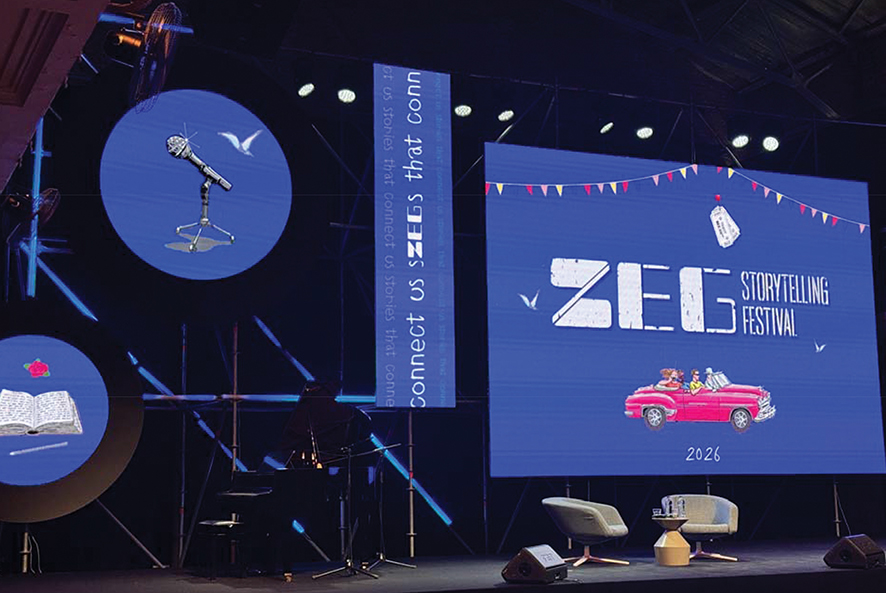
The final evening of ZEG Festival 2026 in Tbilisi could hardly have offered a more fitting metaphor for the event as a whole. It ended with a performance by illusionist Brad Barton, whose tricks, simple card manipulations, predictable audience interactions, and familiar theatrical deceptions seemed less like an exploration of perception and reality than a nostalgic return to the vocabulary of children’s birthday entertainment. The promise of philosophical inquiry into illusion, technology, and human consciousness dissolved into something closer to a low-budget variety show.
Shortly before him appeared Serife Wong, presenting a dark meditation on artificial intelligence, mythology, and the future of humanity. The subject itself is undoubtedly urgent. Questions surrounding AI, authorship, and the transformation of culture are among the most significant intellectual debates of our era. Yet the presentation relied heavily on apocalyptic imagery, broad statements about technological danger, and an atmosphere of self-importance that was not matched by intellectual rigor. Complex questions were reduced to familiar fears, and the audience was offered anxiety instead of analysis.
This unfortunate contrast between ambition and execution became a recurring theme of ZEG itself. The festival gathered a remarkable list of artists, thinkers, activists, and public figures, presenting itself as a space where art, technology, politics, and philosophy would collide. The language of the program promised dialogue, radical imagination, and new ways of thinking about the world. Yet the reality was often surprisingly shallow.
Many workshops followed an almost identical pattern. For the first fifteen or twenty minutes, speakers introduced their own practice to an audience that had often already chosen the session precisely because they were familiar with their work. This was followed by predictable questions about creativity and success: “How do you manage to be so talented?,” answered with equally predictable remarks about hard work, passion, and persistence. The difficult questions were rarely asked, and when they appeared, they were often left unexplored.
The most striking irony was that a festival dedicated to intellectual curiosity seemed to have little appetite for genuine disagreement. It celebrated complexity while frequently avoiding it.
At several moments, the organizers themselves appeared on stage to praise the success of the festival, reminding audiences how extraordinary the gathering was and how fortunate everyone was to be part of it. These moments revealed an unexpected insecurity: a truly transformative cultural event rarely needs to constantly announce its own significance.
The festival’s political programming reached its most curious form in discussions surrounding Palestine. Even among speakers broadly sharing the same position, the differences in intellectual substance were striking. Pulitzer Prize-winning novelist Viet Thanh Nguyen, for instance, often seemed less interested in Palestine itself than in using it as yet another stage upon which to continue his long-running argument with America. Every question eventually circled back to the familiar themes of empire, citizenship, displacement, belonging, and the uneasy relationship between his Vietnamese origins and American identity. Palestine appeared almost as a narrative device in a much older personal and intellectual drama: one more chapter in an ongoing attempt to reconcile a colonized history with a citizen’s passport.
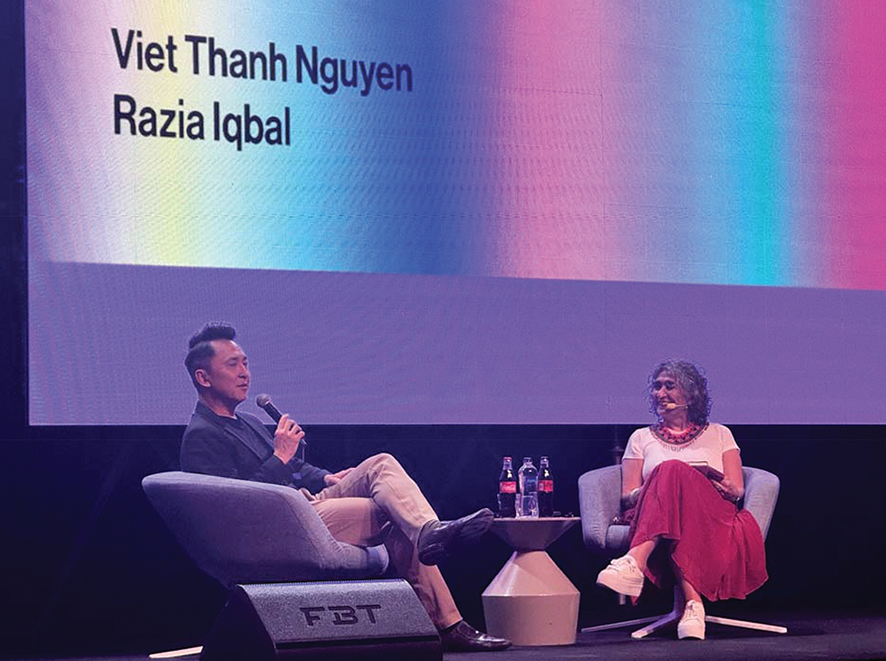
There was another irony that seemed largely lost on the festival. Nguyen’s critique of American power, however differently motivated, unfolded in a Georgian context where anti-American rhetoric has acquired a very different political resonance. Over the past several years, Georgia has witnessed the growing circulation of narratives portraying the United States as a manipulative imperial actor: narratives frequently associated with pro-Russian political forces and media ecosystems. The overlap was not ideological but rhetorical: arguments intended as a critique of American foreign policy occasionally echoed formulations that, within the local context, carry very different historical and political associations.
What made this especially revealing was the festival’s repeated emphasis on situated knowledge, local realities, and contextual sensitivity. Yet here was a case where speakers seemed largely unconcerned with how their words might resonate within the specific political landscape in which they were being delivered. The contradiction suggested a broader weakness of the festival itself. For all its language of community, listening, and engagement, ZEG often appeared more interested in importing ready-made global conversations than in examining how those conversations interact with the realities of the place where they are being staged.
Michael Barenboim offered something different, and in many ways more disappointing. If Nguyen risked turning Palestine into a metaphor, Barenboim reduced it to a slogan. The son of the legendary Daniel Barenboim arrived armed with moral certainty but remarkably little analytical depth. His lecture on music, democracy, and political responsibility consisted largely of broad declarations, whose simplicity became increasingly difficult to sustain once audience members began asking direct questions. Faced with complexity, contradiction, or requests for specificity, the argument repeatedly stalled. Nuance disappeared behind platitudes; difficult realities dissolved into abstractions.
At a certain point, perhaps recognizing that words were no longer helping, Barenboim suggested that music itself could make the case more effectively than argument. It was a revealing moment. Throughout the festival, politics often appeared to function as performance rather than inquiry, as a marker of virtue rather than a subject of serious investigation. The hope seemed to be that symbolic gestures might compensate for intellectual shortcomings. They did not. What emerged instead was a strangely theatrical form of activism, emotionally emphatic, rhetorically confident, yet surprisingly fragile whenever confronted with genuine complexity.
This was the paradox of ZEG 2026. It was a festival full of important names, urgent themes, and noble intentions. It spoke constantly about transformation, empathy, democracy, technology, and the future. Yet too often these ideas remained at the level of branding: cultural keywords assembled into an impressive catalogue rather than developed through difficult conversations.
The problem was not that ZEG lacked intelligence, talent, or good intentions among its participants. The problem was that it confused the appearance of depth with depth itself. It mistook the gathering of famous people for the creation of meaningful dialogue, and the repetition of fashionable political and technological anxieties for genuine critical inquiry.
In a time when the world desperately needs spaces where artists, scientists, philosophers, and activists can genuinely challenge one another, such a failure feels especially disappointing. ZEG did not fail because it aimed too high. It failed because, despite all its ambition, it rarely dared to go deep enough.
Perhaps the most revealing contradiction of ZEG 2026 was its relationship with storytelling itself.
Throughout the festival, participants repeatedly spoke about the necessity of authentic voices, personal narratives, and the irreplaceable human experience behind every meaningful story. Storytelling was presented almost as a sacred act: something that connects people beyond technology, markets, and political divisions.
Yet the festival’s own communication often appeared to be generated by artificial intelligence: announcements, editorial materials, and even publications carried the unmistakable tone of AI-produced language, a polished but strangely empty vocabulary of inspiration, transformation, and collective awakening.
The irony was impossible to ignore. A festival devoted to the defense of human stories seemed unable to tell its own story without outsourcing it to a machine. It spoke passionately about authenticity while producing a public voice that felt algorithmically assembled.
This contradiction would perhaps be less troubling if the festival had acknowledged it as a deliberate artistic or philosophical experiment. After all, the relationship between AI and human creativity is one of the defining questions of our time. But no such reflection was offered. Instead, the technology became an invisible ghost inside a festival that was supposedly examining the future of human expression.
Op-Ed by Ivan Nechaev