Blog by Ana Gagnidze, Georgian Youth Press
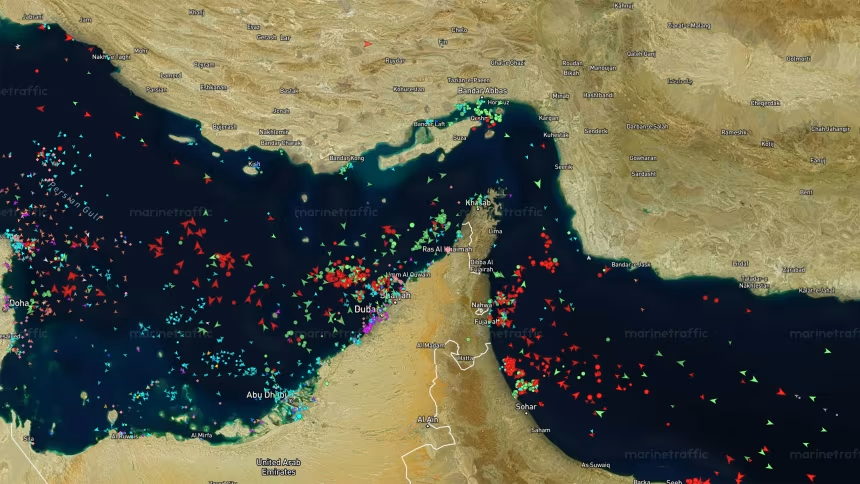
Today the world is facing a major and unprecedented economic crisis. People in the regions concerned are increasingly calling for peace and stability in their everyday lives. Petrol and gas prices are skyrocketing. The entire world’s attention is now concentrated on a mere 21 miles of water linking the Persian Gulf in the northwest with the Gulf of Oman and the Arabian Sea: the Strait of Hormuz, where a growing confrontation threatens global trade, energy supplies, and economic stability. To understand the significance of the current crisis, it is necessary to examine the historical background of US-Iran relations, the causes of the present standoff, and the possible paths toward a peaceful resolution.
Originally close allies and trading partners, the USA, Iran, and the UK had strong trade relations, under which Iran’s oil was distributed to European countries at an affordable cost. However, members of Iran’s government were not content with this arrangement, as they were receiving only a 9% share of the profits from their natural resources. This discontent was further exacerbated by the living conditions of ordinary Iranians, who often struggled to afford essential goods and medications due to high inflation.
In order to “save the people,” a new parliamentary force emerged. This pivotal figure was Mohammad Mosaddegh. When he became prime minister, the Shah was forced to flee. During Mosaddegh’s period in office, he nationalized Iranian oil, which was followed by strict sanctions from the Western bloc, resulting in the withdrawal of experts from this area of the Middle East. This had detrimental consequences for Iran’s economy, as the country lacked trained personnel capable of operating the oil refineries. Subsequently, Mosaddegh’s power quickly declined, and he was arrested following the coup d’état of 1953.
After the 1953 coup, Iran and the US remained allies for 25 years. This alliance was a form of “forced friendship” that came to an end after the Islamic Revolution of 1979. Thus, Iran went from being a close partner in the Middle East to becoming one of America’s greatest regional rivals.
The importance of the Strait of Hormuz
If you think that the 2026 blockade is something new, it is worth looking back at the Iran-Iraq War of 1980-1988. It was during this conflict that the Strait of Hormuz was first used as a global pressure point.
During the war, Iraq bombarded Iran’s oil tankers in an attempt to economically cripple the country. In response to this aggression, Iran mined the strait and attacked ships allied with Iraq.
In an attempt to contain the conflict, the US intervened. American forces escorted oil tankers with the aim of preventing a global energy crisis. This led to direct confrontations between the US and Iran, including the tragic accidental shooting down of an Iranian civilian airliner.
The April 2026 stalemate: A world on the edge
The current crisis began on February 28, 2026, following American-Israeli bombardments targeting Iranian nuclear and missile infrastructure. As a result of continued attacks, the country’s leader was assassinated and the Iranian government was thrown into survival mode.
Instead of initiating a direct naval confrontation, Iran made a strategic move by shutting down the Strait of Hormuz. Through the use of sea mines and threatening broadcasts, it brought oil trade to a standstill. As a result, 20% of the world’s oil supply was blocked, causing oil and gas prices to skyrocket.
This brings us to the current stalemate. We are witnessing two opposing countries blocking the same narrow strait while pursuing different political objectives.
Iran’s position is defensive. The logic behind the blockade is that it will deprive the world of oil and gas for as long as it remains under attack. By targeting the global economy, Iran is effectively using the strait as a shield against Western air strikes.
On April 13, the United States launched a counter-blockade. While Iran is blocking the strait for the entire world, the US is targeting only Iranian ports. The apparent goal of this operation is to exert economic pressure on Iran by preventing it from selling its oil.
The complete deadlock for the world
As of April 24, 2026, we find ourselves in a paradoxical situation. On one side, the USA is demanding nuclear materials and the reopening of the strait in exchange for lifting the blockade. On the other, Iran insists that it will reopen the strait only after military and economic pressure from its opponents ceases.
Can the Islamabad talks save the global economy?
Despite the failure of negotiations on April 11-12 to end the ongoing crisis, the Islamabad talks remain the only diplomatic path toward resolving the current conflict.
As we look to the coming days, three potential solutions are currently on the table in Pakistan:
The American Transaction Plan: President Trump has expressed support for a comprehensive transactional agreement under which the US would lift the blockade after the Iranians hand over their nuclear materials.
The gradual de-escalation plan (Pakistan/China plan): Asian countries propose synchronized steps. For example, if Iran removes 25% of its mines, the US would allow food and medicine shipments into three specific Iranian ports.
The Iranian proposal: To end the crisis, Iran has suggested a ten-point plan under which the Gulf states themselves would ensure the security of the strait.
To sum up, confrontations in the Strait of Hormuz have been a recurring problem for more than 70 years. Whether it was the oil nationalization of 1951 or today’s double blockade, the core issue remains the same: a struggle over sovereignty and economic control.
As of today, the world remains both skeptical and hopeful regarding the outcome of the Islamabad peace talks. The road to peace is difficult and filled with tension. Whether through the American transaction plan or the de-escalation plan, many believe that diplomacy can prevail over force.
Instagram: instagram.com/geoyouthpress/