Following on from last week’s article, this is the second in a three-part series exploring how Batumi has changed in recent years. This time, I want to examine something more uncomfortable: whether some of the city’s challenges are being reinforced not by tourists, but by local attitudes.
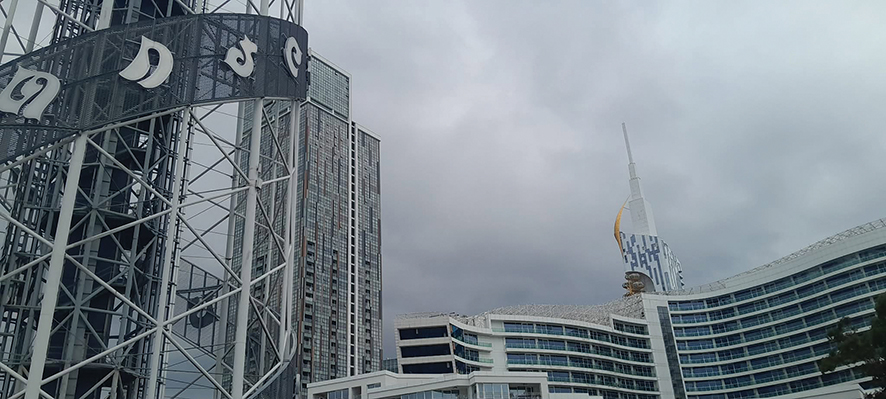
I was sitting in a restaurant on New Boulevard, a part of Batumi that has become something of a hotspot for Russian-speaking tourists. My dad was visiting me and, like many visitors to Georgia, he was looking for exactly what most people come here to experience: Georgian food, music and a taste of local culture.
Yet, this is becoming increasingly difficult to find.
After wandering around for a while, we eventually stumbled across a restaurant that appeared to tick all the boxes. It had a relaxed atmosphere, a view of the sunset, and a singer performing Georgian songs. We sat, ordered drinks, and suddenly the performance switched from Georgian into Russian.
In Batumi, this isn’t unusual.
As I sat listening, I found myself wondering why this had become so normal. Previously, I’d have quietly accepted it, or dismissed it as “not worth mentioning.” Given the political realities of the region, is it unreasonable to ask whether Russian songs belong in venues marketing themselves as Georgian experiences?
After discussing it briefly with my group, I decided it was worth asking.
For context, I speak Georgian, so I approached the singer and spoke to him in his own language. I asked a simple question: “How do you feel singing Russian songs given everything that’s happening in the region?”
It immediately became clear that this was not a welcome conversation.
“What’s the problem?” he replied.
What followed was a respectful but increasingly tense exchange, with both of us firmly defending our positions. He argued that Russians, and the Russian language, were an essential part of Batumi’s economy. There is, of course, truth in that. Russian tourists contribute significantly to the local economy.
But that wasn’t the point I was making.
My concern wasn’t that Russians visit Batumi. It was that the Russian language increasingly dominates parts of the city at the expense of Georgian language and culture. To me, they are two very different conversations.
As we continued talking, it became apparent that our disagreement ran much deeper than one song. I got the impression that he viewed Russia’s presence far more positively than I did, and I realized neither of us was going to persuade the other.
I simply said that, in my opinion, Georgia would struggle to move forward while attitudes like his remained commonplace. Then I smiled, thanked him for his time, and returned to my table.
For the rest of the evening, however, he avoided making eye contact with me. It was obvious he was recounting our conversation to members of staff whenever he had the chance.
Later, I mentioned the exchange to the waitress serving us. She quietly told me that she didn’t think that mindset was good for Adjara either. It was only one opinion, but it reminded me that not everyone sees Batumi’s future in the same way.
The Batumi Effect: Unthinkable in Tbilisi?
There are, in many ways, two different realities in Georgia.
In Tbilisi, speaking Russian to strangers is often avoided, and there is a much stronger emphasis on protecting the Georgian language. That isn’t true in every case, but it is a noticeable cultural difference.
Batumi feels different.
Understanding why is a much larger conversation involving geography, tourism and economics. Yet one argument is heard repeatedly: that accommodating Russian speakers is simply good business.
The question is whether that assumption has become so ingrained that it is no longer questioned.
Does refusing to default to Russian really mean losing customers? Or has it simply become habit?
With English becoming increasingly widespread among younger tourists, and international visitors arriving from far beyond the former Soviet Union, that assumption deserves closer examination.
Perhaps Batumi’s greatest challenge isn’t choosing between culture and commerce. Perhaps it’s recognizing that protecting one doesn’t necessarily require sacrificing the other.
The question, then, is how Georgia moves forward from here. With attitudes shaped by geography, upbringing, personal experience and political beliefs, can there ever be a consensus on what the country’s future should look like? More importantly, can that future be built in a way that strengthens Georgia’s economy without sacrificing its language, identity and culture?
That balance may prove to be Georgia’s greatest challenge, and its greatest opportunity. It is also the question that lies at the heart of the final article in this series, where I’ll explore whether Georgia’s long-term economic future depends on the choices it makes today, and whether prosperity and cultural preservation really have to exist in opposition.
This conversation feels especially relevant this week, as Georgia marks the anniversary of the 2008 war. Eighteen years on, the country continues to live with the consequences of that conflict, while remaining determined to protect its sovereignty, identity and place in Europe. It is a reminder that questions about language, culture and national identity are not abstract political debates: they are deeply personal for many Georgians. As the country looks to the future, the challenge is not choosing between openness and identity, but finding a way to embrace economic opportunity without sacrificing the language, traditions and values that have helped define Georgia through some of its most difficult moments.
Op-Ed by Mary Andersen