• ABOUT US
    • History
    • Our Team
    • Advertising
    • Subscription
  • CONTACT US
Georgia Today
No Result
View All Result
  • News
  • Politics
  • Business & Economy
  • Social & Society
  • Sports
  • Culture
  • News
  • Politics
  • Business & Economy
  • Social & Society
  • Sports
  • Culture
No Result
View All Result
Georgia Today
No Result
View All Result

Remembering the August 2008 Russia-Georgia War

by Georgia Today
August 7, 2026
in Highlights, Politics, Social & Society
Reading Time: 3 mins read
Remembering the August 2008 Russia-Georgia War

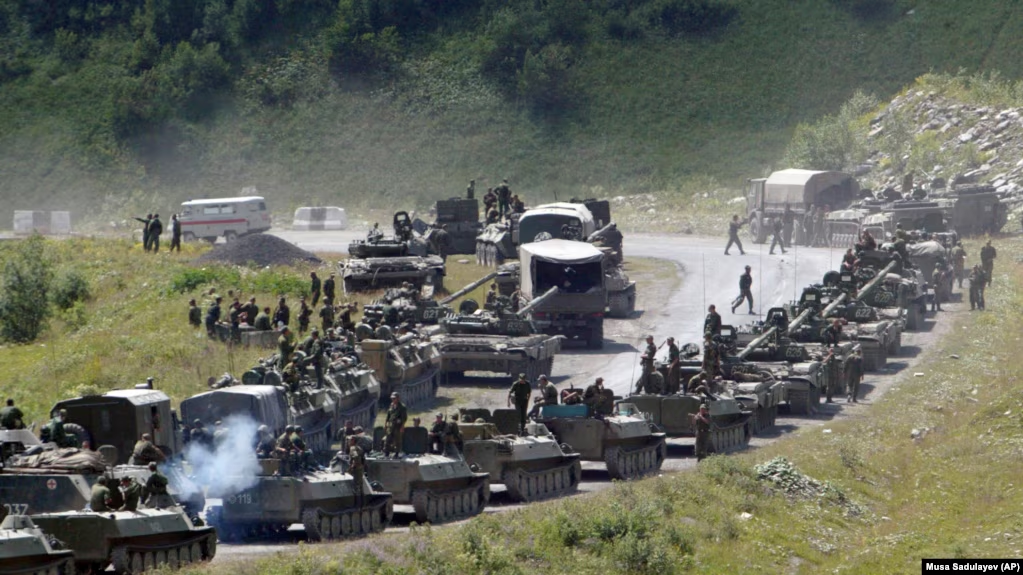
A column of Russian armored vehicles is seen on its way to the South Ossetian capital of Tskhinvali on August 9, 2008.

Eighteen years ago, on the night of August 7, 2008, Georgia entered the darkest period of its modern history. What began with escalating violence around Tskhinvali (“South Ossetia”) quickly turned into a five-day war with Russia, leaving hundreds dead, tens of thousands displaced, and a legacy that continues to shape Georgia’s politics and security concerns today.

The fighting did not come without warning. For months before the war, tensions had been rising between Tbilisi and the de facto authorities in Tskhinvali. Both sides accused each other of ceasefire violations, shelling, and attacks on villages near the administrative boundary line. International observers warned that the security situation was deteriorating, while diplomatic attempts to prevent further escalation failed.

On the evening of August 7, Georgian officials announced a unilateral ceasefire and called for renewed talks. But within hours, after further exchanges of fire around Tskhinvali, Georgia launched a military operation aimed at bringing the region back under government control. Heavy fighting broke out in and around Tskhinvali, the regional capital.

Russia responded by sending troops, tanks, and aircraft through the Roki Tunnel, saying it was intervening to protect Russian peacekeepers and civilians. The fighting soon spread beyond Tskhinvali, with Russian forces also moving through Abkhazia and into areas of Georgia beyond the two breakaway regions.

In the days that followed, Russian forces advanced into several Georgian towns and strategic locations, including Gori, Senaki, and Poti. Air strikes targeted military facilities, transport routes, and infrastructure. As the fighting moved closer to civilian areas, thousands of people fled their homes.

The war ended after a ceasefire agreement brokered by French President Nicolas Sarkozy, whose country held the presidency of the Council of the European Union at the time. The six-point plan called for an end to hostilities, the withdrawal of forces, and international talks aimed at addressing long-term security concerns.

The human cost was severe. According to official Georgian figures, 228 civilians, 170 members of the armed forces, and 14 police officers were killed. Hundreds more were injured, and tens of thousands of people were forced from their homes. Many displaced families have still not been able to return.

On August 26, 2008, Russia recognized Abkhazia and “South Ossetia” as independent states. Georgia and most of the international community continue to consider both territories part of Georgia’s sovereign territory under Russian occupation. Only a small number of countries have recognized their independence.

The aftermath of the war reshaped Georgia’s foreign policy. The conflict reinforced the country’s drive towards closer ties with the European Union and NATO, while leaving unresolved security issues along the occupation lines. Reports of detentions, restrictions on movement, and the expansion of fences and barriers around the occupied territories continue to be a source of tension.

The war also led to the creation of the Geneva International Discussions in October 2008, bringing together Georgia, Russia, the United States, the European Union, the United Nations, the OSCE, and representatives of Abkhazia and “South Ossetia.” The talks continue, although major political breakthroughs remain elusive.

Every August, Georgia remembers those who lost their lives in the war and the thousands who were forced to leave their homes. Nearly two decades later, the events of August 2008 remain one of the defining moments of the country’s recent history, with its effects still visible in Georgia’s politics, security environment, and relations with Russia.
Tags: August 2008August 2008 Russia-Georgia WarGeorgia's occupied regionsRussia-Georgia warTskhinvali war
ShareShareTweet

Related Posts

Nearly 70% of Ukrainians support EU membership
Highlights

Nearly 70% of Ukrainians support EU membership

August 7, 2026
France, Germany, Italy and UK reaffirm support for Georgia’s territorial integrity on 2008 war
Highlights

France, Germany, Italy and UK reaffirm support for Georgia’s territorial integrity on 2008 war

August 7, 2026
Gakharia for Georgia: GD chose to blame its own country instead of mobilizing international community
Politics

Gakharia for Georgia: GD chose to blame its own country instead of mobilizing international community

August 7, 2026

Recommended

Putin, Xi, and allied leaders mark Russia’s Victory Day at Moscow parade

Putin, Xi, and allied leaders mark Russia’s Victory Day at Moscow parade

1 year ago
Experience Seamless Connectivity with Silknet eSIM in Georgia

Experience Seamless Connectivity with Silknet eSIM in Georgia

2 years ago
Champion Karateka Luka Khvedeliani on the Benefits of Georgian Karate for Georgia’s Youth

Georgia to Celebrate First Europe Day with European Union Candidate Status

2 years ago
Georgian Foreign Minister Holds Farewell Meeting with French Ambassador to Georgia

Georgian Foreign Minister Holds Farewell Meeting with French Ambassador to Georgia

4 years ago
Natia Mezvrishvili on Dealing with 2 Political Giants

Natia Mezvrishvili on Dealing with 2 Political Giants

4 years ago
Giorgi Gakharia: We were Told We Were Capable of Nothing – It’s All a Lie and Ukraine is a Great Example of This

Giorgi Gakharia: We were Told We Were Capable of Nothing – It’s All a Lie and Ukraine is a Great Example of This

4 years ago
GT Interview with Giorgi Badridze

GT Interview with Giorgi Badridze

4 years ago
Russo-Ukrainian War and Georgia – Analysis from security expert Kakha Kemoklidze

Russo-Ukrainian War and Georgia – Analysis from security expert Kakha Kemoklidze

4 years ago

Navigation

  • News
  • Politics
  • Business & Economy
  • Social & Society
  • Sports
  • Culture
  • International
  • Where.ge
  • Newspaper
  • Magazine
  • GEO
  • OP-ED
  • About Us
    • History
    • Our Team
    • Advertising
    • Subscription
  • Contact

Highlights

Two minors charged in Giga Avaliani murder case

Suspected attempt to transport sanctioned goods to Russia uncovered at Sarpi customs

Hungarian journalist Laszlo Mezesi leaves Georgia after detention

Givi Tsuleiskiri sentenced to 12 years, Sphero Holding employee gets 8 years

Remembering the August 2008 Russia-Georgia War

Ukraine Latest: Russia Makes Slow Gains as Missile Attacks Intensify

Trending

Experience Seamless Connectivity with Silknet eSIM in Georgia
Business & Economy

Experience Seamless Connectivity with Silknet eSIM in Georgia

by Georgia Today
June 26, 2024

Why Silknet's eSIM could be your top choice in Georgia  Since its introduction, eSIM technology has become...

Photo by the author

Virtuosity and Versatility: Marc-André Hamelin Opens Tbilisi Piano Festival 2024

May 30, 2024
  • Where.ge
  • Newspaper
  • GEO
  • Magazine
  • Old Website

2000-2026 © Georgia Today

No Result
View All Result
  • News
  • Politics
  • Business & Economy
  • Social & Society
  • Sports
  • Culture
  • International
  • Where.ge
  • Newspaper
  • Magazine
  • GEO
  • OP-ED
  • About Us
    • History
    • Our Team
    • Advertising
    • Subscription
  • Contact

2000-2026 © Georgia Today