Some memories of war are beyond words. Across the world, people continue to endure conflicts that have brought unimaginable suffering. People have lost loved ones, watched their homes destroyed and been forced to flee. I can’t claim to know what that feels like. But in August 2008, many Georgians did.
Russian bombs fell on towns and cities, civilians were killed, families fled their homes, and thousands were displaced. I was not among those directly caught in the fighting, but I was living in Tbilisi as the war unfolded. Like everyone around me, I had no idea how far it would spread or what each day would bring. The fear was real. The uncertainty was real. And for one long night, it felt entirely possible that the capital could become part of the battlefield.
For weeks, there had been growing fear around the Tskhinvali region (now known as “South Ossetia”). The situation between Georgian forces and separatists had deteriorated, with shelling, accusations and military movements increasing in the days before the fighting erupted. On 7 August, President Mikheil Saakashvili announced a unilateral ceasefire, but events quickly spiraled. By the night of 7–8 August, the conflict had become a full-scale war involving Georgia and Russia.
Nobody in Tbilisi knew where it would end. News reports mixed with rumors, and it became almost impossible to separate one from the other. Reports of Russian troop movements spread quickly. Some people thought Russian forces could reach Tbilisi within hours. Whether every rumor was accurate hardly mattered; it felt possible, and that was enough. Suddenly we were quietly asking one another the same question: If they keep coming, what do we do?
I remember being one of the last people to take out money from a particular ATM before it ran out due to panic withdrawals. The people lined up behind me hurried off to find another machine. Suddenly, cash became something precious. Cars snaked slowly down every road leading to a fuel station. Supermarket shelves began emptying a little more quickly than usual. Families phoned one another, made contingency plans, and quietly packed bags.
Many people headed east and south to stay with relatives or friends in villages away from the capital.
Others were caught completely off guard. Some families holidaying on the Black Sea coast suddenly found themselves unable to return home as roads became unsafe. They stayed in their hotels, separated from loved ones in Tbilisi and unsure when they would be able to come back.
I delayed packing bags for my husband and I. Perhaps it was denial. Perhaps it was the very human belief that if you wait long enough, the frightening thing might disappear.
On August 8th, I packed those bags.
My parents-in-law refused to leave the city. They were elderly, fragile, and deeply attached to their home. Our plan, if things became impossible, was to drive to Turkey by the back roads, through Manglisi, Akhaltsikhe, and onwards. It was not a carefully designed evacuation strategy; it was more the kind of plan people make when they have no idea what will happen next but need to feel that they still have some control.
We worried that my Georgian husband, if caught running, might be called up. He’d done his military service in his early twenties, and, that week, the fear of mobilization became something entirely possible.
We joined the queue for fuel. We bought extra food. We watched the news constantly.
And then came the night we decided to leave. The possibility of Russian forces reaching closer to the capital no longer felt like an abstract fear. Russian troops had poured into the Tskhinvali region, Georgian forces had withdrawn from Tskhinvali town, and reports of Russian military movements beyond the conflict zone were being splashed across the TV screens. Nobody knew whether the advance would stop or continue south. The rumors were frightening, but they were not coming from nowhere. For the first time, many people in Tbilisi felt that the war was no longer happening somewhere else; it was moving towards them.
We went to collect a friend. The plan was to take him home to pick up his bag and meet other friends who wanted to come with us.
In the strange atmosphere of those days, every small decision felt loaded with meaning. I remember feeling irrationally panicked that I didn’t speak a word of Russian. How would I communicate if we were stopped by the occupiers? We had a Georgian flag with us in the car, and, as we drove through the quiet, night-dark city, I asked them to hide it in the glove compartment. It wasn’t a political statement; it was fear. It was the instinctive caution of someone who did not know what the next hours might bring or who we might encounter.
My Georgian friends laughed about it. I didn’t. They’d lived through the collapse of the Soviet Union, the “dark 90s,” civil war, and years when friends were lost in the chaos of gang violence. Their relationship with uncertainty was entirely different from mine, as I’d grown up in a quiet part of the United Kingdom where danger was something distant and unusual. They knew something about surviving difficult times that I was only beginning to understand.
Our friend lived near Mama Daviti Church on Mtatsminda, and it was there that I was standing on the balcony when the TV tower lights went out. The sight of this landmark of Tbilisi suddenly thrust into darkness was frightening. The blackout was a precaution as fears grew that the city might be targeted, and in that moment the city seemed to hold its breath.
And yet, inside our friend’s apartment, life continued.
The table had been prepared by the older women of the family who had no plan to leave: food to fill us up before we said our goodbyes. There was khachapuri, fried chicken, salad, shoti bread, cheese, fruit and, of course, wine and vodka. The men drank and toasted again and again: to Georgia, to victory, and to staying strong in whatever the coming days might bring.
I sat there listening to the laughter while also listening to the streets around us. Every passing minibus made me tense. In my imagination, every rattling engine sounded like a Russian tank.

Eventually, the toasts did their work and my husband and his friends were no longer in a state to drive. Our escape plan was postponed, and we spent the night at our friend’s home.
By morning, everything looked different. The city was still there. The streets were still busy. People were still shopping, drinking coffee and going to work. The fear of the night before had not disappeared, but daylight somehow made things feel more manageable.
Then we watched the news.
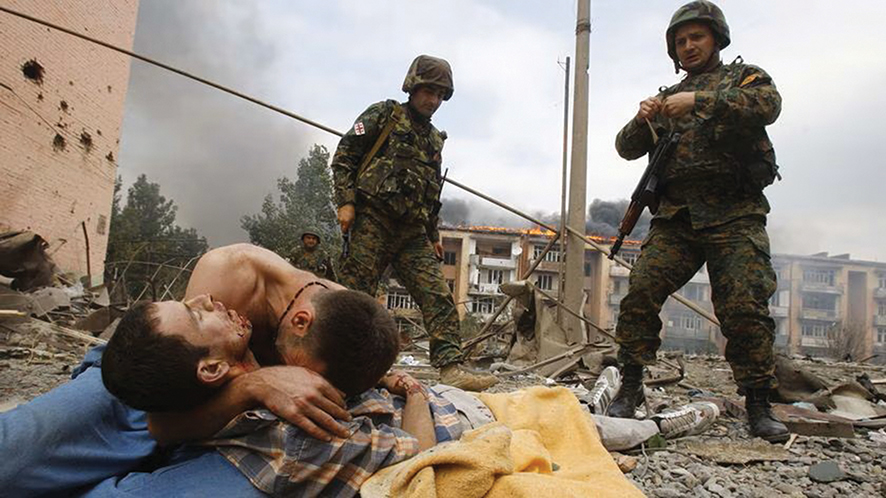
Russian military units, including armor and airborne troops, had reinforced “South Ossetia” and were pushing Georgian forces back around Tskhinvali. Russian aircraft had bombed targets around Gori, a city around 80 kilometers from the capital, including a strike that hit a residential building. The images were shocking. I’m sure you’ve seen them.
But in the comfort of daylight, sitting in front of the news report, seeing those people, our countrymen, suffering, the fear of the night before turned into anger and defiance.
We decided to go home.
The August War lasted only five days, but those five days changed Georgia forever. Russian forces advanced deep into Georgian territory, taking control of Gori and other areas beyond Tskhinvali and Abkhazia. As Russian troops moved southwards, they reached positions near Igoeti, around 40 kilometers from Tbilisi, confirming why many of us in the capital had feared the fighting could reach us.
Thousands of people were displaced from the two Georgian regions, many forced to live in temporary accommodation, repurposed hotels and abandoned buildings. Families who had fled to safer areas, including those who’d been stranded on the Black Sea coast, eventually began returning home when roads reopened and access became possible.
After the ceasefire agreement brokered by French President Nicolas Sarkozy on behalf of the European Union, Russia recognized Abkhazia and Tskhinvali (“South Ossetia”) as independent states. U.S. military aircraft arrived at Tbilisi International Airport with humanitarian aid, an indisputable sign of international support and perhaps one of the reasons Tbilisi was not hit by the Russians.
The human cost of the war doesn’t compare to what we see around us in the world today, but for Georgia it was enormous. Around 850 people were killed, including civilians, Georgian soldiers, Russian troops and “South Ossetian” fighters. Hundreds of thousands of people were affected by the conflict, and many Georgians never returned to the homes they lost; consequences that remain unresolved to this day.
And yet, one of my strongest memories of that time is not of destruction. It is of people refusing to surrender normal life.
Georgians cooked, joked, argued, sang, raised glasses and looked after each other. A country that had already endured the collapse of an empire, civil war, economic hardship and uncertainty once again found a way to stand upright.
I came to Georgia as an outsider. I was the person nervously listening for tanks while my friends were drinking toasts and telling stories. But somewhere between the panic-buying, the fuel queues, the darkened TV tower and that crowded balcony on Mtatsminda, Georgia became more than a place where I happened to be living.
So many years later, I am still here.
The war passed. The fear passed. The country rebuilt, reset in some way, and carried on. And perhaps that is the most Georgian thing of all: not the absence of fear, but the ability to sit around a table, pour another glass, tell another story, and continue.
Blog by Katie Ruth Davies