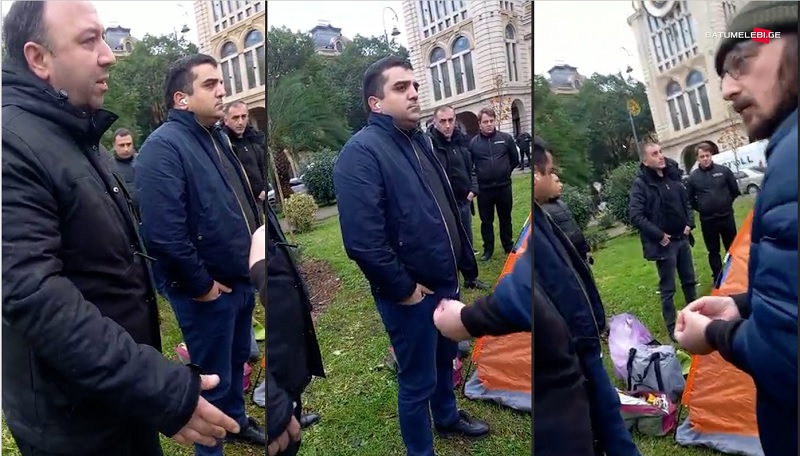
The European Court of Human Rights (ECHR) has ruled that Georgia violated the European Convention on Human Rights in a case involving restrictions on a protester who attempted to pitch a tent in Batumi.
The decision, issued on June 23 in the case Karchava v. Georgia, found that declaring Zurab Karchava an administrative offender for disobeying police instructions breached his rights to freedom of expression and assembly.
The applicant was represented before the court by the Georgian Young Lawyers’ Association.
The case file shows that Karchava, a psychotherapist, attempted in December 2022 to set up a tent near a monument on Memed Abashidze Avenue in Batumi, announcing a hunger strike demanding free school meals. He had informed Batumi City Hall in advance and said he did not intend to block traffic.
City Hall later told him the area was being used for New Year events and advised him to choose another location, while noting that he still had the right to express his views.
On the day of the incident, police twice intervened when Karchava attempted to pitch the tent. He was briefly taken to a police station for identification, then returned to the site and continued his protest.
He was later arrested for disobeying lawful police orders under Article 173 of Georgia’s Code of Administrative Offenses and held for 24 hours in pre-trial detention. A domestic court later found him guilty but issued only a verbal warning, citing his clean record.
The Strasbourg court said domestic authorities failed to provide “relevant and sufficient” reasons for the interference, adding that Karchava’s actions were peaceful and concerned a matter of public interest.
It concluded that the measures taken had a chilling effect on freedom of expression, finding violations of Article 10 (freedom of expression) in conjunction with Article 11 (freedom of assembly).
The court ordered the state to pay EUR 1,000 in non-pecuniary damages.