On a damp February evening, the lobby of the Tbilisi Photography & Multimedia Museum in Stamba’s concrete shell felt unusually hushed. The city outside, perpetually oscillating between café chatter and political murmurs, seemed to lower its volume for the arrival of a German artist whose work has long insisted that history never does. On February 18, at 7 p.m., Stille Bewegungen. Tranquil Motions opened in Tbilisi: fourteen works spanning four decades by Marcel Odenbach, one of Germany’s most rigorous anatomists of memory.

The exhibition, organized by ifa, the Institut für Auslandsbeziehungen, and presented in cooperation with the Goethe-Institut Georgien, arrives with the quiet authority of an archival dossier. Curated by Matthias Mühling, director of the Lenbachhaus in Munich, the show is less a retrospective than a cartography: a map of recurring obsessions—colonial residue, collective amnesia, the performance of identity, the seductive surface of media images.
Tbilisi has, in recent years, grown accustomed to ambitious international projects. Yet Odenbach’s presence feels different. His is an art that distrusts spectacle. It operates through montage, through interruption, through a steady dismantling of visual comfort. The title Tranquil Motions carries a faint irony. Odenbach’s images often begin in stillness—a shaving ritual in a Turkish barbershop, the languid sway of palm leaves, a rehearsal room where a piano waits—before revealing the tectonic tensions beneath.

In As If Memories Could Deceive Me (1986), a rehearsal unfolds across a split screen: documentary fragments of Nazi Germany intrude upon the controlled gestures of musical practice. The keyboard becomes a site of contamination. The private act of rehearsal absorbs the public trauma of book burnings and Nuremberg rhetoric. Odenbach’s strategy is surgical. He allows history to seep into the present through formal means: superimposition, abrupt cuts, the refusal of narrative closure.
For a Georgian audience, acutely aware of how recent conflicts are archived, misarchived, or weaponized, such works resonate with disquieting clarity. The culture of remembrance here remains contested terrain. Museums are battlegrounds of narrative. Odenbach does not offer instruction; he stages friction. His installations function as laboratories in which viewers test their own susceptibility to images.
In Tropenkoller (2017), the afterlives of German colonialism in Togo unfold through a layered montage of archival footage and contemporary travel imagery. The “tropics” emerge as projection screen and wound simultaneously. Palm trees, that most European of fantasies, tremble under the weight of exploitation. Odenbach’s editing practice—slow, deliberate, essayistic—reveals colonialism as a visual regime as much as a political one.

Georgia, too, understands the complexities of an empire’s gaze. Russian, Ottoman, Persian, Soviet: each left its sediment in architecture and memory. Watching Odenbach’s colonial excavations inside a Tbilisi institution feels like a mirror held at an angle: not a direct reflection, yet unmistakably familiar.
Perhaps the most chilling work in the exhibition is In Still Waters Crocodiles Lurk (2004/2003), which circles the aftermath of the Rwandan genocide. The film avoids explicit atrocity. Instead, it lingers on pastoral images—banana plantations, cattle, soft hills—while radio propaganda hums in the background.
The horror resides in disjunction. Violence becomes atmospheric, absorbed into landscape.
This aesthetic of indirection is Odenbach’s signature. He trusts the viewer’s capacity for inference. In Tbilisi, where public discourse often swings between euphoric self-mythologizing and apocalyptic anxiety, such restraint reads as ethical clarity. The work does not shout; it unsettles.
Several pieces in Tranquil Motions return to the body as archive. In Male Stories 1, a shaving ritual becomes allegory; tradition etched onto skin. In So Long as the Ball Keeps Rolling, footballers’ legs in motion condense nationalism into muscular choreography. Odenbach isolates gestures and repeats them until they acquire ideological density.
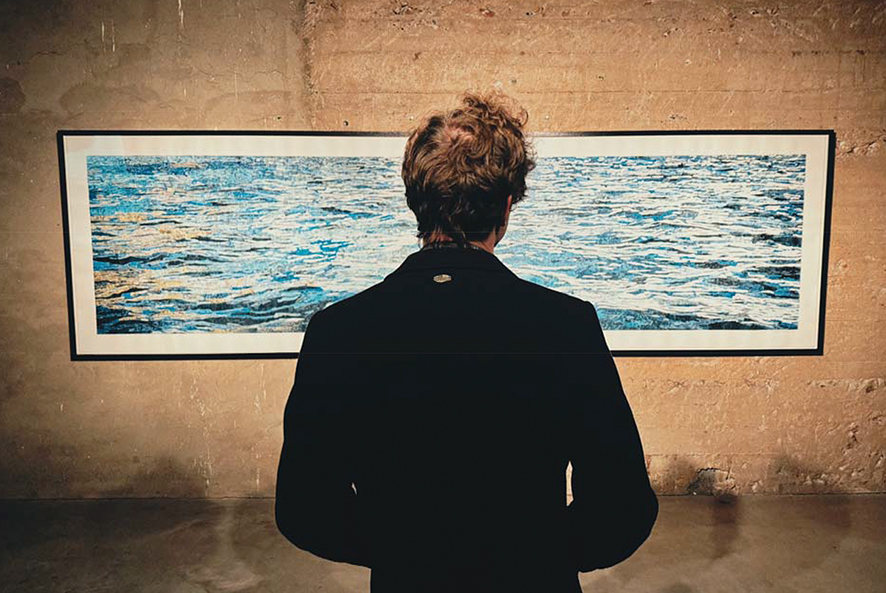
There is something almost choreographic in his method. The exhibition unfolds as a score of recurring motifs: lips touching a camera lens in Too Beautiful to Be True, the sea’s surface collaged into a mosaic of longing in A Day at the Sea. Images approach, withdraw, overlay one another. Meaning accumulates through rhythm. The opening was followed the next evening by an artist talk at the Goethe-Institut, moderated by Ana Gabelaia.
Tbilisi’s cultural scene often oscillates between local urgency and global aspiration. Hosting Odenbach compresses that oscillation into a productive tension. The exhibition situates the city within a broader European discourse on memory politics while simultaneously sharpening local questions: Who controls the archive? How does trauma circulate in images? What does it mean to look?

The collaboration between ifa, the Goethe-Institut, and TPMM underscores a particular model of cultural diplomacy; one that favors complexity over branding. No national pavilion, no celebratory narrative. Instead, a German artist who dissects Germany’s own historical blind spots, presented in a Georgian context equally entangled with history’s debris.
In an era when moving images saturate every surface, Odenbach’s practice insists on slowness. His works demand duration. They reward patience. They cultivate doubt. Tranquil Motions is less about tranquility than about the micro-movements of conscience—those nearly imperceptible shifts in perception that occur when an image refuses to settle.
As Tbilisi continues to define its cultural self-image—balancing tourism, protest, nostalgia, futurism—this exhibition offers a different tempo. It suggests that the most radical gesture might be sustained attention. To look carefully. To re-edit inherited narratives. To accept that still waters, whether in Rwanda or on the banks of the Mtkvari, always conceal undercurrents.
The show runs through May 3. It leaves behind a quiet provocation: history moves, even when the image seems still.
By Ivan Nechaev