Unlike cities, mountains seem to resist history. Their silhouettes appear eternal, unchanged by politics, wars, or generations of human lives unfolding beneath them. Yet photography has the remarkable ability to reveal that even landscapes we imagine to be timeless are constantly evolving. A glacier retreats. A village expands. A tower loses its neighboring house. A forest climbs higher up the slope.
A new exhibition at the Zurab Tsereteli Museum of Modern Art in Tbilisi invites visitors to witness precisely this passage of time.
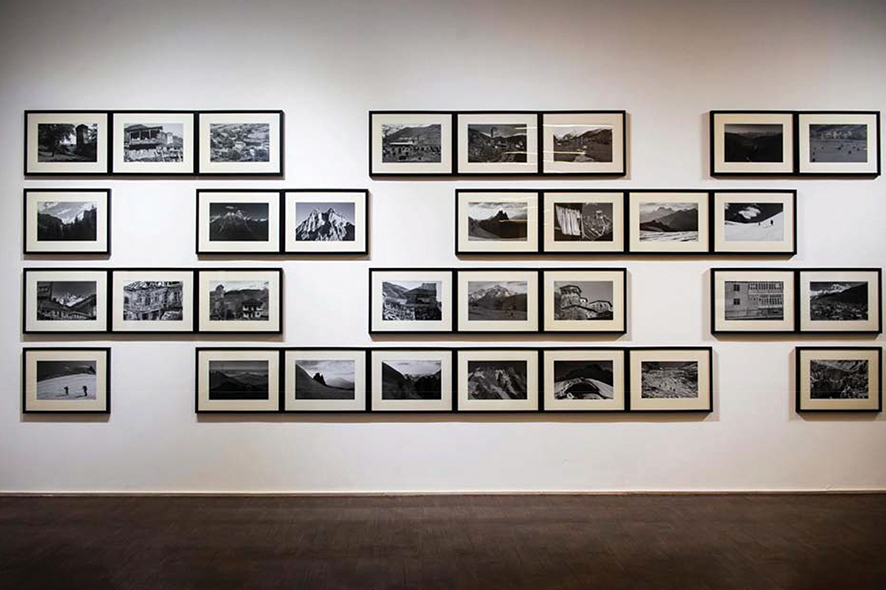
The exhibition brings together photographs taken 135 years apart, creating a visual dialogue between two expeditions separated by more than a century. In 1890, the Italian mountaineer, photographer, and explorer Vittorio Sella traveled through the Caucasus, concluding one of his most remarkable expeditions in Georgia’s mountainous region of Svaneti. During that journey, he photographed more than thirty mountain peaks, twenty of which were climbed for the first time by his own expedition, as well as villages, defensive towers, churches, and the everyday lives of the Svan people.
Far more than travel souvenirs, Sella’s photographs became invaluable historical documents. They preserve a world that was only beginning to encounter modernity: extended families gathered around ancestral churches, isolated mountain settlements, and domestic architecture whose details now belong as much to ethnography as to living memory. One striking image even depicts a house whose exterior displays the severed hands of enemies: a symbol of courage and martial honor in traditional Svan culture, reminding contemporary viewers that mountain societies often developed their own moral codes, far removed from those of Europe’s urban centers.
Today, Sella’s photographs are regarded as treasures not only of photography but also of historical geography, anthropology, and cultural heritage. Their very existence is astonishing.
Traveling with a large-format camera and fragile glass negatives measuring roughly 30 by 40 centimeters, Sella carried equipment that weighed dozens of kilograms across glaciers, steep passes, and remote mountain trails. He even designed specialized backpacks and saddles to transport his photographic apparatus safely through terrain that remains challenging even for modern hikers. At a time when photography demanded chemistry, patience, and extraordinary physical endurance, every image represented hours of preparation and considerable personal risk.
Perhaps this is why Sella’s work possesses an almost sculptural quality. Each photograph feels earned. Remarkably, his Svaneti archive remained largely forgotten for nearly a century before being rediscovered and transferred to the National Archives of Georgia, allowing contemporary audiences to encounter one of the earliest comprehensive visual records of the region.
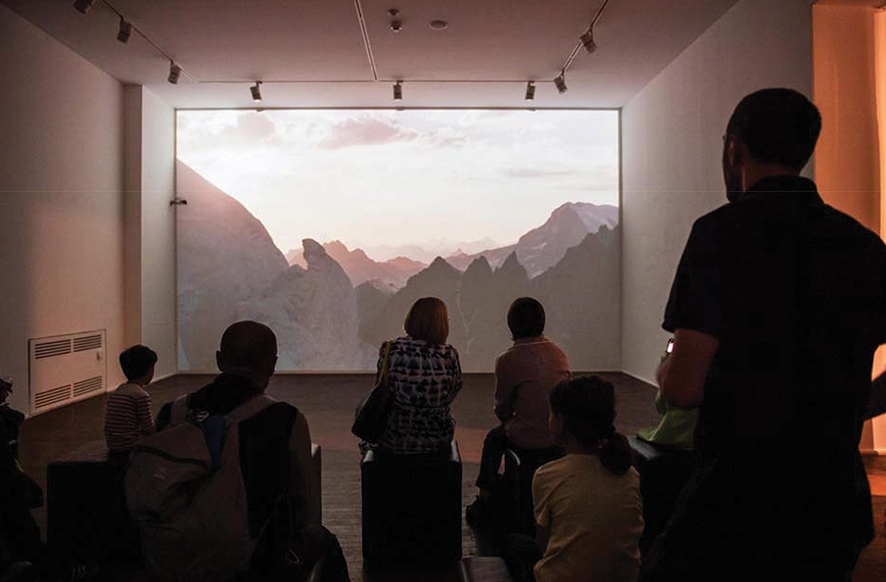
The second half of the exhibition belongs to the present. Between 2025 and 2026, Georgian photographer and videographer Nika Lebanidze retraced Sella’s route through Svaneti, seeking out the precise locations from which the Italian photographer had worked 135 years earlier. Using the same viewpoints whenever possible, Lebanidze created contemporary counterparts to Sella’s images.
This “then-and-now” approach has become an increasingly important practice in contemporary photography. Rather than documenting a place at a single moment, it transforms photography into an instrument for measuring time itself. The paired images reveal not only physical changes in architecture and landscape but also subtler transformations in how people inhabit space. Some villages have grown. Others appear quieter. Forests reclaim abandoned areas, while roads and tourism infrastructure reshape valleys that were once accessible only on horseback. The exhibition therefore asks visitors to look beyond nostalgia.
Too often, historical photography encourages a simplistic narrative of loss: a belief that the past was inherently more authentic than the present. Here, however, comparison becomes more nuanced. Change is neither celebrated nor mourned; it is simply observed. Photography becomes evidence rather than judgment.
In many ways, the project reflects a broader shift within contemporary museums. Increasingly, exhibitions are less concerned with displaying isolated masterpieces than with creating conversations across time. Archives are no longer viewed as static repositories of memory, but as living collections that acquire new meanings when contemporary artists engage with them. Lebanidze’s photographs do not imitate Sella’s work; they complete it.
There is also a quietly poetic connection between Italy and Svaneti that survives beyond the exhibition itself. One of Mestia’s streets now bears Vittorio Sella’s name: a reminder that exploration can create cultural relationships lasting far longer than the journey itself. Even more remarkable is the fact that Sella completed his final mountain ascent at the age of seventy-six, embodying a lifelong commitment to curiosity rather than conquest.
Ultimately, this exhibition is about far more than mountains. It is about photography’s unique ability to compress centuries into a single glance. Standing before two nearly identical compositions separated by 135 years, visitors experience time not as an abstract historical concept but as something visible. The mountains remain, yet nothing is quite the same: not the glaciers, not the villages, not the people, and perhaps not even the way we ourselves have learned to look at the world.
The exhibition is on view at the Zurab Tsereteli Museum of Modern Art through July 20.
By Ivan Nechaev