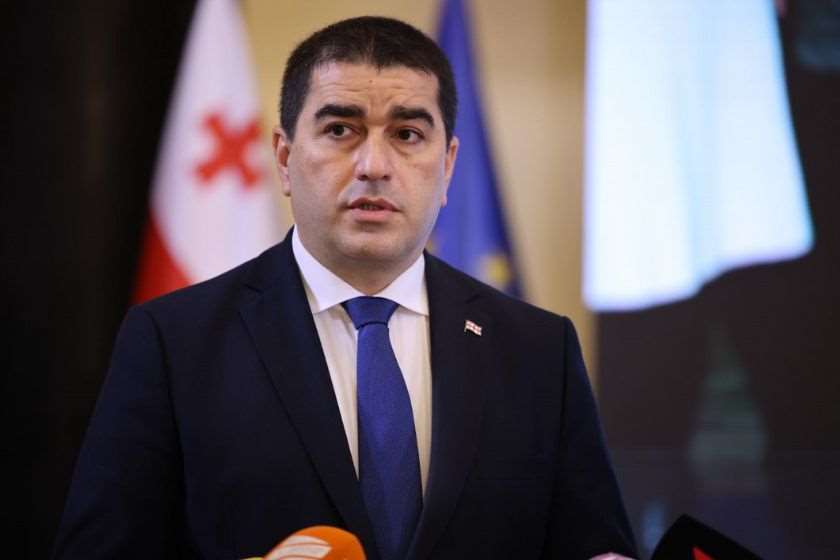
Georgian Parliament Speaker Shalva Papuashvili has strongly criticized the latest resolutions adopted by the European Parliament and the Parliamentary Assembly of the Council of Europe, describing them as an attack on Georgia’s sovereignty and statehood.
Speaking at a briefing in parliament on June 25, Papuashvili said the two documents had “crossed the red lines established by the Georgian people” and “grossly violated the principles of Georgia’s sovereignty and national independence.”
The parliament speaker said that the European Parliament had “effectively equated itself with Russia’s occupation policy.”
“While Russia denies Georgia’s sovereignty over one-fifth of its territory, the European Parliament refuses to recognize Georgia’s sovereignty over its entire territory. It has disregarded the independence and sovereignty won by the Georgian people through struggle and sacrifice and has insulted the very idea of Georgian statehood,” Papuashvili said.
He also objected to references in the European Parliament’s report linking the Georgian Orthodox Church to Russian religious networks and influence operations.
Papuashvili said this constituted the first open attack by an official European institution on the Georgian Church and insulted the religious feelings of millions of believers.
“The European Parliament’s resolution does not only oppose Georgia’s democratic institutions; it also represents the first open attack on the Georgian Church. A simultaneous attack on Georgia’s state sovereignty and the Georgian Church is, in essence, an attack on the idea of Georgian statehood,” he said.
He called on the European Commission to distance itself from what he described as the European Parliament’s “gross attack” on the Georgian Church.
Papuashvili further argued that the latest European Parliament resolution demonstrates that “EU bureaucracy must take effective steps to restore dialogue with Georgia.” He claimed that this requires ending what he described as hostile rhetoric toward the Georgian people and the Georgian Orthodox Church, stopping “disinformation” against Georgia’s democratically elected government, fully recognizing Georgia’s state sovereignty, and strictly adhering to the fundamental principles of international law.
The comments came in response to two recent critical assessments of Georgia by European institutions.
On June 24, PACE adopted a resolution on the functioning of democratic institutions in Georgia by 83 votes to five. The resolution expressed concern over continued democratic backsliding, pressure on civil society, political opposition and independent voices, and warned that efforts to ban opposition parties and prosecute their leaders could place Georgia on the path toward one-party rule. The Assembly also questioned the authorities’ commitment to fulfilling Georgia’s obligations as a member of the Council of Europe while reaffirming its willingness to maintain dialogue with the Georgian government.
Earlier, on June 17, the European Parliament adopted its annual report on Georgia by 436 votes to 145. The report assessed the state of democracy, the rule of law and Georgia’s EU integration process, placing particular emphasis on recent political developments, restrictive legislation and the actions of the ruling authorities. It also expressed concern over democratic regression and called for measures to restore democratic standards and respect for fundamental rights.
Georgia’s delegation has had its voting rights in PACE restricted for the second consecutive year. Following that decision, the ruling Georgian Dream party suspended its participation in the Assembly. The restriction was imposed over concerns regarding the fairness and legitimacy of the October 26, 2024 parliamentary elections, reported human rights violations and the government’s decision to halt Georgia’s EU accession process.