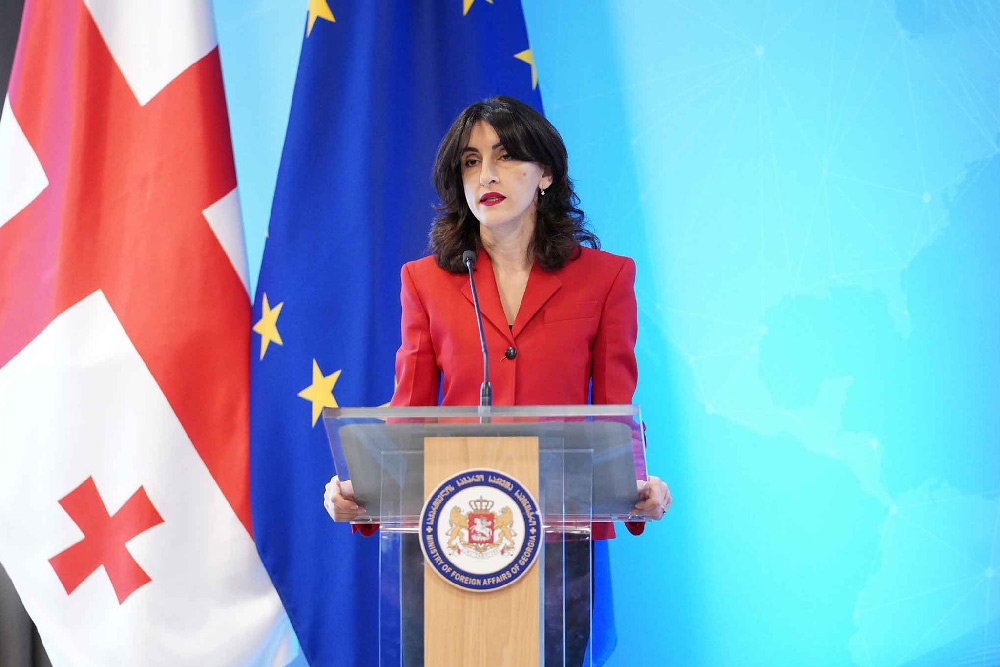
Georgian Foreign Minister and Deputy Prime Minister Maka Bochorishvili has criticized a draft resolution of the Parliamentary Assembly of the Council of Europe (PACE), describing it as another attempt to use international institutions for political purposes.
Speaking to journalists, Bochorishvili said certain groups were seeking to promote what she called anti-Georgian narratives through international organizations and have them formalized in resolutions.
“This is another attempt to use international organizations and institutions for political purposes. They are doing everything possible to ensure that narratives regarding Georgia, which have already been reflected in a number of resolutions, are repeated as widely as possible across different institutions and adopted in various forms,” Bochorishvili said.
She argued that international organizations were increasingly being used as political instruments, citing developments in the European Parliament, the Council of Europe and the Organization for Security and Co-operation in Europe (OSCE).
“We have seen this in different institutions. We constantly see it in the European Parliament, we see it in the Council of Europe, and there was also an attempt to use it within the OSCE through the launch of the Moscow Mechanism regarding Georgia,” she said.
Bochorishvili added that the Georgian government regularly raises the issue with international partners and considers such practices harmful to the credibility of international institutions.
“We discuss this with our partners and emphasize it frequently. It is completely unacceptable when trust in international institutions is undermined by such methods,” the minister stated.
The comments come amid debate over a draft resolution prepared by the Monitoring Committee of the Parliamentary Assembly of the Council of Europe, which expresses concern over what it describes as democratic backsliding in Georgia. The document states that the conditions for holding “genuinely democratic elections” currently do not exist in the country and raises concerns about restrictions on opposition parties, civil society and independent media. It also calls for the repeal of several recently adopted laws and urges the authorities to engage in an inclusive political dialogue. The draft resolution is expected to be considered by the Assembly during its session.
The draft resolution follows a series of critical assessments by European institutions regarding developments in Georgia, including concerns over democratic governance, political polarization and the country’s adherence to its obligations as a member of the Council of Europe.