Cities are full of unofficial landmarks. Some are cafés where generations of writers gathered, others are market stalls known only to locals, or benches associated with a memorable photograph. Increasingly, they are also connected with animals. Edinburgh has Greyfriars Bobby, whose devotion to his owner turned a Skye Terrier into one of Scotland’s best-known symbols. Tokyo continues to attract visitors to the statue of Hachiko, the Akita who waited for his owner every evening at Shibuya Station long after the professor had died. Istanbul has made room in its urban mythology for countless cats, while in Kraków, the bronze dragon remains inseparable from the city’s identity, despite existing only in legend.
Batumi’s contribution to this curious geography of urban memory is much more recent, and entirely real.
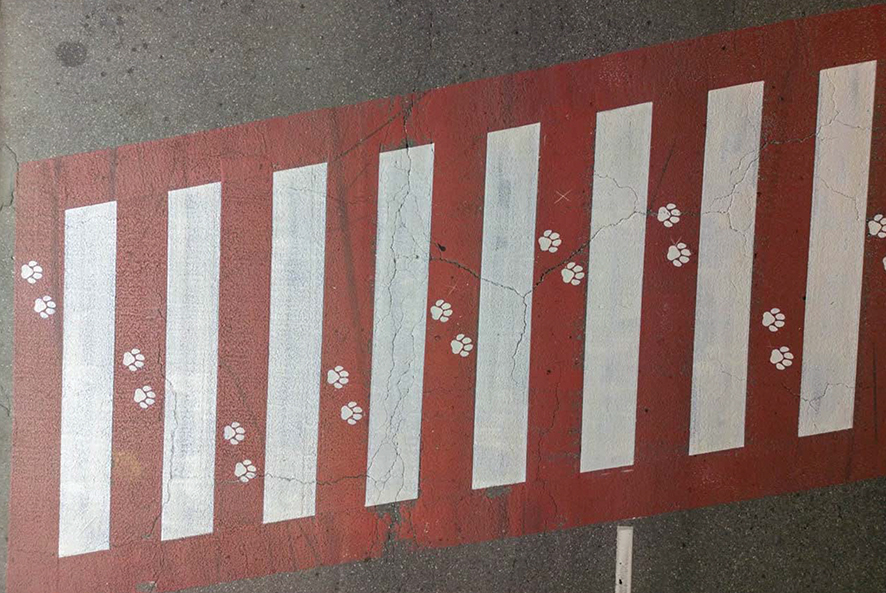
This week, the city painted a trail of paw prints at the pedestrian crossing where Kupata, Batumi’s beloved stray dog, became known for an unusual daily routine. Long before millions of people discovered him online, local residents had become accustomed to seeing the dog bark at approaching cars, wait for traffic to stop, and accompany children across the street. In 2020, a video of one such crossing spread rapidly across social media, transforming Kupata into an international sensation.
The internet, of course, has no shortage of animal celebrities. Every week seems to produce another viral pet whose fame disappears almost as quickly as it arrives. Kupata’s story proved remarkably resistant to that cycle. Even after his death in 2023, people continued to visit the crossing, share memories, and recall not simply the viral video, but the years of everyday encounters that had preceded it. Viral fame often creates symbols out of isolated moments. Kupata became a symbol because he had already become part of Batumi’s daily life.
Kupata became a symbol because he had already become part of Batumi’s daily life
The newly painted paw prints reflect a broader shift in the way cities think about memory. Public monuments have traditionally celebrated rulers, military victories or national heroes. Yet contemporary urban culture increasingly values smaller narratives: stories that reveal how a place feels rather than simply what happened there. Municipalities around the world have begun preserving locations associated with musicians, writers, local traditions and even ordinary citizens whose stories shaped the emotional landscape of a neighborhood. Batumi’s decision suggests that acts of kindness, even those performed by a stray dog, deserve a place in that conversation.
The memorial itself is strikingly modest. There is no large sculpture, no ceremonial square, no attempt to monumentalize the story. Instead, the city marked the very place where it unfolded. Every person crossing the street now literally walks alongside Kupata’s footsteps. It is a reminder that public memory does not always require imposing architecture: sometimes it survives through a subtle intervention that blends naturally into everyday life.
Urbanists often argue that cities are remembered less through their official attractions than through the stories people tell about them. Ask someone about Venice, and they may remember the cats once living in its bookshops. Ask about Istanbul, and many visitors recall its street animals before its monuments. Increasingly, travelers search not only for UNESCO sites, but also for narratives that reveal a city’s character.
Kupata has become precisely such a narrative for Batumi. His story says something quietly reassuring about the relationship between people and the places they inhabit. A stray dog was accepted as part of the neighbourhood. Residents looked after him. Children recognised him. Drivers learned to expect him. Years later, the city chose not to let that relationship disappear into the endless archive of forgotten internet videos.
For all the discussions about smart cities, digital infrastructure and urban branding, Batumi’s newest memorial points to a different measure of a city’s maturity: its willingness to preserve small acts of generosity alongside grand historical narratives.
The painted paw prints will probably never become one of Georgia’s great tourist attractions. They do not need to. Their significance lies elsewhere. They quietly acknowledge that sometimes the stories worth remembering are not those of power or fame, but those of everyday trust, repeated often enough to become part of a city’s identity.
By Ivan Nechaev