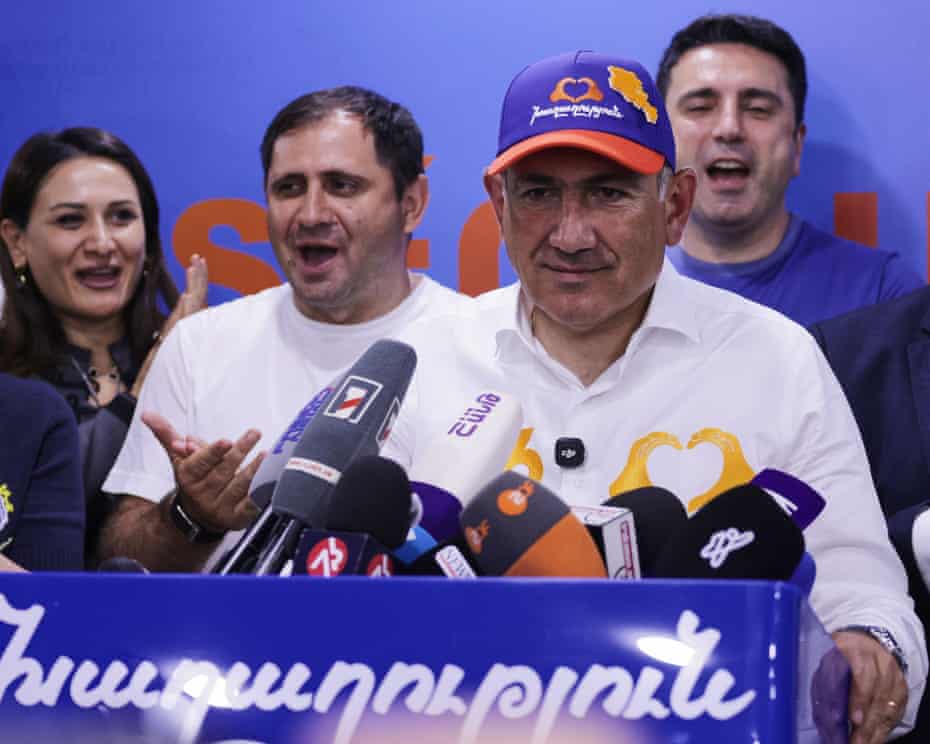
Armenia’s Central Electoral Commission has completed the counting of ballots from all 2,005 polling stations in the country’s parliamentary elections, confirming that four political forces will be represented in the new National Assembly.
Based on the final results, Prime Minister Nikol Pashinyan’s ruling Civil Contract party won 727,160 votes, or 49.81% of the total, securing first place and retaining a parliamentary majority.
The Strong Armenia alliance finished second with 340,062 votes (23.29%), followed by the Armenia alliance with 145,097 votes (9.94%). Prosperous Armenia narrowly crossed the 4% electoral threshold with 58,368 votes (4.00%), allowing the party to return to parliament.
The Wings of Unity party placed fifth, receiving 33,618 votes, or 2.30% of the vote.
The final distribution of seats in Armenia’s 105-member parliament will be as follows:
Civil Contract – 61 seats
Strong Armenia alliance – 28 seats
Armenia alliance – 11 seats
Prosperous Armenia – 5 seats
Based on Armenian media reports, four additional seats reserved for the country’s largest national minorities were distributed between the leading parties, with three mandates allocated to Civil Contract and one to the Strong Armenia alliance, increasing the latter’s parliamentary representation to 28 seats.
Official data show that voter turnout reached 58.97% of eligible voters.
The election was widely viewed as a contest between Pashinyan’s ruling party and several opposition forces advocating closer ties with Russia. A total of 18 political entities — including 16 parties and two alliances — were registered to participate.
Among the main contenders were Pashinyan’s Civil Contract party, former President Robert Kocharyan’s Armenia alliance, and the Strong Armenia alliance led by businessman Narek Karapetyan, who has been described by critics as pro-Russian and indirectly supported by Moscow.
Throughout the campaign, opposition groups argued that Pashinyan’s pro-Western foreign policy course risked damaging Armenia’s relations with Russia and could lead to economic difficulties. Moscow also issued direct and indirect warnings regarding Armenia’s geopolitical trajectory, with some Russian officials and commentators invoking the possibility of the country following “the Ukrainian path.”
In the run-up to the vote, several international journalistic investigations alleged that Russian-linked networks had sought to influence the Armenian election process through various channels, accusations that further intensified the geopolitical significance of the ballot.
Image source: The Guardian
Related story: Armenia’s ruling party leads parliamentary election with 50.07% of vote after 94% of ballots counted