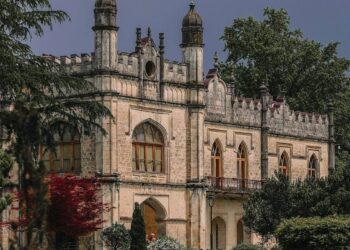
This year’s edition of Tbilisi Art Fair 2026 at Expo Georgia unfolded with a peculiar duality. On one level, it retained the recognizable structure of a regional contemporary art fair: galleries, independent platforms, emerging artists, public programs, installations, conversations, circulation. On another, the event increasingly resembled something less commercial and more diagnostic: a large-scale cultural scan of how the post-Soviet and adjacent artistic sphere currently imagines itself after three decades of political fragmentation, market transition, symbolic exhaustion, and accelerated global integration.
What distinguished this edition was neither scale nor spectacle. The fair’s significance emerged from texture. More specifically: from the way many projects demonstrated an unusual sensitivity toward materiality, historical sediment, and forms of memory embedded in objects, surfaces, architectures, and vernacular visual systems. The strongest works this year rarely operated through declarative political rhetoric. Instead, they approached history obliquely, through residue, structure, archival mutation, ritual forms, damaged aesthetics, and unstable symbolic languages.
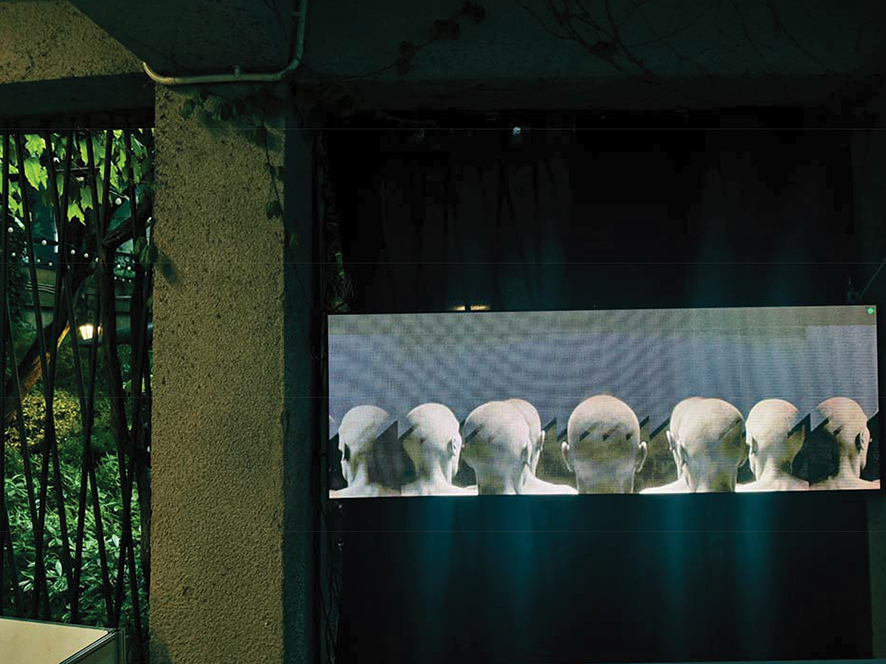
For years, artistic production from the Caucasus and wider post-Soviet geography has remained trapped inside external expectations demanding easily exportable narratives: conflict, transition, trauma, authoritarianism, identity. Those themes remain present, inevitably. Yet the most intellectually serious practices visible at TAF increasingly move elsewhere: toward epistemology, anthropology, metaphysics, ecological temporality, or the archaeology of everyday life. In that sense, the fair revealed a region gradually escaping ethnographic readability.
Expo Georgia as an Accidental Historical Medium
The location itself played a decisive role. Expo Georgia remains one of the most psychologically charged exhibition complexes in Tbilisi precisely because its architecture preserves the fossilized ambitions of Soviet exhibition culture. Like many exhibition grounds built throughout the USSR during the postwar decades, it functioned historically as a theatrical machine for staging industrial optimism and technological futurity. Even today, the pavilions retain a peculiar semi-utopian emptiness: large modular interiors suspended somewhere between decayed monumentality and infrastructural neutrality.
Within the context of contemporary art, this architecture acquires a second life. Works shown there inevitably enter dialogue with the spatial unconscious of late Soviet modernity. One constantly senses overlapping temporalities: socialist exhibition design, post-independence economic improvisation, neoliberal event culture, and contemporary artistic discourse occupying the same physical shell.
TAF’s curatorial ecosystem this year seemed unusually aware of this condition. Rather than concealing the spatial memory of the site through excessive scenography, many exhibitions allowed the architecture to remain partially exposed; producing a productive friction between contemporary works and inherited ideological space.
Levan Mindiashvili and the Problem of Cultural Totality
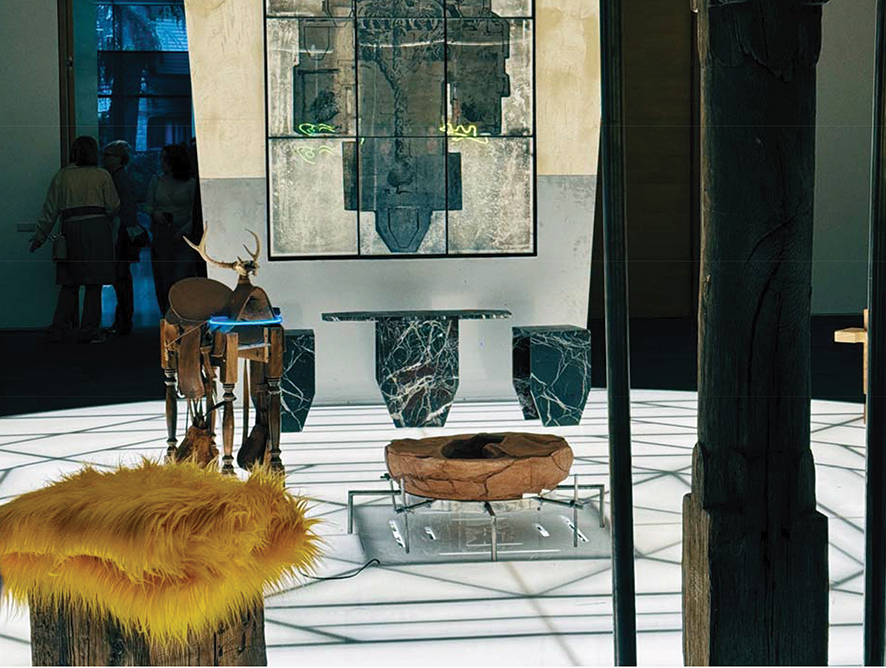
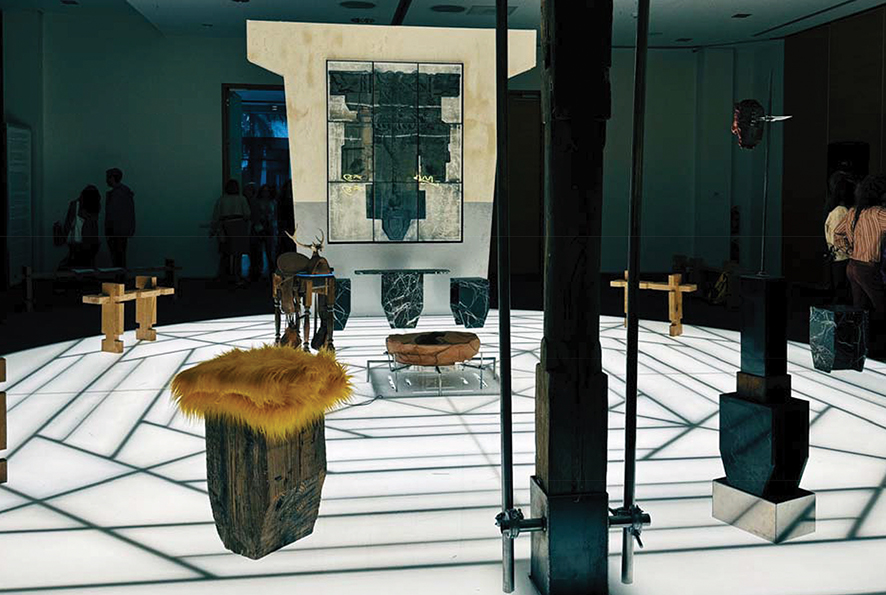
Among the most conceptually rigorous projects was Levan Mindiashvili’s The Mother Pillar I in Pavilion 3. The installation’s importance lies less in its visual composition than in its attempt to construct a synthetic cultural model from heterogeneous Georgian symbolic systems. Mindiashvili mobilizes vernacular architecture, polyphonic logic, liturgical spatiality, design, sound activation, and performative gathering structures as components within a broader inquiry into how collective identity is materially organized.
The key term here is “platform.” The installation does not operate autonomously as a closed sculptural object. It functions infrastructurally. Events, discussions, screenings, and sound interventions continually reactivate the work, preventing it from stabilizing into pure form. This procedural openness aligns the project with relational traditions in contemporary art, yet Mindiashvili avoids the familiar emptiness of participatory aesthetics by grounding the work in specifically Georgian epistemic structures.
Polyphony becomes especially significant in this context. Outside Georgia, polyphony is frequently aestheticized as folklore heritage. Mindiashvili instead approaches it structurally, as a model for organizing multiplicity without centralization. The work implicitly asks whether Georgian culture historically developed mechanisms for sustaining heterogeneity without dissolving communal coherence. This question extends beyond music. It touches architecture, supra traditions, liturgical choreography, oral storytelling, and social negotiation itself.
Importantly, The Mother Pillar avoids romantic nationalism. The installation’s visual language remains unstable, fragmented, partially provisional. One senses a culture attempting to assemble itself from discontinuous historical layers rather than return to imagined origins.
Industrial Graphics and the Soviet Vernacular Image
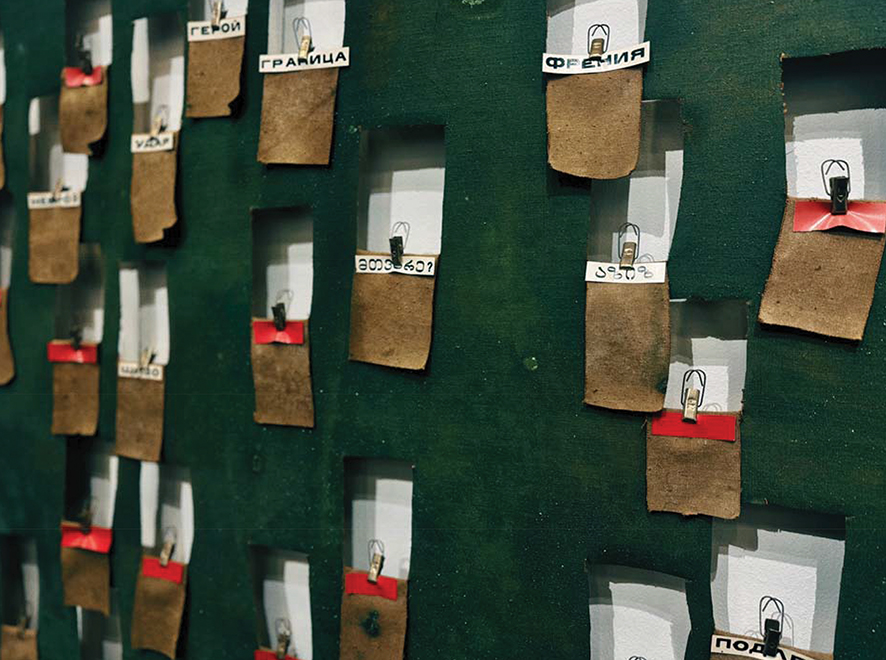
If Mindiashvili’s project examined symbolic totality, All That Material Culture in Pavilion 6 focused on the opposite scale: the microscopic politics of everyday design. Curated by Vija Skangale, the exhibition analyzed Soviet Georgian industrial graphics between 1950 and 1990 through works by Severian Ketskhoveli, Anri Samashvili, and Tsotne Moniava.
What made the exhibition compelling was its refusal to treat graphic design merely as commercial ephemera. Instead, the curatorial framework approached packaging, typography, labeling systems, and industrial imagery as ideological surfaces where Soviet standardization encountered local cultural persistence.
Wine labels became particularly revealing. Within Soviet visual culture, wine branding occupied a peculiar zone between industrial bureaucracy and regional mythology. Georgian designers repeatedly inserted ornamental motifs, calligraphic rhythms, chromatic palettes, and symbolic references carrying distinctly local resonances while formally operating inside centralized production systems.
The result was neither resistance nor compliance in simplistic terms. Rather, one observed continuous negotiation. This nuance distinguished the exhibition from many contemporary attempts to revisit Soviet material culture through nostalgia or retrospective irony. The project treated design historically; as a medium through which competing symbolic orders became materially entangled.
Equally important was the exhibition’s attention to process: sketches, archival fragments, production traces, and unfinished variants revealed industrial design as a site of intellectual labor rather than decorative output.
The Contemporary Photographic Ordinary
Common Places, also in Pavilion 6, offered a quieter but theoretically sophisticated counterpoint. Featuring artists including Pentti Sammallahti and Masao Yamamoto, the exhibition investigated ordinary environments through photographic minimalism and reduced narrative intensity.
The strongest works here shared an attentiveness to peripheral perception. Doorways. Minor weather shifts. Residual shadows. Temporary arrangements of objects. Architectural intervals. The exhibition’s curatorial intelligence lay in resisting spectacularity. Photography today often oscillates between hyper-conceptual staging and endless documentary excess. Commonplaces instead returned to phenomenological observation: the slow registration of how space acquires emotional density through repeated habitation.
This approach resonated unexpectedly well within Tbilisi itself, a city where urban transformation increasingly produces discontinuous perceptual experiences: Soviet infrastructures adjacent to speculative developments, decaying courtyards beside aggressively curated hospitality spaces, informal economies intersecting with global lifestyle aesthetics. The exhibition indirectly mirrored these urban conditions through attention to unnoticed spatial atmospheres.
TAF Hive and the Regional Studio Condition
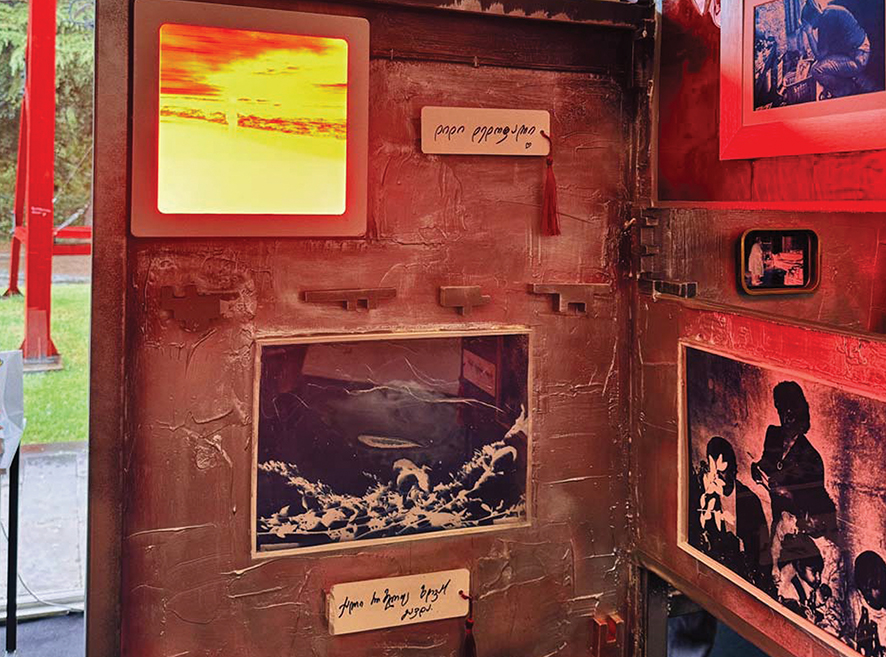
The TAF Hive section perhaps revealed the fair’s most important long-term direction. Unlike traditional gallery presentations, Hive foregrounded individual practices still developing their conceptual vocabularies. This produced inevitable unevenness, though also genuine moments of experimentation.
Artists from Tbilisi, Baku, Yerevan, Berlin, Paris, Milan, and elsewhere formed a loose cartography of what might be called the regional studio condition: artistic production shaped simultaneously by local instability and transnational circulation.
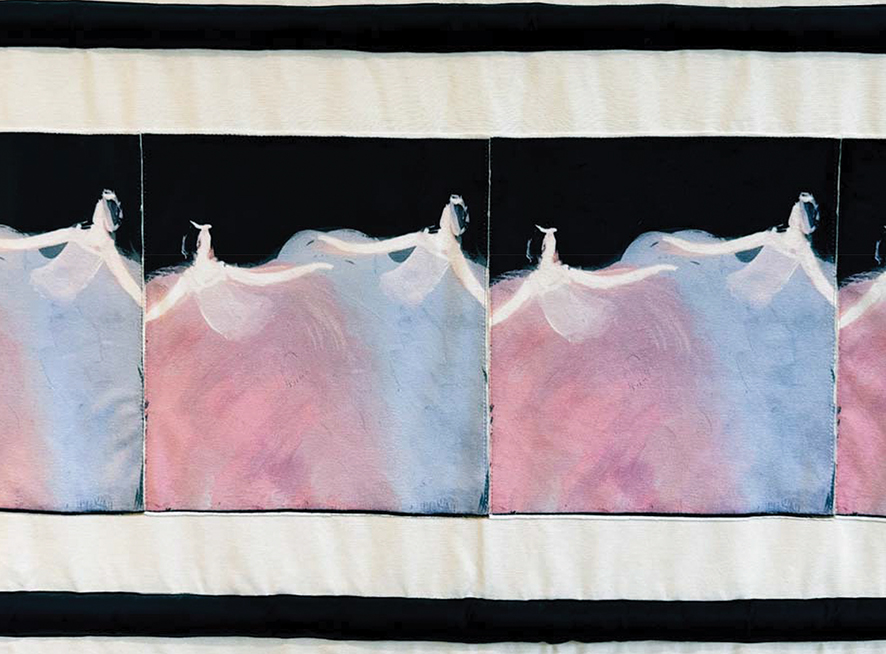
What united many younger practices was a noticeable shift away from grand ideological narration toward materially intimate investigation. Ceramics appeared repeatedly. Textiles. Found materials. Minor gestures. Archival manipulation. Private symbolic systems. Body fragments.
This tendency reflects broader transformations within post-Soviet contemporary art. Earlier generations often worked through explicit confrontation with state violence, nationalism, memory politics, or historical trauma. Younger artists increasingly approach these same realities through indirect sensory languages: less declarative, more atmospheric, sometimes deliberately opaque. Opacity here functions productively. It protects complexity from immediate consumption.
After Visibility
TAF’s broader importance increasingly lies in its ability to complicate visibility itself. For many years, artistic ecosystems from the Caucasus and Central Asia were discussed internationally through the language of emergence: “emerging scenes,” “new voices,” “undiscovered regions.” Such terminology carried implicit hierarchies positioning Western institutions as the primary sites of validation.
This framework now feels insufficient. The most compelling projects at TAF no longer seek discovery. They operate from the assumption that regional artistic production already possesses theoretical, historical, and formal sophistication requiring more nuanced critical engagement. What remains unresolved is infrastructural continuity.
The fair exposed both the vitality and fragility of the ecosystem surrounding it: ambitious independent initiatives existing alongside unstable funding structures, international attention intersecting with local precarity, institutional aspiration developing inside politically volatile conditions.
By the final day, TAF 2026 felt less like a marketplace than a temporary intellectual climate — one where questions about material memory, symbolic inheritance, vernacular modernities, and post-imperial subjectivity could briefly circulate across disciplines, languages, and geographies without collapsing into simplified narratives.
By Ivan Nechaev