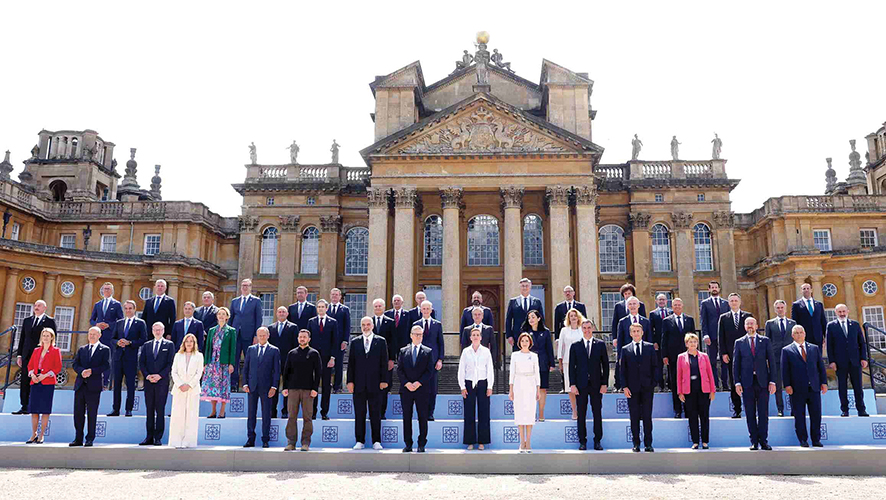
The gathering held in the first week of May in Yerevan, was surprisingly not devoted to International Labor day, but rather something that might cause a shift in the geopolitical map of Eurasia. For decades, the South Caucasus existed in the collective Western imagination as a volatile “near abroad;” a rim-land where Moscow’s shadow loomed large above the region which bridges Europe and Asia. But as nearly fifty heads of state descended upon the Armenian capital for the 8th European Political Community (EPC) Summit, the message was unmistakable: the frontier of the European project has moved decisively eastward, anchored by a new “axis of peace” that stretches from the Atlantic to the Caspian.
The most striking new development in Yerevan was the presence of a guest who arrived from across the ocean. Canada’s historic debut as the first non-European participant signaled the EPC’s evolution from a regional talk-shop into a global democratic guild. Prime Minister Mark Carney framed Ottawa’s arrival not as an intrusion, but as a homecoming of values, describing a “triple alignment” of history, trust, and shared security. By joining the Security Action for Europe initiative, Canada has signaled that the defense of a rules-based international order is no longer a matter of geography, but of shared destiny. This transatlantic bridge might create the necessary conditions to provide Armenia with a vital security canopy at a moment when it seems set on systematically dismantling its decades-long reliance on Russian protection.

At the heart of this realignment is the ambitious “Connectivity Partnership,” a blueprint designed to help Armenia integrate into the Middle Corridor and other regional transit arrangements. This is more than a matter of paving new roads or stringing fiber-optic cables; it is an initiative that should assist in a structural divorce from the Kremlin. By weaving Armenia into the EU’s “Global Gateway,” Brussels is wagering significant funds to ensure that the nation’s energy grids and digital infrastructure speak a European language. The aim is to create an “irreversible pivot,” making the cost of returning to its former path prohibitively high by fostering deep, institutionalized ties with Western markets and standards.
Yet, the summit was haunted by the ongoing fires of the war in Ukraine. President Volodymyr Zelensky, making his country’s first highest level visit to Yerevan in over twenty years, transformed the proceedings into a wartime council. His presence served as a visceral reminder that the sovereignty of the Caucasus is intrinsically linked to the trenches of the Donbas. We also witnessed a brief, high-stakes encounter between Zelensky and Georgian Prime Minister Irakli Kobakhidze. Although the relationship between Kyiv and Tbilisi has been frayed by Georgia’s cautious “pragmatic” approaches, the meeting was a necessary piece of political theater. For Kobakhidze, it was a gesture to appease a restive, pro-European populace; for Zelensky, it was a strategic move to ensure Georgia remains within the democratic fold.
Ultimately, the Yerevan summit suggests that the “European vision” is gaining a new kind of strategic depth. While Azerbaijan continues to play a more transactional role, positioning itself as an indispensable energy broker while maintaining its own sovereign distance, the overarching narrative is one of a continent closing ranks. In the thin air of the Caucasus, the EPC has begun to forge a new identity defined not by the narrow rules of Brussels, but by a collective resistance to imperial fragmentation. The future of European stability, it seems, will no longer be dictated in the comfortable salons of Paris, Madrid or Berlin, but in the resilient and transformative corridors of the East.
By George Katcharava
Author’s bio: George Katcharava is the founder of eurasiaanalyst.com, a geopolitical risk and advisory firm.