The United Kingdom’s sanctions against Georgian television channels Imedi and POSTV have triggered a wave of diplomatic and corporate upheaval. On February 24, the UK imposed asset freezes, restrictions on trust services, and director disqualification measures, claiming the broadcasters deliberately spread misleading information about Russia’s full-scale invasion of Ukraine to audiences in Georgia. According to London, the channels have promoted narratives portraying Ukraine’s government and President Volodymyr Zelensky as illegitimate, described Ukraine as a Western puppet, and suggested that Ukraine and Western countries were attempting to destabilize Georgia.
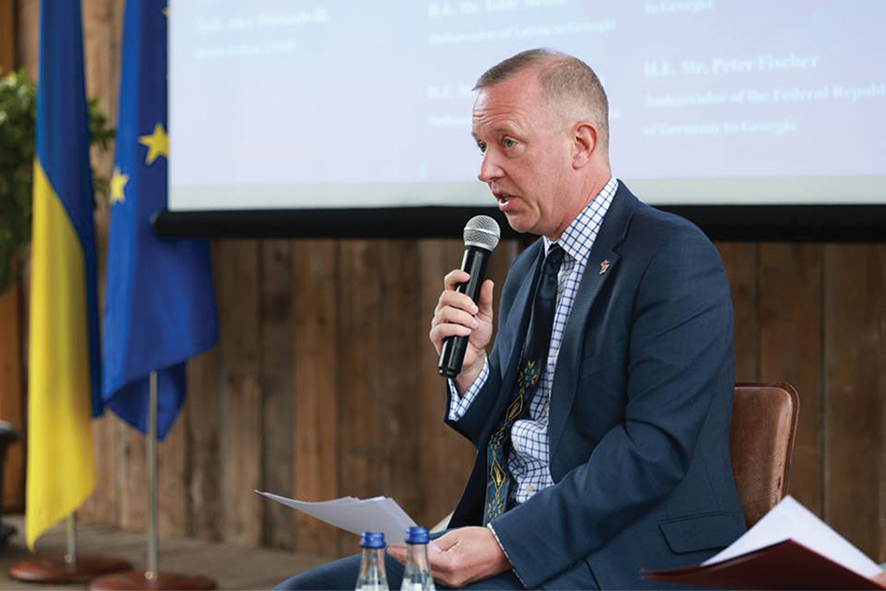
In response, the UK Ambassador to Georgia, Gareth Ward, was summoned to the Ministry of Foreign Affairs. Foreign Minister Maka Bochorishvili said the ambassador was called to explain the legal grounds for the sanctions, describing the decision as “astonishing.”
She stressed that sanctions affecting media outlets require a “very solid legal foundation” and criticized what she called the cynical targeting of Georgian television companies to weaken Russia.
Prime Minister Irakli Kobakhidze also weighed in, assuring that media freedom at both Imedi and POSTV would be fully protected. He said no journalist would face restrictions or disadvantages because of the sanctions, describing the measures as a formal violation of media freedom that would have no practical impact. Drawing parallels to 2007, when Imedi was forcibly shut down under the previous government, Kobakhidze emphasized that the current administration remains committed to protecting fundamental rights and the independence of the press.
The sanctions coincided with a major reshuffle at Imedi. On February 25, businessman Irakli Rukhadze and several supervisory board members submitted their resignations to Georgia’s Public Registry. Those stepping down included Rukhadze, chairman of the board, Giorgi Bakhtadze, Giorgi Kalandarishvili, deputy chairman, and Davit Shonia. Only Director General Maka Lomidze remains on the board. The resignations requested same-day processing, which the registry has not yet confirmed.
The board members cited a change in ownership as the reason for their departure. Rukhadze had announced on February 6 that he would exit ownership of the pro-government outlet, which he had controlled for years. Reports indicate that Imedi carried around 17 million lari in state debt and was sold for 1,000 lari.
Under the new ownership structure, Prime Media Global will hold 50% of Imedi, while Lomidze and her four deputies hold the remaining 50%. Prime Media Global is fully owned by Ilia Mikelashvili. Rukhadze transferred his intermediary company, Georgian Media Production Group LLC, through which he held full ownership, to the new group. Mikelashvili has held several public and private sector positions and previously sought membership in the Georgian National Communications Commission. Reports suggest that the agreement includes clauses defining editorial policy and restricting criticism of Rukhadze and his affiliates.
Rukhadze said stepping away from Imedi was a difficult but necessary decision, noting that television ownership no longer aligned with his business interests. He expressed confidence in the new management and wished the channel success. Mikelashvili said Prime Media Global intends to maintain Imedi’s editorial direction.
Imedi rejected the UK sanctions as politically motivated and lacking legitimacy. The broadcaster emphasized its 22-year history as a defender of freedom of speech in Georgia and recalled the 2007 storming of its offices, describing that period as a violation of democratic standards and media freedom. The channel reaffirmed its commitment to responsible journalism and serving the public.
By Team GT