
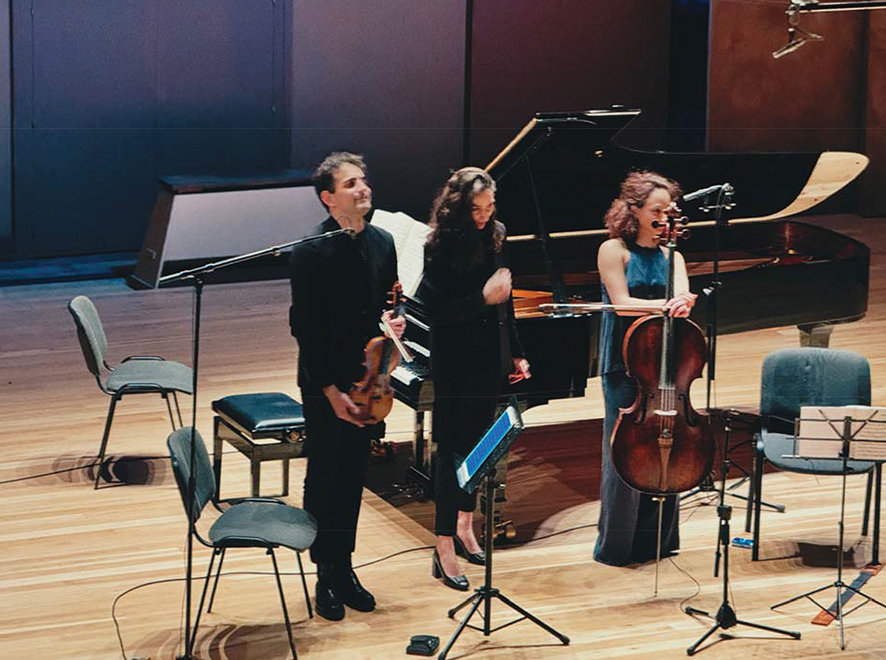
On a quiet Tuesday evening in early March, the Grand Concert Hall of the Tbilisi State Conservatoire gathered a small but attentive audience for an art form that has always existed somewhere between conversation and architecture: the piano trio. The program, Piano Trio No. 39 by Joseph Haydn and Piano Trio No. 1, Op. 8 by Johannes Brahms, promised a journey from the poised geometry of the Classical era to the turbulent emotional topography of early Romanticism.
Yet the deeper significance of the evening lay elsewhere: in the particular cultural ecosystem of Tbilisi, where chamber music continues to function as a kind of intellectual refuge: an intimate republic of listening in a city whose artistic life often oscillates between exuberant spectacle and fragile institutional survival.
At the center of the program stood the trio itself: violinist Elvin Hoxha Ganiyev, cellist Lizi Ramishvili, and pianist Irma Gigani. The constellation of nationalities—Azerbaijani, Albanian, Turkish, and Georgian—felt emblematic of the musical geography of the contemporary Caucasus, a region where artistic identities frequently spill across borders more fluidly than political ones.
Chamber music, by its very nature, rewards this kind of cultural hybridity. Unlike orchestral performance, which imposes hierarchy through the figure of the conductor, the piano trio operates as a miniature democracy. Every gesture must be negotiated. Every phrase becomes an argument, a compromise, a shared intuition.
Haydn’s Piano Trio No. 39, one of the luminous late works written in London in the 1790s, unfolds with a kind of refined conversational wit that feels almost architectural. The music builds structures rather than emotional storms. Its opening Allegro bursts forward with crisp rhythmic articulation, the piano carrying much of the thematic material while the violin and cello weave commentary around it like elegantly dressed interlocutors at an Enlightenment salon.
In performance, these classical balances demand extraordinary restraint. The temptation to romanticize Haydn, to inflate his elegance into drama, hovers constantly over modern interpretations. The trio resisted that temptation with admirable discipline. Gigani’s piano playing maintained a crystalline clarity, shaping phrases with an almost Mozartian lightness. Ramishvili’s cello provided the warm structural underpinning that Haydn’s writing quietly depends upon. Ganiyev, whose violin tone carries a youthful brightness, traced melodic lines with precision rather than theatrical flourish.
The Andante unfolded like a slow philosophical conversation, its lyrical phrases suspended in time. Here chamber music reveals its most essential quality: listening as a form of creation. One musician breathes; another answers. The silence between notes becomes part of the score.
Haydn’s final movement, a playful Allegro, delights in subtle rhythmic surprises, tiny musical jokes scattered across the texture. In the Conservatoire hall these gestures produced a sense of quiet delight, as though the eighteenth century itself had briefly entered the room with a polite smile.
If Haydn builds musical architecture, Brahms constructs emotional landscapes.
The First Piano Trio in B major, Op. 8 occupies a fascinating place in Brahms’s biography. Written when the composer was barely twenty and later radically revised decades afterward, the work contains within it two temporal selves: the passionate young composer intoxicated by Romantic ideals and the mature master who returned to the piece with ruthless editorial discipline.

The opening Allegro con brio emerges from the piano as a broad, lyrical horizon before expanding into sweeping thematic arcs. Brahms treats the trio almost symphonically, allowing dense harmonic textures to surge through the ensemble. Gigani approached these passages with an expansive sound that filled the hall without overwhelming her colleagues: a delicate balancing act in Brahms, where the piano part often threatens to dominate.
Ramishvili’s cello voice became the emotional axis of the ensemble, drawing long melodic lines with a dark, almost vocal warmth. Brahms adored the cello’s ability to speak in the register closest to the human voice, and in this performance the instrument indeed seemed to sing.
Ganiyev’s violin entered with flashes of brilliance, particularly in the scherzo-like passages where Brahms’s restless rhythmic energy erupts into sudden surges of motion. The trio’s collective phrasing allowed these dramatic contrasts to unfold organically rather than through exaggerated gestures.
The slow movement, perhaps the work’s emotional heart, hovered in a suspended atmosphere of introspection. Here Brahms writes music that seems to remember something it cannot fully articulate: a melody searching through harmonic shadows, fragments of memory circling each other like thoughts at the edge of consciousness.
By the time the finale arrived, the music had accumulated a sense of narrative inevitability. Brahms rarely writes triumphant endings. His finales often feel like philosophical resolutions: moments where tension transforms into something quieter, deeper, and more ambiguous.
In a time when much of the global music industry gravitates toward spectacle, the piano trio represents a radically different artistic model. Three musicians. No conductor. No technological amplification. The entire expressive universe distilled into the fragile chemistry of shared attention.
The concert offered exactly that: a reminder that chamber music remains one of the most sophisticated forms of human conversation ever invented. For ninety minutes in a hall on Griboedov street, Haydn’s Enlightenment elegance and Brahms’s Romantic introspection met in the hands of three musicians who transformed centuries of musical thought into living sound.
Review by Ivan Nechaev










