At Wagner’s 150th-anniversary festival, artificial intelligence was supposed to redefine opera. Instead, Bayreuth exposed something far more revealing: not the limitations of algorithms, but the limitations of the people who claimed to know how to use them.
The videos traveled around the world long before any serious critical assessment had time to appear. Footage of Bayreuth’s creative team receiving a storm of boos during the curtain calls quickly became one of the defining cultural images of the summer, accompanied by an irresistible headline: artificial intelligence had attempted to stage Wagner and failed spectacularly. It was a perfect media narrative.
Technology had challenged one of Europe’s most sacred cultural institutions, the audience had rejected it, and the experiment appeared to end as a cautionary tale about the dangers of replacing artists with machines.
Except that almost none of it was true.
Bayreuth audiences have never been gentle with innovation. Patrice Chéreau’s Centenary Ring was booed relentlessly before entering the history of opera as one of the twentieth century’s defining productions.
Frank Castorf experienced similar hostility. On the Green Hill, boos have often accompanied works that later became landmarks. They are not, by themselves, evidence of failure. What made this premiere unusual was not the intensity of the reaction but its object. The audience did not seem to be rejecting artistic radicalism. It was reacting to something far more unsettling: the feeling that behind all the technological promises there was remarkably little theatrical imagination.
Within hours, critics and commentators had already reached the easiest possible conclusion. Artificial intelligence had failed.
No. Artificial intelligence was never given the opportunity to succeed.
The official Bayreuth program quietly tells a very different story. The production was conceived by curator Marcus Lobbes, developed through the artistic and technical concept of Marcus Lobbes and Nils Corte, with dramaturgy by Andri Hardmeier, Digital and AI Storytelling by Roman Senkl, and Creative Code and Visual Art by Nils Corte together with Phil Hagen Jungschlaeger. Those credits matter because they locate responsibility exactly where it belongs. Artificial intelligence did not direct this Ring. Human beings did.
That distinction has almost disappeared from the public conversation. Newspapers continue to describe this as “the AI Ring,” as though an autonomous machine had suddenly assumed the role traditionally occupied by Wieland Wagner, Patrice Chéreau, Harry Kupfer, or Frank Castorf. Nothing could be further from reality. Artificial intelligence made none of the decisions that actually constitute directing. It did not determine how characters relate to one another. It did not shape dramatic rhythm. It did not construct movement, define psychological space, or decide when silence should become meaningful. Those decisions remained entirely human.
In that sense, the prompt engineer, whether presented under the more elegant titles of AI storyteller, creative coder, or digital artist, became one of the evening’s actual directors. Directing has never been about the tools themselves. It is about deciding which tools deserve to exist on stage and which should remain invisible. Every omission is as important as every addition. Every artistic limitation imposed upon the technology ultimately became part of the production’s aesthetic. Unfortunately, the limitations proved more memorable than the possibilities.
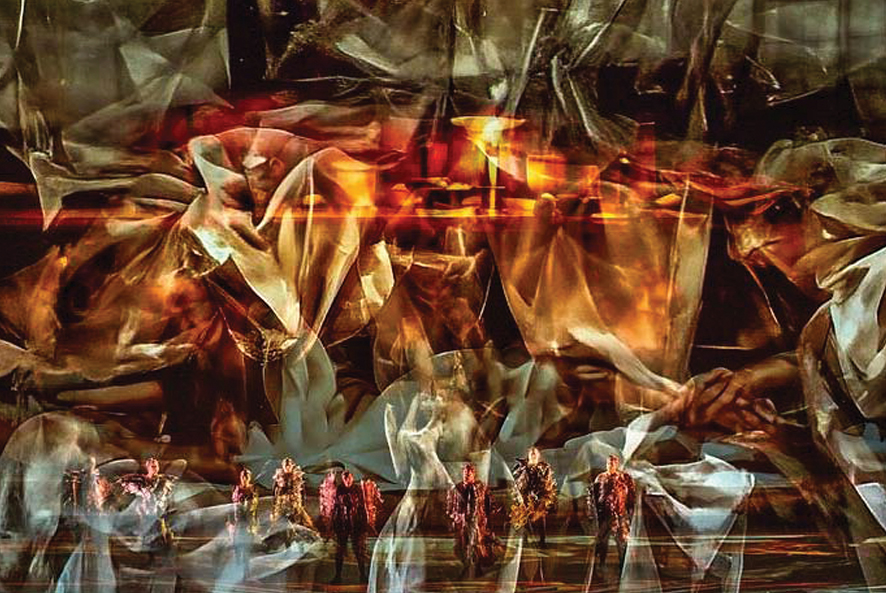
Throughout much of the cycle, singers appeared stranded inside a concept that had surprisingly little interest in directing them. Wagner’s dramas depend upon relationships: power negotiated through gesture, silence loaded with history, physical distance carrying emotional meaning long before a word is sung. Instead, performers frequently found themselves standing almost motionless while projected imagery assumed responsibility for visual storytelling. One could hardly avoid asking a rather uncomfortable question: was this genuinely a new stage production, or had Bayreuth quietly transformed one of opera’s greatest tetralogies into a concert performance accompanied by an elaborate video installation?
That question matters because Bayreuth is not simply another opera house. It represents one of the world’s great cultural pilgrimages. Audiences wait years for tickets, travel across continents, organize vacations around performances, and invest not only considerable sums of money but also immense emotional expectations. They come to witness theater, not merely to hear extraordinary music accompanied by digital projections. When staging contributes so little to the dramatic experience, the distinction between a fully realized production and a semi-staged concert ceases to be theoretical. It becomes part of the audience’s contract with the institution itself.
Ironically, the concept behind the anniversary could hardly have been more compelling. Few cultural institutions possess an archive comparable to Bayreuth’s. One hundred and fifty years of productions have generated an unparalleled accumulation of photographs, stage designs, costume sketches, rehearsal materials, prompt books, reviews, musicological studies, recordings, and visual traditions. If there is any opera house capable of treating artificial intelligence not simply as a visual tool but as an intellectual collaborator, it is Bayreuth. Yet that extraordinary archive remained largely untouched as an analytical resource.
Instead, artificial intelligence was assigned perhaps the least interesting task imaginable. It was asked to produce images. Even more surprisingly, the production embraced many of the visual imperfections that have become synonymous with generative AI itself. Distorted anatomy, hyperreal flowers, unstable textures, impossible objects and the familiar dreamlike smoothness of algorithmically generated imagery were elevated into an aesthetic language. Yet these are not artistic discoveries. They are technical imperfections. Treating software limitations as visual style does not suddenly transform them into profound artistic statements. It merely reveals that the creators confused glitches with originality.
There is a certain irony in watching one of the most sophisticated analytical technologies humanity has developed reduced to reproducing the very mistakes that made it an internet meme. Artificial intelligence became artificial decoration. The machine was handed a paintbrush when it might have been given an archive.
The suspicion inevitably arises that the project became more concerned with copyright than curiosity.
That concern is understandable. Every institution experimenting with generative AI must navigate complicated legal questions surrounding authorship and intellectual property. But once the fear of reproducing existing artistic material becomes greater than the desire to discover genuinely new relationships, technology ceases to function as a creative partner and becomes little more than a carefully restrained illustration tool. Bayreuth did not ask artificial intelligence to investigate Wagner’s world. It asked it to avoid legal risk.
The consequences became painfully obvious in the visual conception itself. The now-infamous feathered costumes, which quickly became objects of ridicule online, were widely blamed on artificial intelligence.
Yet no algorithm wandered unaccompanied into the costume workshop. Human designers conceived them, approved them, and placed internationally celebrated singers inside them. Once again, responsibility quietly migrated away from identifiable authors toward a convenient technological scapegoat. The machine accepted criticism for decisions it never actually made.
What made the evening genuinely frustrating was the extraordinary artistic achievement unfolding only a few meters below the stage. Christian Thielemann once again demonstrated why many Wagnerians speak almost affectionately of “Thielemannism” as though it were a distinct interpretative philosophy. Rather than pursuing monumentality for its own sake, he revealed the astonishing elasticity hidden inside Wagner’s architecture. His celebrated pianissimi never function merely as moments of quietness; they become reservoirs of dramatic tension. Inner orchestral voices emerge with remarkable transparency before disappearing naturally back into the orchestral fabric, allowing leitmotifs to breathe rather than announcing them as intellectual signposts. Time itself seems to expand under his baton.
The Bayreuth Festival Orchestra responded with extraordinary refinement. Wagner’s immense musical structures unfolded organically, each climax earning its arrival through patience rather than sheer volume. It was precisely the kind of deeply intelligent musicianship that the stage itself so often seemed unwilling to match.
The cast deserved equally high praise. Michael Volle’s Wotan and Wanderer combined authority with remarkable psychological subtlety. Klaus Florian Vogt once again demonstrated the luminous, unmistakably individual vocal sound that has made him one of today’s defining Heldentenors. Camilla Nylund brought dignity and emotional depth to Brünnhilde, while Elza van den Heever created a Sieglinde of extraordinary sincerity. Jochen Schmeckenbecher, Christa Mayer, Mika Kares, and the rest of this exceptional ensemble repeatedly reminded the audience what Wagner’s theater can achieve when entrusted to artists of the highest caliber. Which only made the surrounding emptiness more conspicuous.
How does one assemble musicians capable of creating drama at this level, only to leave them with so little drama to inhabit?
The disappointment becomes even greater because the production repeatedly hints at a far more fascinating project that never quite materializes. Imagine, for a moment, that Bayreuth had approached artificial intelligence not as a visual effect but as an intellectual collaborator. The anniversary Ring could have become one of the most ambitious digital humanities projects ever attempted by an opera house.
Few institutions anywhere in the world possess an archive capable of sustaining such an experiment. Bayreuth is not merely a theater; it is the accumulated memory of Wagner performance itself. Every production leaves behind photographs, sketches, rehearsal notes, stage diagrams, critical debates, audience reactions, and visual languages that continue to influence generations of directors.
Artificial intelligence is uniquely suited to working with precisely this kind of material. Its greatest strength is not image generation but pattern recognition. It can compare thousands of documents simultaneously, discover relationships invisible to individual researchers, connect ideas separated by decades, and reveal historical continuities that would otherwise remain buried inside archives. That, ultimately, is what intelligence means: not the ability to imitate, but the ability to discover.

Imagine AI tracing how individual leitmotifs gradually acquired visual identities across a century and a half of Bayreuth productions. Imagine comparing Wieland Wagner’s radical minimalism with Patrice Chéreau’s industrial mythology, Harry Kupfer’s psychological realism, Frank Castorf’s political deconstruction, and countless other interpretations, revealing unexpected artistic genealogies between productions separated by generations. Imagine allowing the audience to watch Wagner’s theatrical language evolve rather than simply surrounding singers with digitally generated scenery. Instead of illustrating Wagner, artificial intelligence could have illuminated him.
That intellectual ambition could have extended far beyond the stage. The anniversary itself might have become an immersive digital ecosystem. Visitors could have explored interactive installations before performances, navigating one hundred and fifty years of Bayreuth history through intelligent systems capable of answering questions, comparing productions, reconstructing lost stagings, or visualizing the evolution of Wagnerian symbolism. Instead of listening passively to introductory talks or browsing static exhibitions, audiences could have engaged directly with one of the richest theatrical archives ever assembled.
Young visitors, in particular, might have encountered Wagner through exploration rather than instruction. Artificial intelligence offers cultural institutions a rare opportunity to transform education into participation. Rather than explaining opera to new audiences, it allows audiences to investigate opera for themselves. That difference is enormous. Curiosity lasts longer than information.
The anniversary publication represented another remarkable missed opportunity. Instead of reproducing low-resolution AI-generated imagery, Bayreuth could have documented the experiment itself. Which archives were digitized? Which historical materials entered the system? Which questions were posed? Which unexpected discoveries emerged? How did programmers, dramaturgs, historians, musicologists, and artists collaborate? Such a publication would have become something far more valuable than another commemorative catalog. It would have stood as one of the first serious documents examining how artificial intelligence might reshape the preservation and interpretation of cultural heritage. This, perhaps, is where the broader conversation truly begins.
The question is no longer whether artificial intelligence belongs inside cultural institutions. It already does. Museums, libraries, festivals, orchestras, universities, and theaters across Europe are beginning to explore what these technologies might contribute to scholarship, preservation, education, and artistic creation. The real question is considerably more demanding: will institutions use AI to deepen their understanding of culture, or simply to make culture appear more technologically fashionable?
Bayreuth’s anniversary suggests an answer that is both disappointing and instructive. Technology does not compensate for intellectual uncertainty. It amplifies it. If the artistic concept is profound, artificial intelligence can extend it in extraordinary directions. If the concept itself remains superficial, AI merely produces superficiality more efficiently. The quality of the outcome ultimately reflects not the sophistication of the software but the sophistication of the people guiding it.
That lesson extends well beyond Germany. Countries increasingly investing in cultural tourism face exactly the same challenge. Georgia, for example, has spent the past decade transforming festivals into an essential part of its international identity. Events such as the Tsinandali Festival, the Tbilisi International Theater Festival, the Tbilisi Piano Festival, and major productions at the Tbilisi Opera and Ballet Theater are no longer simply performances; they are reasons for international audiences to visit the country. As cultural institutions begin experimenting with artificial intelligence, Bayreuth offers an important reminder.
Technology alone will never become the attraction. Visitors travel for ideas, for artistic vision, and for experiences they cannot find elsewhere. AI can strengthen that vision, but it cannot replace it. In the end, the competitive advantage will belong not to the institution with the most sophisticated algorithms, but to the one asking the most intelligent questions.
There is a deeper irony here. Richard Wagner dreamed of the Gesamtkunstwerk: the total work of art in which music, poetry, architecture, philosophy, visual design, and the newest technologies available to his generation would merge into a single artistic experience. He was never afraid of technological innovation; he demanded it whenever it served artistic necessity. Artificial intelligence could one day become another participant in that vision; not replacing artists, but expanding the ways in which art can be understood, researched, remembered, and experienced.
Bayreuth’s anniversary Ring will almost certainly be remembered as “the AI Ring.” It deserves a more accurate title. It was not the AI Ring. It was Marcus Lobbes’ Ring. It was Nils Corte’s Ring. It was Roman Senkl’s Ring. It was Andri Hardmeier’s Ring. Artificial intelligence did not assume authorship; these people did. Every major artistic decision, from the dramatic concept to the visual language, from the role assigned to technology to the role denied to the singers, remained unmistakably human.
That is why the conversation after Bayreuth should not be about whether artificial intelligence can direct opera. It should be about whether we are finally prepared to admit that, even in the age of algorithms, artistic responsibility still belongs to artists. Artificial intelligence never directed Wagner’s Ring. Marcus Lobbes, Nils Corte, Roman Senkl, Andri Hardmeier, and the creative team that built this concept, did.
History should remember the distinction.
Review by Ivan Nechaev