There are moments in theater when a premiere feels less like the addition of a new production to a repertoire and more like the reopening of a metaphysical wound. The arrival of The Eccentrics at Gabriadze Theater belongs precisely to that category. After many years without a new major production, the theater founded by Rezo Gabriadze returns with a performance that is simultaneously an adaptation, an inheritance ritual, a philosophical parable, and a coded reflection on contemporary existence.
Directed by Leo Gabriadze and based on one of Rezo Gabriadze’s most beloved texts, The Eccentrics, emerges as a story about impossible flight in a civilization weighed down by memory, debt, prisons, madness, and gravity itself. Or, as the production’s subtitle almost mischievously proposes: a story of love, debts, and the Second Law of Thermodynamics.
That final phrase initially sounds like one of Gabriadze’s classic absurdist jokes. By the end of the performance, it lands with devastating philosophical precision.
The Physics of Georgian Sadness
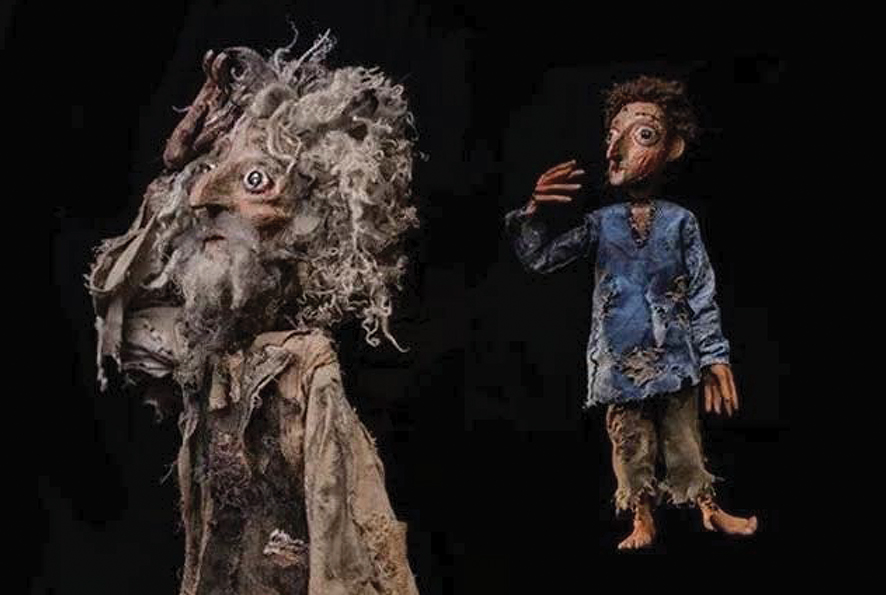
The plot appears deceptively simple. Ertaoz, a naïve provincial dreamer, leaves home searching for destiny. Instead, he finds prison. There he encounters Christephore, an aging scientist incarcerated because of a failed love affair. Between walls designed to suppress imagination, the two men begin constructing an impossible machine capable of carrying them beyond earthly limitations.
In another theatrical universe, this premise could become whimsical steampunk fantasy or sentimental comedy. Inside the Gabriadze cosmology, however, flight acquires spiritual dimensions. Everything in the production resists the heaviness of the earth.
Prisons. Debts. Failed love. Bureaucracy. Madness. Mortality. History itself. Gravity becomes psychological before it becomes physical. The flying machine at the center of the play therefore functions as something much larger than an invention. It becomes a rebellion against entropy. Leo Gabriadze explicitly frames the production through thermodynamics, invoking the formula: \frac{ds}{dt}=0.
In physics, entropy measures disorder, the irreversible movement toward equilibrium and stillness. In The Eccentrics, that scientific principle transforms into metaphysical theater. The formula ceases to describe thermodynamic systems and begins describing exhausted civilizations.
The characters seek a state beyond struggle itself. A release from accumulated emotional weight. A transcendence of historical exhaustion. What is remarkable is how organically Gabriadze fuses scientific vocabulary with Georgian poetic fatalism. Soviet culture long cultivated faith in technological utopia. Gabriadze instead transforms science into melancholy folklore. The laboratory and the fairy tale coexist without contradiction.
The result feels uniquely Georgian: metaphysics expressed through broken machinery.
Eccentricity as Moral Resistance
Leo Gabriadze’s director’s note contains the key to the production: “An eccentric, in our case, is anyone who, despite society’s disapproval, believes to the very end in their own unconventional ideas.” This definition suddenly feels alarmingly contemporary.
Today’s world increasingly punishes eccentricity. Algorithmic culture rewards predictability. Political systems reward obedience. Digital life rewards flattening. Public discourse has become dominated by nervous conformity masquerading as rationality. In such conditions, the Gabriadze eccentric ceases to be comic decoration and becomes an ethical archetype. The eccentrics are the final defenders of imagination. And imagination, in this production, is treated as a survival mechanism.
Throughout the performance, society appears divided between prisons and madhouses. Some characters are literally incarcerated. Others move through reality in states of collective delirium. The distinction barely matters. Institutions designed to maintain order seem indistinguishable from systems of psychological collapse. Against this landscape, Ertaoz and Christephore’s absurd dream of flight becomes strangely rational. Why remain on earth if the earth itself has become uninhabitable?
The production never turns this into direct political allegory, yet contemporary resonances emerge almost unbearably clearly. One watches The Eccentrics in 2026 with the uncomfortable sensation that Gabriadze somehow anticipated an age defined by mass exhaustion, informational psychosis, emotional fragmentation, and permanent societal claustrophobia.
Half the world imprisoned. Half the world mad. And somewhere between them, a handful of eccentrics attempting to build wings.
Beyond the Myth of the Film
For many spectators, The Eccentrics remains inseparable from the legendary 1973 film adaptation directed by Eldar Shengelaia, with music by Giya Kancheli. That film occupies near-sacred status within Georgian cultural memory. Its atmosphere, drifting between tragedy and intoxicated comedy, became foundational to how Georgian melancholy is aesthetically imagined. Leo Gabriadze makes a bold decision: he refuses to reproduce the cinematic spell.
The production uses very little Kancheli. Instead, it returns insistently to the textual architecture of Rezo Gabriadze’s play itself. This shifts the emotional balance dramatically. Without the lush orchestral melancholy associated with the film, the audience encounters the writing almost naked. And the writing turns out to be harsher than memory allows.
It leaves the audience with the realization that perhaps civilization survives only because a few ridiculous, naïve, impractical people continue believing that another sky remains possible
The theatrical version reveals how much violence, loneliness, absurdity, and metaphysical terror always existed beneath Gabriadze’s humor. The laughter acquires sharp edges. The lyricism becomes skeletal. Certain scenes approach Beckettian despair before suddenly collapsing into provincial absurdity.
This is perhaps the production’s greatest triumph: it rescues The Eccentrics from nostalgia. Rather than embalming the text as a national treasure, Leo Gabriadze reactivates its danger.
The Civilization of the Qvevri
Among the production’s most unforgettable visual ideas is the recurring use of the qvevri, the massive Georgian clay wine vessels buried underground for fermentation.
Few images could better encapsulate Georgian civilization. Wine in Georgia has never functioned merely as drink. The qvevri represents ancestry, ritual, burial, intoxication, memory, hospitality, and continuity with the earth itself. UNESCO recognizes qvevri winemaking as intangible cultural heritage precisely because the vessels operate almost as philosophical objects. Leo Gabriadze transforms them into existential symbols.
People hide inside them. Sit inside them. Suffer inside them. Die inside them. The qvevri becomes prison, womb, coffin, archive, nation. The image resonates with terrifying beauty because it compresses the entire Georgian historical condition into a single object: a culture endlessly burying sorrow underground while fermenting beauty from the same darkness. At moments, the stage resembles an archaeological excavation of collective memory. At others, it feels like a cemetery preserving unfinished dreams in clay.
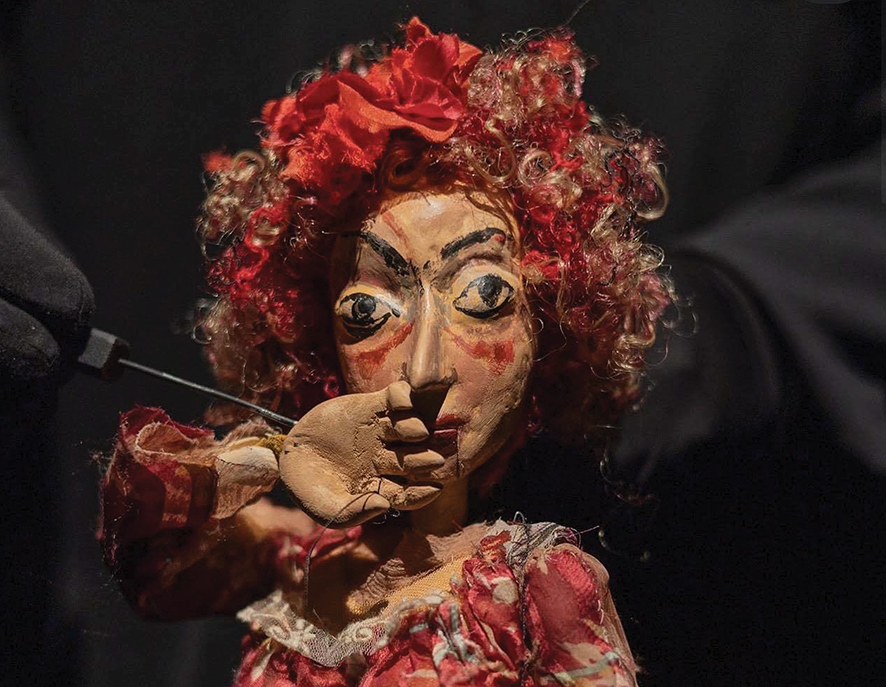
The metaphor never becomes decorative intellectualism because Gabriadze’s Theater has always understood something fundamental: objects possess souls. Chairs think. Teacups mourn. Trains remember. Puppets suffer. Clay vessels absorb centuries. Matter itself carries trauma.
Puppets, Inheritance, and the Theater After Rezo
Every production now staged at Gabriadze Theater inevitably carries another invisible narrative beneath the visible one: the question of what happens after Rezo Gabriadze. Can a theater survive the death of its creator without becoming a museum? Can inheritance remain alive rather than ceremonial?
The Eccentrics answers this question with unusual intelligence because Leo Gabriadze does not attempt perfect imitation. Instead, he stages inheritance itself as instability.
The production repeatedly returns to debts passed from one generation to another. Emotional debts. Moral debts. Historical debts. Unfinished obligations. In this sense, Leo’s position becomes almost painfully autobiographical. The son inherits not merely a theater, but responsibility for an entire emotional universe beloved by audiences across generations.
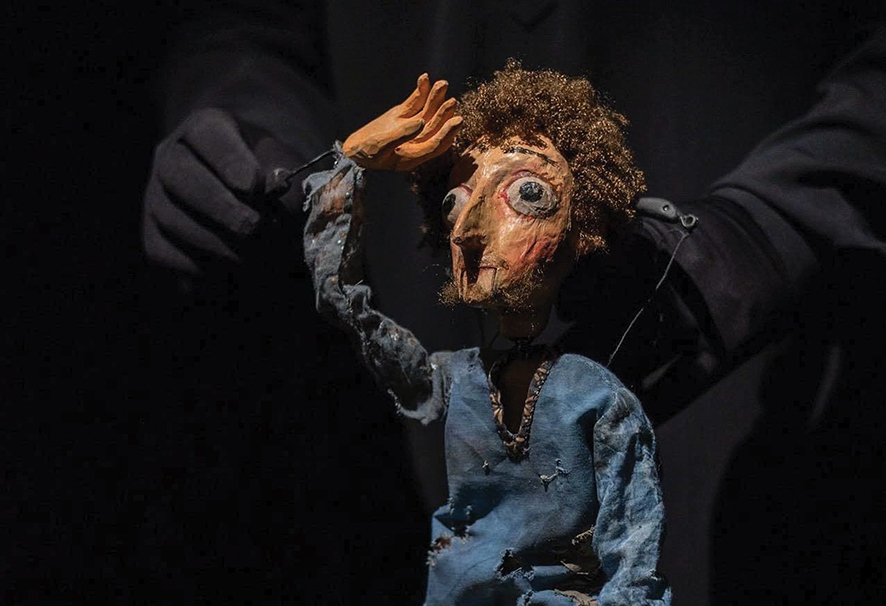
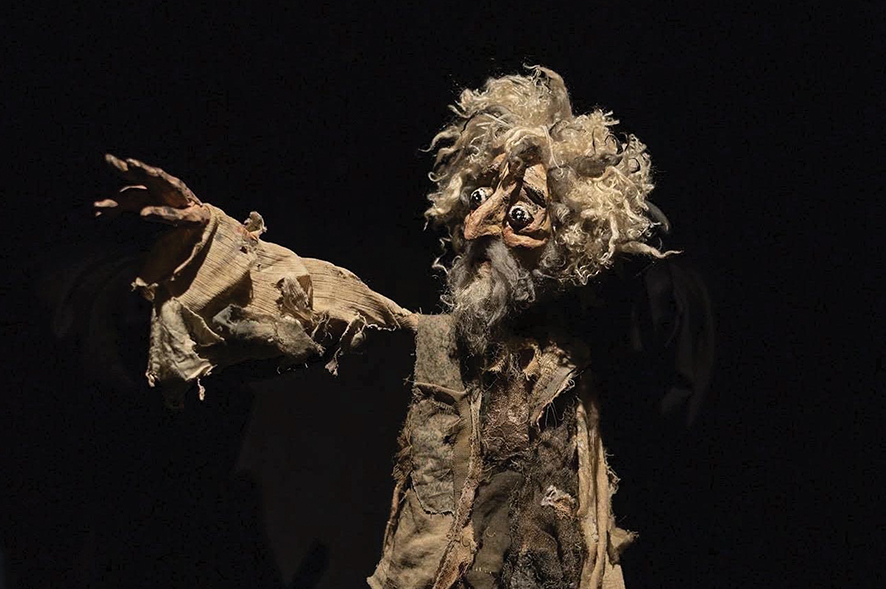
And so the production quietly becomes a performance about continuation itself. The puppets and sets, created in the theater workshops according to Rezo Gabriadze’s original sketches, carry extraordinary symbolic weight. They do not function as nostalgic relics. They appear instead like fragments of an unfinished cosmology still attempting to move.
The ensemble of animators and puppet masters performs something larger than technical craft. They become custodians of fragile emotional mechanics. Every movement feels haunted by memory and yet stubbornly alive. That tension gives the production its emotional electricity.
One constantly senses two simultaneous presences: the father’s world, and the son learning how to breathe inside it.
The Last Humanists
By the final scenes, when Ertaoz and Christephore pass through prison, madhouse, debt, failed love, and earthly humiliation before finally ascending skyward, The Eccentrics arrives at something unexpectedly moving.
The production proposes that eccentricity itself may be humanity’s final moral resource. Not intelligence. Not ideology. Not efficiency. Not power. Only the stubborn refusal to surrender imagination.
Gabriadze’s eccentrics build impossible machines because reality without impossible dreams becomes spiritually uninhabitable. Their flight therefore matters less as physical escape than as metaphysical resistance.
The performance leaves the audience with a strange and painful realization: perhaps civilization survives only because a few ridiculous, naïve, impractical people continue believing that another sky remains possible.
Inside contemporary culture, exhausted by cynicism, optimization, and permanent anxiety, that belief suddenly feels revolutionary. And in that sense, Leo Gabriadze’s premiere accomplishes something exceedingly rare. It does not merely preserve the Gabriadze legacy. It proves that the legacy can still fly.
By Ivan Nechaev