The Russian missile and drone attack that damaged the historic Kyiv Pechersk Lavra during a massive overnight assault on Ukraine on June 15 prompted strong reactions from Ukrainian officials, international organizations, and religious leaders, who described the strike as an attack on a site of global cultural and spiritual significance.
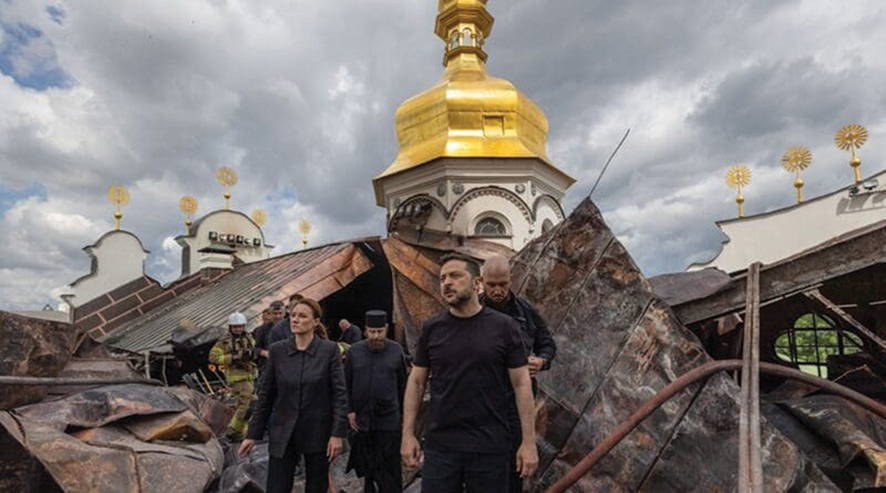
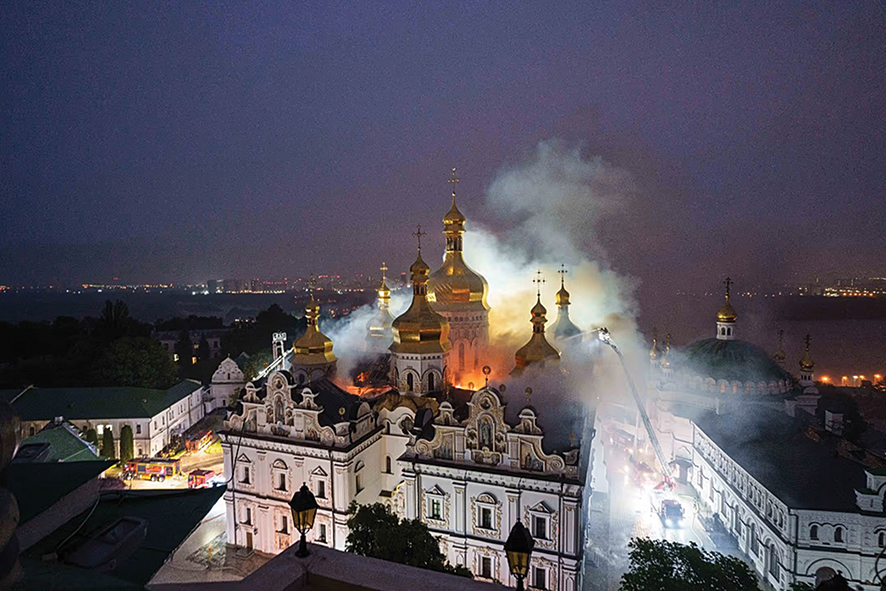
According to Ukrainian authorities, the attack sparked a fire at the Dormition Cathedral within the monastery complex. Emergency crews later extinguished the blaze, but reports indicated that both the exterior and interior of the cathedral suffered significant damage. Adjacent historic structures, including sections of the Lavra’s fortification complex and the Ivan Kushnik Tower, were also reportedly affected.
The strike formed part of a wider Russian assault in which, according to President Volodymyr Zelensky, Moscow launched 70 missiles and 611 drones against targets across Ukraine. Preliminary reports indicated that four people were killed and 28 injured in Kyiv alone.
Founded in the 11th century, the Kyiv Pechersk Lavra, also known as the Monastery of the Caves, is one of Eastern Orthodoxy’s most revered spiritual centers and a symbol of Ukrainian religious and cultural identity. Together with Saint Sophia Cathedral, it forms part of a UNESCO World Heritage Site.
Zelensky described the strike as “an attack on the Christian community and humanity’s cultural heritage,” adding that it represented “one of the most serious crimes committed by Russia against Christian culture to date.”
Ukraine’s Foreign Minister Andrii Sybiha issued an equally forceful response: “By striking the Kyiv Pechersk Lavra, one of the greatest holy sites of Christianity, Putin has forever put his name on the list of history’s worst barbarians,” Sybiha wrote on social media. “Only Russian scum who have nothing sacred can deliberately damage the Kyiv Pechersk Lavra, a unique UNESCO heritage site under special protection.”
UNESCO subsequently condemned the strike, saying it stood ready to assist Ukrainian authorities in assessing the damage and identifying urgent protective measures.
The wording of UNESCO’s initial statement, however, drew criticism from Ukraine’s Foreign Ministry, which argued that the organization had failed to explicitly state that Russia was responsible for the attack.
Foreign Ministry spokesperson Heorhii Tykhyi described the omission as “absurd.”
The strike also prompted reactions from abroad. Ecumenical Patriarch Bartholomew I condemned what he called a “barbaric and destructive attack” on a site that forms part of Christianity’s shared heritage. French Foreign Minister Jean-Noël Barrot compared the strike to “a bombing of Notre Dame,” while French President Emmanuel Macron wrote that nothing could justify an attack on “our shared universal heritage.”
EU foreign policy chief Kaja Kallas condemned the attack on Ukrainian civilians and the centuries-old Kyiv Pechersk Lavra, describing the strike as a war crime and stating that “Russia will have to answer for it.”
Russian authorities, however, rejected responsibility. State media cited the Russian Defense Ministry as claiming that the Lavra was struck by a US-supplied Patriot air defense missile, which it alleged had malfunctioned or been part of a batch of expired missiles provided to Ukraine by Western countries.
Archimandrite Avraamiy, vicar of the Kyiv-Pechersk Lavra, told RFE/RL hours after the attack that the strike was “yet another act of Russian barbarism” and showed that “nothing is sacred to them.”
“The feeling was as if an enemy bullet had hit you straight in the heart,” he added.
By Team GT