There is a particular kind of exhibition text that promises “dialogue” and “synchronicity” and “immersive environments,” the familiar soft rhetoric of contemporary curating. Catalogue of Sensory Data, the collaborative exhibition by Nata Varazi and Gvantsa Jishkariani at The Why Not Gallery, begins there, and then, somewhat unexpectedly, delivers on it. The surprise lies in the material fact of the work: Felt. Wool. Fiber. A medium historically coded as domestic, minor, peripheral, here expands into a total environment that feels like an atmosphere one moves through, inhales, brushes against.

The first encounter is spatial rather than conceptual. Suspended forms, spiked, star-like, vaguely vegetal or perhaps microbial, hover in midair, their saturated reds, ochres, and bruised violets absorbing and diffusing light. They read as both decorative and faintly threatening, soft sculptures that retain the memory of touch even when untouched. Their tactility is not incidental; it is the primary language. The surfaces are visibly worked, compressed, agitated into density. This is insistence: matter shaped through repetition, pressure, time.

Behind and around them, the wall-based works unfold a parallel narrative. A large textile composition, dominated by a white deer-like figure, elongated and almost spectral, evokes a symbolic lexicon that feels at once folkloric and estranged. If Varazi’s contribution leans toward the surreal and the oneiric, Jishkariani’s presence is felt in the friction between image and context. Her long-standing engagement with post-Soviet visual culture, its propaganda aesthetics, its ornamental excess, its uneasy humor, surfaces here in a softened, almost disarmed form. The usual irony is muted, or perhaps metabolized into material. Felt absorbs critique; it slows it down, renders it tactile, almost tender.

What binds the exhibition is not simply thematic overlap, identity, memory, inner experience, but a shared commitment to what might be called affective indexing. The “catalogue” of the title is not taxonomic in any strict sense. There is no system here, no clear classification. Instead, the works function as entries in a loose, unstable archive of sensation: longing, vulnerability, a kind of ambient melancholy that resists narrative closure.
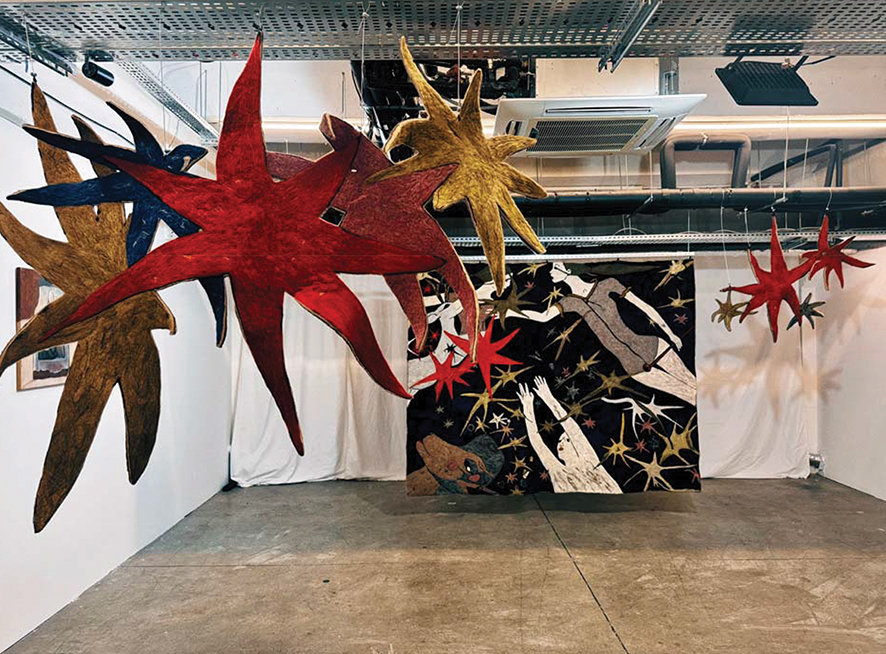
This is where the exhibition’s strength becomes most apparent. Rather than staging trauma or identity as spectacle, a tendency visible in much contemporary practice emerging from post-Soviet contexts, Catalogue of Sensory Data turns inward, privileging states that are difficult to articulate and therefore often dismissed. The softness of the material becomes a conceptual strategy. It refuses the hardness of declaration, the clarity of political messaging, without retreating into apolitical abstraction.

The Why Not Gallery’s collaboration with Fabrika Project Space frames this exhibition as a beginning. It feels appropriately provisional. Catalogue of Sensory Data does not resolve into a statement; it accumulates. It lingers as a sensation carried out of the space, something half-formed and persistent, like the afterimage of color when the eyes close. In this sense, the exhibition succeeds most where it is least declarative. It does not tell us what to feel. It constructs the conditions under which feeling, ambiguous, layered, unresolved, becomes newly legible.
Review by Ivan Nechaev