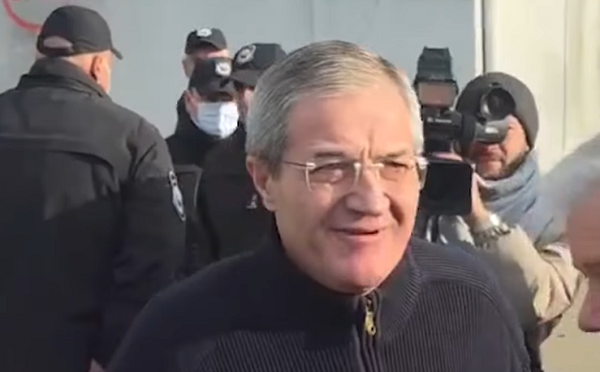
Opposition politician Givi Targamadze has been released from Rustavi Penitentiary No. 12 after serving a seven-month prison sentence.
Speaking to reporters after leaving the penitentiary, Targamadze said he regretted his own release while others remain behind bars.
“First of all, of course, I am sorry for the fact that I was released and so many people remain in prisons. I would be really happy if I were the last to be released, after them. Unfortunately, we can’t stop this,” he said.
Targamadze wished good health, courage, and endurance to those still imprisoned, noting that they have long demonstrated their resilience. He expressed hope that “in the end, everything will be fine.”
He also thanked those who supported him during his imprisonment, with special words for his family.
“I want to express my gratitude to those people who have been cheering us on these months, and especially my family. My wife and children are real fighting girls, but it would have been much harder for them without you. For that, I am very grateful. I love you all,” Targamadze said.
Targamadze was arrested on June 27, 2025, after voluntarily reporting to the Vake–Saburtalo Police Station following a court decision ordering his detention.
The court found him guilty of failing to comply with a request from a temporary parliamentary investigative commission. By the ruling of Judge Nino Galustashvili, he was sentenced to seven months’ imprisonment and banned from holding public office for two years.
Targamadze did not attend the court hearing and was therefore unable to deliver a final statement. He had been summoned to Parliament on April 3 to provide explanations to the temporary investigative commission but failed to appear. Criminal charges were subsequently brought against him.
Prior to his detention, the court imposed a preventive measure of 10,000 GEL in bail, which he paid within the timeframe prescribed by law. He was charged under Article 349 of the Criminal Code of Georgia, which concerns failure to comply with the request of a temporary investigative commission of Parliament. The offence is punishable by a fine, imprisonment of up to one year, or deprivation of the right to hold office or engage in certain activities for up to three years.
Image: GHN