Georgia’s Ministry of Economy and Sustainable Development has issued a statement clarifying the purpose behind the creation of a restricted airspace zone near the Abastumani Observatory, dismissing circulating claims as “deliberately misleading, incorrect, and unverified.”
Ministry says the planned changes form part of a broader update of navigation data within Georgia’s airspace and do not represent any significant deviation from established practices. Officials emphasized that the adjustments are fully aligned with both national interests and international aviation standards, and remain compatible with the principles of Free Route Airspace (FRA). The introduction of such restricted zones, the statement noted, is a widely accepted and common mechanism in global aviation practice.
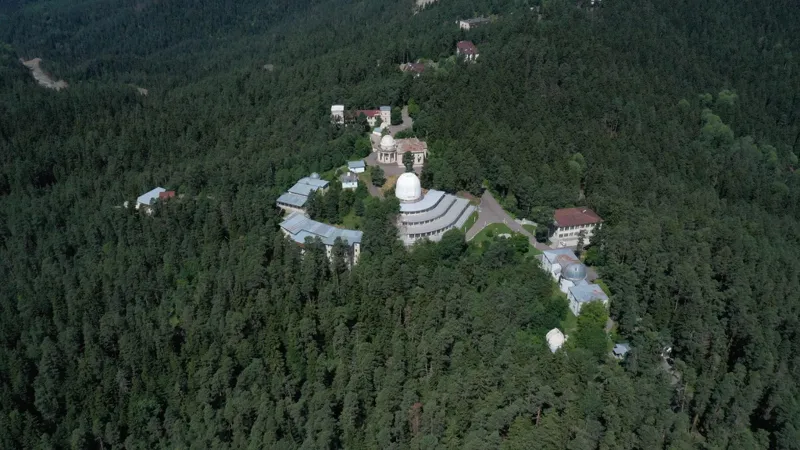
The Ministry explained that the initiative originated several years ago from the Abastumani Observatory itself. In formal submissions to the authorities, scientists outlined concerns that heavy air traffic and aircraft condensation trails negatively impact the area’s astroclimate and the quality of astronomical observations. The decision to introduce the restricted zone, the Ministry said, is primarily aimed at supporting the observatory’s scientific development by ensuring appropriate environmental conditions, while maintaining full compliance with flight safety standards.
At the same time, officials stressed that the changes do not involve the cancellation of international air routes. Existing parameters for safe and efficient air traffic management remain fully intact, and there is no basis to suggest that the measure will affect airline operations or the use of Georgian airspace.
The restrictions will apply only to high-altitude flights conducted under instrument flight rules (IFR), where condensation trails may form. Low-altitude visual flights (VFR) will not be subject to the new limitations.
Beyond its scientific significance, the Ministry also highlighted the potential positive impact on tourism. Strengthening environmental conditions around Abastumani is expected to enhance the resort’s attractiveness on the global tourism map. The area is already recognized as one of Georgia’s notable resorts, combining natural and therapeutic resources in a unique setting.
With its clean air, pine forests, mineral waters, and proximity to the Borjomi-Kharagauli National Park, Abastumani is increasingly aligned with global demand for environmentally pristine and health-oriented destinations. The Ministry noted that the resort’s climate-balneological potential further elevates its value as both a healing and recreational tourism hub.
The sustainable development of Abastumani remains a national priority, with strategic planning processes currently underway to ensure its long-term, balanced, and competitive growth, the Ministry claimed.
In conclusion, the Ministry underscored that the introduction of the restricted zone is intended to simultaneously support scientific research and tourism development, without hindering the evolution of Georgia’s airspace. It added that, together with “Sakaeronavigatsia,” ongoing efforts will continue to focus on ensuring safe, efficient, and modern airspace management in line with international standards.
Header image: Abastumani resort
Related story: Kaladze defends new “Abastumani-2” no-fly zone, cites observatory scientists’ concerns