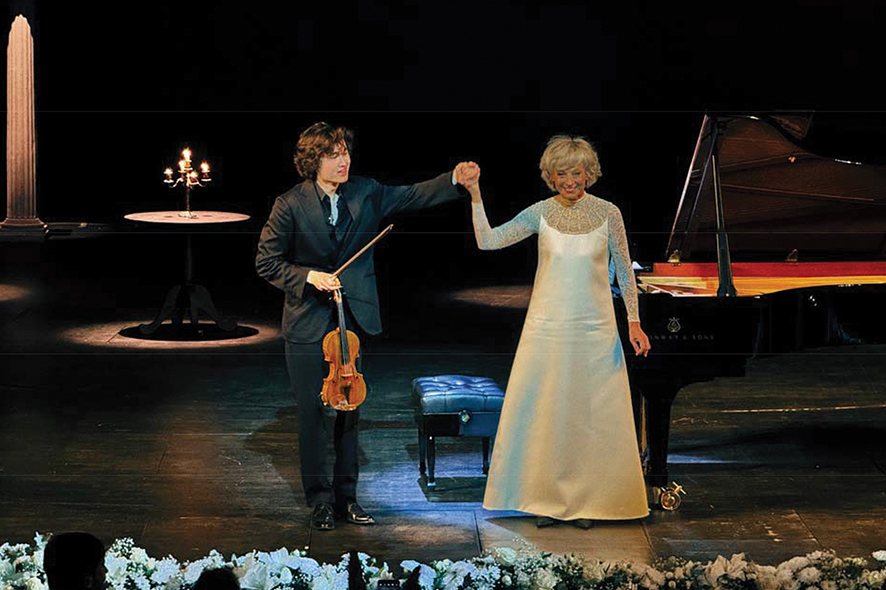
The first evening of the International Festival Classical Concerts in Batumi 2026, at the Ilia Chavchavadze State Drama Theater, unfolded as a study in artistic identity. Daniel Lozakovich and Hélène Mercier brought to the stage the world of their album Lost to the World, treating it as a living structure; one that continues to evolve in performance. This was a concert shaped by a clear internal logic: the primacy of line, the control of sound, the refusal of excess. The album provides the blueprint, though its real substance lies in the performers’ shared approach to music-making.
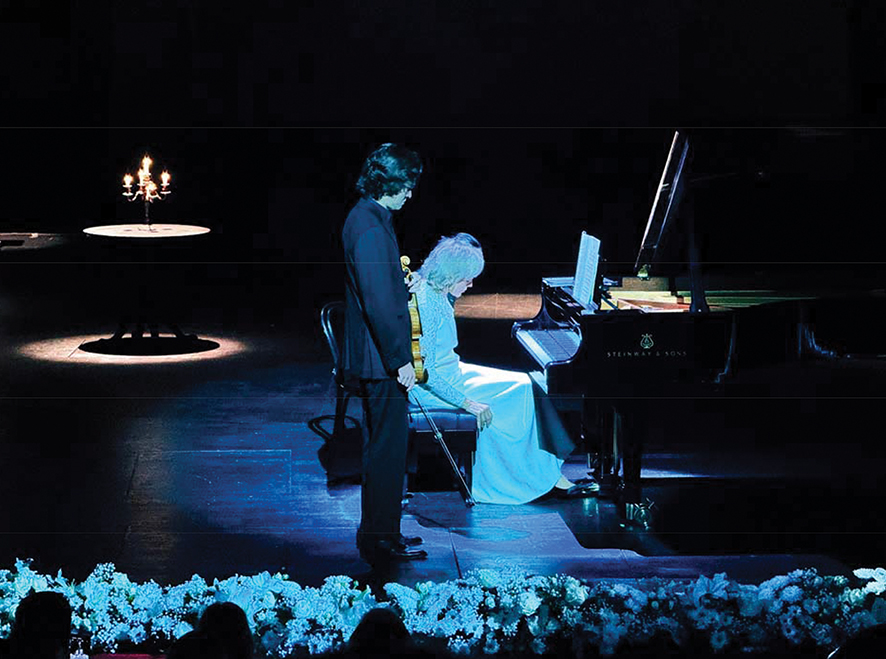
Lozakovich’s playing carries the authority of a fully formed technique, refined through a career that has moved rapidly across major international stages. What distinguishes him is the way he reduces that apparatus to essentials. On the album, in the opening phrases of Vocalise, the sound appears almost weightless, sustained through an even bow and a tightly focused tone. The vibrato remains measured, applied with intention. Each phrase extends through a controlled arc, with no superfluous gesture. In Batumi, this aesthetic became physical. The violin line held a steady center, the bow maintaining a consistent contact point, the phrasing unfolding with a sense of inevitability. Expression emerged through continuity rather than emphasis.
Mercier’s role within the duo defines the structural environment of that line. Her background, spanning the Paris Conservatory and collaborations with leading orchestras, resonates in a playing style that balances clarity with flexibility. On the recording, Debussy’s La fille aux cheveux de lin reveals her approach: chords voiced with internal precision, pedaling calibrated to sustain resonance without blur, timing shaped to support the unfolding phrase. Every element contributes to a stable harmonic field. The piano establishes depth and proportion, allowing the violin to move freely within it. The sound remains open, with each harmonic transition clearly articulated.

The defining quality of the duo lies in their shared sense of time. Their ensemble operates through a finely tuned awareness of phrasing as a continuous process. In Fauré’s Après un rêve, as heard on the album, the alignment of the final cadence illustrates this unity: the violin releases into silence at the exact point where the piano resolves the harmonic tension. The gesture carries a natural coherence, shaped by mutual timing. On stage, this cohesion deepened. Tempo shifts occurred within phrases, shaped collectively. Dynamics developed as unified curves. The performers moved through the music with a single rhythmic instinct, creating a continuous flow.
Lost to the World gathers a repertoire centered on transcription and lyrical form. Its structure reflects a sustained interest in melody as the primary carrier of meaning. In Mahler’s Ich bin der Welt abhanden gekommen, the recording presents a line extended across long spans, supported by a piano texture that preserves harmonic depth. The reduction to violin and piano concentrates the expressive material, focusing attention on the continuity of sound.
The album includes works that traditionally foreground virtuosity, including Kreisler’s Prelude and Allegro. Within this duo’s approach, technical elements remain integrated into the larger musical flow. Lozakovich executes rapid passages with precision and control, maintaining clarity of articulation across registers. Mercier sustains balance within complex textures, her touch even and consistent. The technical layer functions as a support for the line. In performance, this integration allowed the music to retain its continuity. Each passage contributed to the overall trajectory without disrupting it.
The presence of works associated with Weill and Kosma expands the album’s expressive field. Their melodic language, shaped by song traditions, aligns naturally with the duo’s focus on line. On the recording of Youkali, the phrase unfolds with directness and clarity, shaped through careful dynamic control. In Batumi, this approach carried into the live space, maintaining a consistent tonal language across stylistic boundaries. The program’s coherence emerged from this continuity of approach.

The transition from recording to performance forms a central aspect of the evening. The album provides a fixed reference point; the concert introduces variability and presence. Lozakovich and Mercier extend the recorded material into the acoustic environment of the hall, allowing phrases to adapt in real time. The sound gains dimension through interaction with space and audience. At the Ilia Chavchavadze State Drama Theater, this transformation appeared in the shaping of resonance and silence.
The opening of the festival established a focused artistic direction. The duo presented a practice grounded in precision, balance, and continuity of line. The album Lost to the World functioned as both source and framework, guiding the performance while remaining open to variation. The result formed a coherent sonic statement. Two musicians, a shared language, and a repertoire shaped through disciplined attention to sound. The festival began with a clear articulation of musical thought, sustained from the first note to the last.
In an era dominated by spectacle, the choice to open with a program of restraint carries a certain audacity. It suggests that cultural significance does not always require amplification. Sometimes, it emerges through attenuation; through the careful shaping of silence, the refusal of excess. Batumi’s festival begins, then, with a gesture that is both modest and strategic. A violin, a piano, a repertoire of inwardness. A city testing the acoustics of its own ambition.
By Ivan Nechaev