On April 19, inside the cavernous industrial shell of Factory Tbilisi, something happened that will be discussed for years with the peculiar mixture of disbelief and certainty reserved for turning points. The ‘Kordz x Sakamoto: A Ryuichi Sakamoto Tribute Concert’ did not simply honor a composer: it reorganized the grammar of how contemporary music can exist in space, in time, and in the body of an audience.
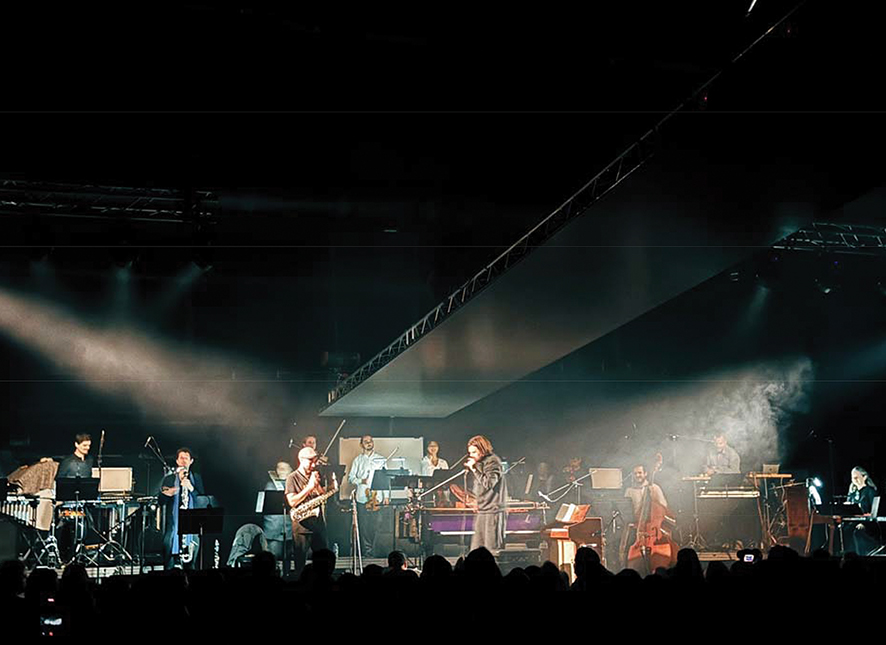
The event, produced by Stockton Records, sold out in advance. That fact alone says little. What matters is the kind of listening that emerged: concentrated, physical, collective. The audience stood, moved, held their breath, recorded fragments, then forgot their phones. The room recalibrated itself around sound.
At the center stood Kordz: composer, architect of the evening, and one of the few figures in the region working at the intersection of post-classical composition, electronic minimalism, and large-scale immersive design. The material: the music of Ryuichi Sakamoto. The method: transformation.
A Line of Transmission: From Sakamoto to Kordz
The importance of this project begins long before Tbilisi. It traces back to a relationship; not personal in the conventional sense, but artistic and acknowledged. During his lifetime, Sakamoto expressed appreciation for Kordz’s engagement with his work, recognizing in it a rare quality: attention without imitation. That distinction defines the entire project.

Sakamoto’s oeuvre resists containment. Composer, pianist, electronic pioneer, film scorer, environmental thinker: his music moves between systems. 1000 Knives (1978) emerges from early electronic experimentation infused with political awareness; Tibetan Dance unfolds through cyclical rhythmic structures that suggest ritual and movement rather than narrative development. His later works dissolve into fragile textures, where sound itself becomes the subject.
Kordz approaches this body of work as a living system. The project, first realized at the Holland Festival in 2021 in collaboration with Het Muziek (formerly Asko|Schönberg) and Boris Acket, established a model: Sakamoto’s music as material for expansion, layering, and spatial translation. The Tbilisi performance represents the maturation of that model.

Lost in Sound: Rewriting the Conditions of Perception
Before the Sakamoto tribute unfolded, Kordz introduced a work that quietly reframed the entire evening: Lost in Sound. Developed together with collaborators Haerius and Dozde, Lost in Sound began as an experimental video game: an environment in which the act of composition is transferred to the listener. The premise is disarmingly simple: music emerges through interaction. One moves through a virtual world, and in doing so, writes sound. Gesture becomes structure; navigation becomes phrasing.
This background matters, because it explains the deeper logic of the performance version. The live iteration presented in Tbilisi does not merely translate a digital concept into concert form. It preserves its core idea: music as a space that can be entered, explored, and shaped in real time. The addition of live musicians marks a decisive transformation. The original interactive system, fluid, responsive, open-ended, acquires physical resistance. Sound now carries weight. The electronic layer remains, though it no longer floats freely. It anchors itself to bodies, to gestures, to time unfolding in the room.
In this configuration, Lost in Sound operates on two simultaneous levels. On one level, it retains its identity as a generative system: music as process, as environment, as something that can be navigated. On another, it becomes performance: a set of decisions made in the presence of an audience, shaped by attention, by acoustics, by the irreversibility of the moment. The effect at Factory Tbilisi proved immediate. The audience encountered a field rather than a sequence. Sound extended across the space in layers, sustained tones, pulses, fragments of melody, each element positioned with care, yet open enough to allow perception to move freely between them.
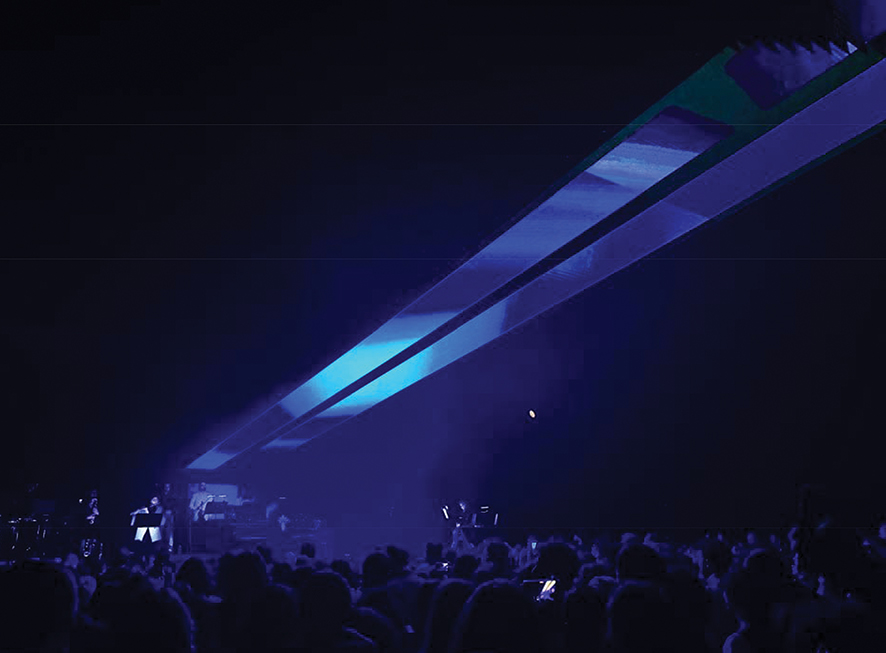
This opening segment recalibrated listening. It dissolved habitual expectations of form, established a different pace of perception, and prepared the ear for duration and repetition as the primary carriers of meaning. By the time the music of Ryuichi Sakamoto entered, the audience was already inside a different acoustic logic. Lost in Sound did not function as a prelude in the traditional sense. It acted as a threshold: an entry point into a concert where composition, installation, and performance converge into a single, continuous act.
Eight Parts, One Organism
The Sakamoto tribute unfolded in eight parts. To describe them as “pieces” would miss the point. The structure operated as a continuous organism; motifs circulating, transforming, reappearing under altered conditions.
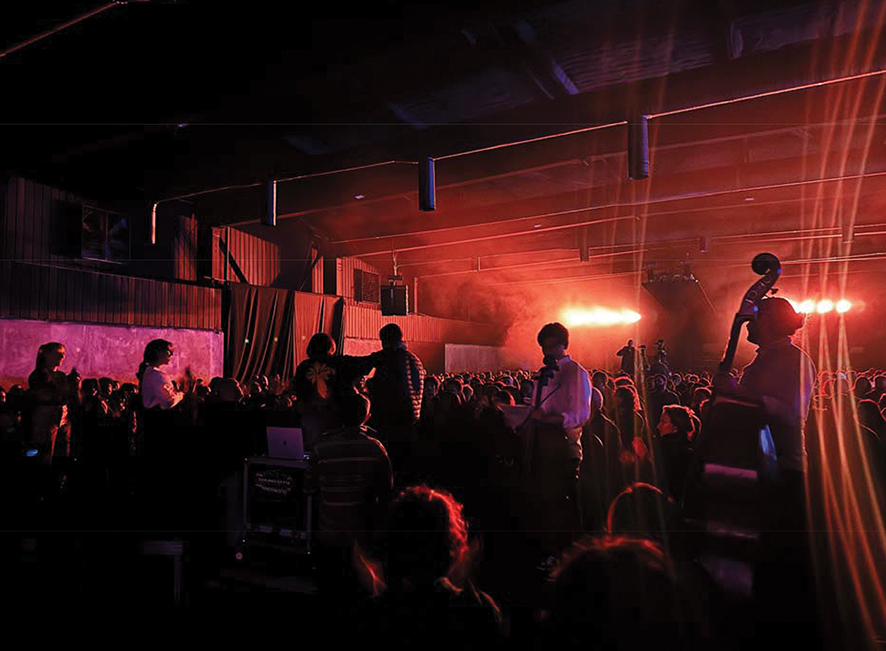
In 1000 Knives, rhythmic cells, originally tied to early electronic sequencing, expanded into layered textures distributed across the ensemble. Pulse became spatial rather than metric. The listener perceived movement through density and distribution. Tibetan Dance introduced cyclical motion. Repetition accumulated energy. Micro-variations, slight shifts in articulation, dynamic inflection, instrumental color, generated large-scale transformation. The music did not progress; it deepened. Kordz’s treatment preserved Sakamoto’s essential characteristics: clarity of gesture, sensitivity to timbre, openness of form, while amplifying their structural implications.
The success of such a project depends on execution at the highest level. The presence of Het Muziek ensured a foundation of technical and interpretive excellence. Their experience in contemporary repertoire, where precision and flexibility coexist, proved essential. Alongside them, Georgian musicians brought a distinct energy and clarity: Tamriko Kordzaia — piano, synthesizer; Elene Gogodze — viola; Konstantine Gotsiridze — violin; Giorgi Nadareishvili — cello; Nino Ochigava — flute.

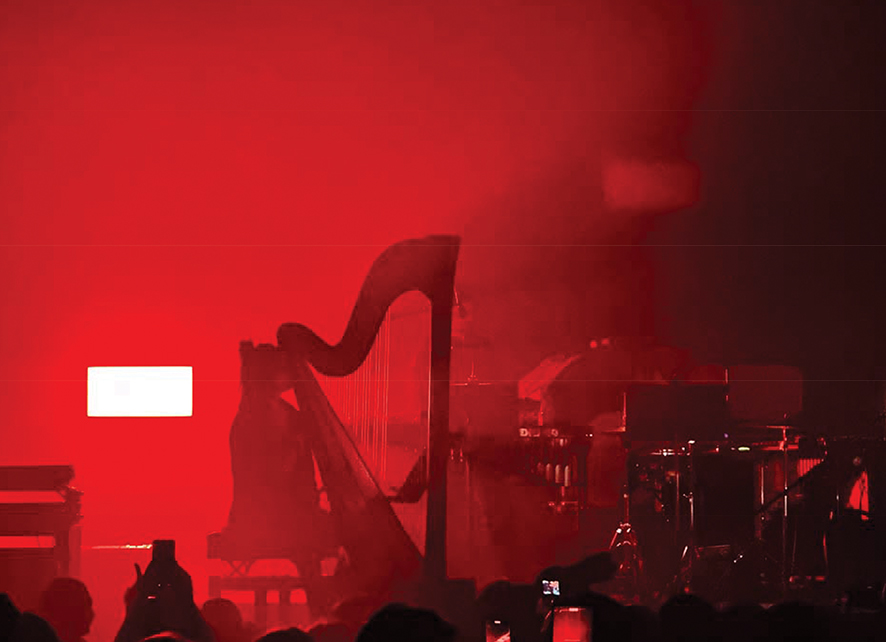
Each performer operated within a tightly controlled sonic architecture. Lines passed between instruments with seamless continuity. Entrances aligned with microscopic precision. Dynamic layers stacked without congestion. Tamriko Kordzaia’s role extended beyond performance. Her dual engagement with acoustic piano and synthesizer created a bridge between material and transformation. She anchored the ensemble while opening it outward into the electronic field.
The visual dimension, conceived by Boris Acket in collaboration with Lumus Instruments, elevated the project into the realm of total artwork. Light functioned as counterpoint. Beams intersected, expanded, dissolved. The industrial volume of Factory Tbilisi became an active participant. At moments, performers appeared as silhouettes within a luminous grid; at others, the space opened into vast planes of shifting intensity.
Crucially, the visual system responded to sound. Changes in texture triggered transformations in light. The audience experienced composition across senses: hearing and seeing fused into a single perceptual field.

A New Scale of Musical Event
The decision to present the concert to a standing audience reshaped the social dynamics of listening. Proximity increased. Movement entered the field. The boundary between performer and listener softened.
Kordz himself has described the rare combination of chamber-level detail with the immediacy of a “pop-sized” crowd. In Tbilisi, this combination achieved a rare equilibrium. The ensemble maintained precision; the audience supplied energy. Feedback circulated. The performers adjusted to the room; the room responded in real time. The concert became a shared act. Every layer of the event contributed to its coherence. Organizer Stockton Records provided a production conceived as composition. Technical elements, lighting, sound design, spatial arrangement, functioned as structural components of the work.
The significance of this concert lies in its redefinition of scale. Scale here does not refer to size alone, though the visual and spatial dimensions were considerable. It refers to the integration of elements, music, light, space, audience, into a unified system. Kordz’s project situates itself within a lineage that includes minimalism, electronic music, and installation art, while maintaining a clear compositional identity. It engages Sakamoto’s legacy through transformation, extending it into a new context.
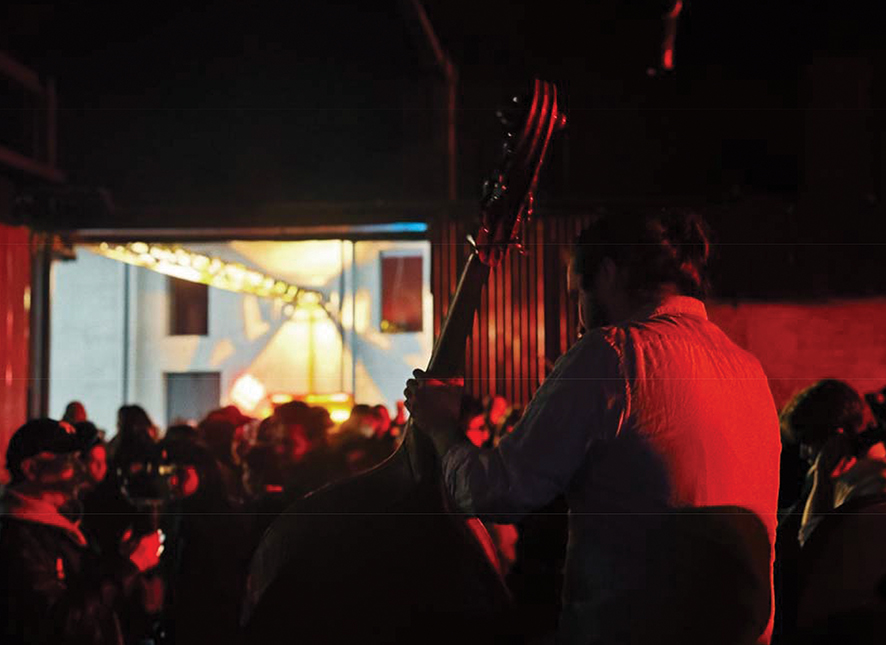
For Tbilisi, the event marks a moment of alignment with international practice at the highest level. The project’s origins at the Holland Festival situate it within a global circuit; its realization here demonstrates the capacity of local infrastructure and audiences to sustain such work. Concerts often produce memory. This one produced a shift in expectation. Sound became architecture. Time became material. The boundary between listening and inhabiting dissolved. And for a few hours in Tbilisi, contemporary music revealed a future already present.
Review by Ivan Nechaev