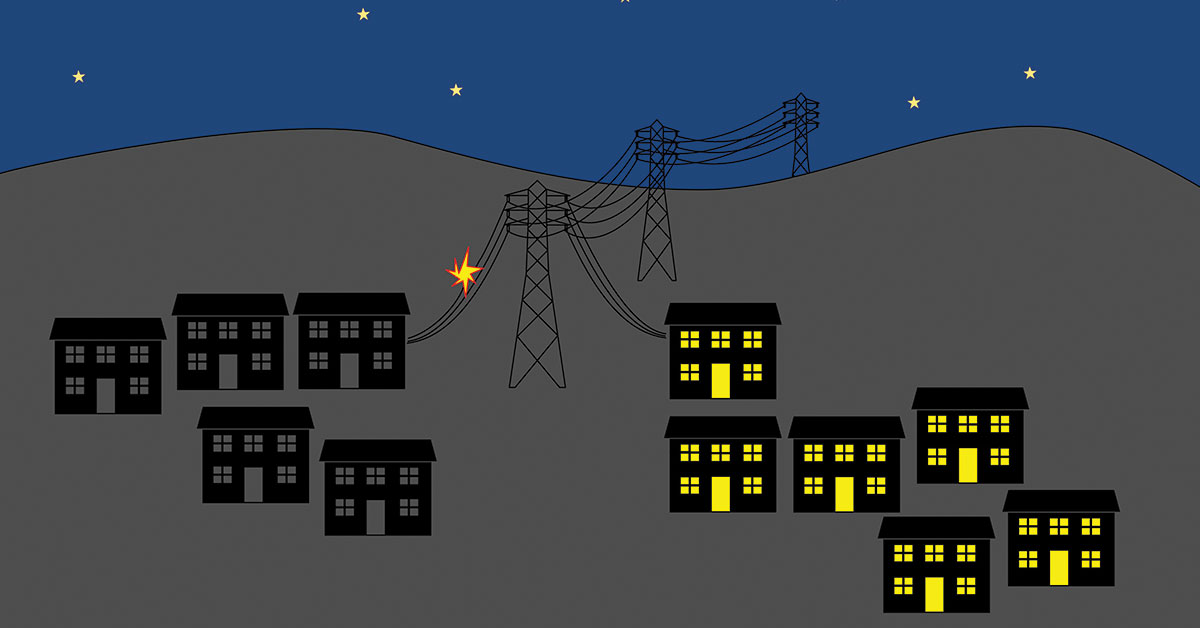
Georgia’s energy regulator says a transmission line outage may have contributed to the nationwide blackout on July 24, but ENERGO-PRO Georgia rejects suggestions that one of its lines could have caused the country’s power system to collapse.
The Georgian National Energy and Water Supply Regulatory Commission (GNERC) presented its preliminary findings on July 30, saying the Georgian power system disconnected from Azerbaijan’s electricity grid at about 00:10 and entered isolated operation. The regulator says frequency and voltage then dropped, triggering a cascading shutdown of power plants and consumers that resulted in a nationwide blackout.
GNERC says one factor identified so far, based on information provided by the Georgian State Electrosystem, was the outage of the 110-kV ‘Geguti’ transmission line connected to the ‘Kutaisi 220’ substation, which belongs to ENERGO-PRO Georgia.
The regulator also argues that the Georgian State Electrosystem should have recalculated its existing protection and automation systems instead of waiting for fully functional rapid protection to be installed on transmission lines, in order to reduce the risk of automatic disconnection from Azerbaijan.
GNERC says the investigation is focusing on two key issues: why the Georgian grid disconnected from Azerbaijan and whether the country’s power system was capable of operating independently after the separation.
On July 31, the Chairman of the Board of Directors of ENERGO-PRO Georgia Holding, Mikheil Botsvadze, rejected the suggestion that the company’s transmission line could have caused the nationwide outage.
“It is clear that the disconnection of any distribution company line cannot and should not lead to the country switching to isolated operation, disconnecting from the neighboring country’s power system and a nationwide blackout,” Botsvadze said.
He also noted that two major blackouts occurred within 32 hours, while the company’s transmission line was not mentioned in connection with the second outage.
“Perhaps both cases should be discussed together to determine the common factors behind them,” Botsvadze added, while expressing support for energy sector professionals working to restore and maintain the system.
Tbilisi Mayor and former Energy Minister Kakha Kaladze also commented on the regulator’s preliminary assessment, saying similar incidents occur in other countries.
“This type of incident happens everywhere, including in European cities,” Kaladze said. He recalled a nationwide outage that occurred during his tenure as energy minister and said the important thing was that authorities responded quickly.
The nationwide blackout began shortly after midnight on July 24. Electricity supplies were gradually restored, with service returning across the country by around 08:00 on July 25.
The Georgian State Electrosystem says it is continuing to determine the cause of the outage, while GNERC is conducting its own review.
Georgia’s State Security Service launched a criminal investigation on July 25 under Article 318 of the Criminal Code, which concerns disrupting the operation of strategically important facilities in a way that threatens the country’s state interests.
Related stories:
Georgia hit by nationwide power outage
State Security Service probes nationwide power outages as suspected sabotage