The problem with a large part of contemporary chamber music lies in its excessive comfort. Too many concerts sound as though they have already been approved in advance: balanced, elegant, emotionally regulated, carefully protected from unpredictability. Listeners leave satisfied, musicians remain impeccable, and the music evaporates almost immediately afterward. The concert by Eliso Virsaladze and the David Oistrakh Quartet at the Tbilisi State Conservatoire unfolded according to another logic entirely.
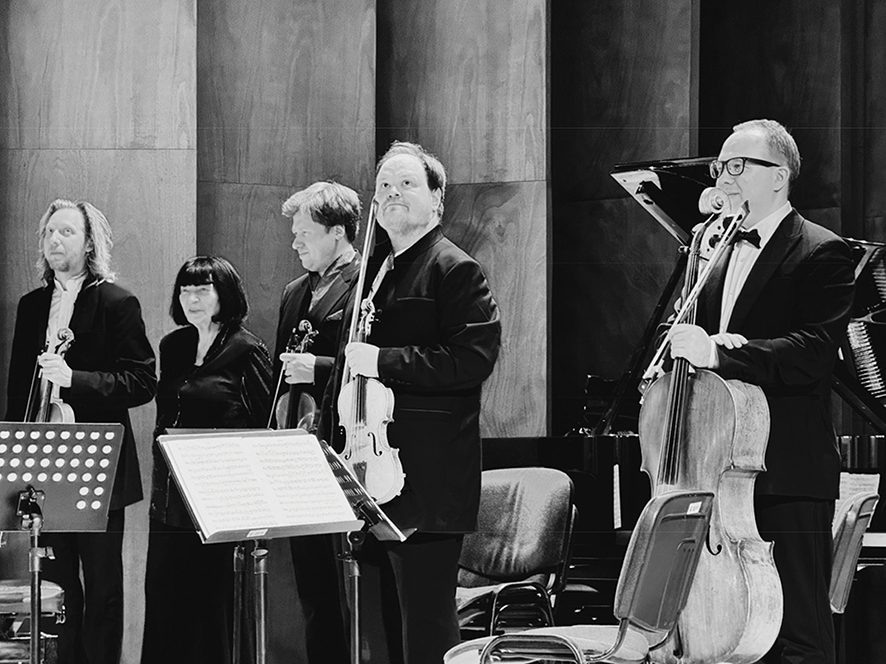
From the first minutes, the evening carried a strange internal instability. The quartet, Andrey Baranov, Daniel Austrich, Fedor Belugin, Alexey Zhilin, approached the score without smoothing over its tensions. Their playing preserved resistance inside the texture: sharp corners between voices, sudden darkening of timbre, phrases that seemed to pull against one another rather than settle comfortably into ensemble unity. The result felt intensely physical.
One could hear bodies listening to each other in real time: adjusting, provoking, reacting. Chamber music here functioned less as polished architecture and more as live negotiation. The Conservatoire hall, with all its Soviet acoustic memory and pedagogical severity, amplified this feeling even further.
And in the center of it all sat Eliso Virsaladze.
Her playing continues to possess a quality that has become almost endangered: complete indifference toward effect. Many great pianists today perform with visible awareness of image, gesture, emotional readability. Virsaladze seems interested only in the internal pressure of the music itself. She plays from inside the structure outward. That creates an unusual sensation for the listener. Nothing is underlined. Nothing is sold emotionally. The music unfolds with immense confidence in its own material.
Her sound has weight without heaviness. Even large climaxes retain transparency. Harmonic movement remains visible beneath the surface at all times, which gives the performance extraordinary momentum. Virsaladze never allows phrases to become static objects of beauty. Everything continues moving forward internally. And perhaps this is why the ensemble sounded so convincing around her.
The piano never functioned as a dominating center of gravity. Instead, the musicians built a shared acoustic field where details circulated freely between strings and keyboard. Small gestures suddenly acquired significance. A passing inner line. A brief hesitation before resolution. The grain of bow against string. The slightly dangerous elasticity of tempo. By the end of the evening, the most memorable element was not virtuosity, prestige, or historical symbolism. It was the sensation of hearing musicians think together in real time.
Review by Ivan Nechaev