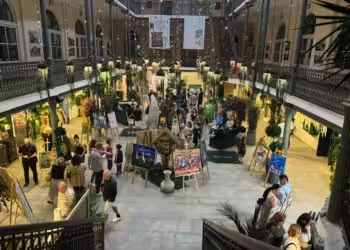
The reopening of the National Palace on Rustaveli Avenue on October 23 marked a rare alignment of heritage, youth, and musical intelligence. Once an imperial residence and later a Soviet youth center, the building now begins a new life as a concert venue. Its inaugural event featured the Tbilisi Youth Orchestra named after Gia Kancheli under Vakhtang Gabidzashvili, with Sandro Gegechkori as soloist. The program—Beethoven’s Piano Concerto No. 6 in D major, Op. 61a and Haydn’s Symphony No. 94 “Surprise”—proved both refined and symbolically charged.
Beethoven’s Op. 61a, his self-arranged piano version of the Violin Concerto, is seldom performed—a hybrid work between concerto and symphony, demanding clarity and restraint over virtuoso showmanship. Sandro Gegechkori, a young pianist already known on the competition circuit, approached it with academic precision and mature self-control. Gegechkori’s sound—bright, centered, never percussive—fit Beethoven’s transparent orchestration.

Vakhtang Gabidzashvili shaped the orchestra with firm architectural discipline. The strings produced a lean, cohesive sonority, and the winds—particularly oboes and bassoons—sustained a balanced tone within the hall’s newly responsive acoustics. Gabidzashvili’s conducting was lucid and proportionate: phrases clearly drawn, dynamics precisely layered, transitions controlled. His restraint gave space for the soloist’s clarity to breathe.
After the interval, Haydn’s “Surprise” Symphony offered a sharp stylistic counterpoint. Gabidzashvili approached it as a study in timing and articulation rather than theatrical humor. The famous chord in the Andante landed with exact calculation—less comic than structural, a jolt of focus. The Minuet revealed clean rhythmic balance, while the Finale displayed the orchestra’s ensemble discipline and energy. For a youth orchestra, this Haydn showed rare stylistic literacy: phrasing without exaggeration, rhythmic vitality without haste. Gabidzashvili’s reading was brisk, grounded, and convincingly Classical.

The newly restored National Palace adds an important mid-sized venue to Tbilisi’s concert map. The acoustics—bright and articulate—favor chamber-scale orchestras. The decision to open with a youth ensemble was more than symbolic: it tied the building’s history as a space for learning to its new role as a professional cultural institution. The evening had no sense of ceremony for its own sake; it was a demonstration of competence and ambition. This was an opening that communicated readiness rather than nostalgia.
The concert’s success lay in its concentration. Gabidzashvili offered structure, Gegechkori discipline, and the orchestra coherence. The repertoire avoided routine: Beethoven’s rarely heard experiment and Haydn’s sharp wit created a balanced dialogue between curiosity and tradition. The National Palace reopened not with fanfare, but with intelligence. What resonated most was not grandeur, but the sound of a new generation—technically grounded, stylistically alert, and already aware of its cultural task in contemporary Tbilisi.
Review by Ivan Nechaev