There are festivals that exist to confirm a cultural status, and there are festivals that gradually transform the cultural metabolism of a city. The Tbilisi Piano Fest belongs to the latter category. Every June, for a few weeks, Tbilisi enters a different temporal rhythm: one dictated not by the speed of the city but by the measured breathing of a phrase, the weight of a silence, the almost invisible movement of a hand over eighty-eight keys.
Over the past years, under the artistic direction of pianist Dudana Mazmanishvili, the festival has become one of the most ambitious musical initiatives in Georgia. What distinguishes Mazmanishvili’s curatorial approach is her refusal to treat the piano recital as a museum object. The program is built not around predictable virtuoso fireworks, but around different traditions of pianism: intellectual rigor, historical awareness, individual sound, and artistic personality.
The 2026 edition demonstrated this philosophy with exceptional clarity. The festival opened with Alexei Volodin and Edith Peña, continued with the Georgian-born composer-pianist Nikoloz Namoradze, and welcomed internationally celebrated artists such as Paul Lewis, one of the most important Beethoven interpreters of our time; the legendary Cyprien Katsaris with special guests; Simon Ghraichy, whose programs move freely between traditions and cultures; and Konstantin Lifschitz, a pianist renowned for his profound intellectual engagement with the repertoire.
The festival also included an open-air finale at Orbeli Square with Carlo Ponti conducting the Georgian Philharmonic Orchestra alongside Dudana Mazmanishvili herself: a symbolic moment where the artistic director stepped out of her role as curator and became part of the musical dialogue she had created.
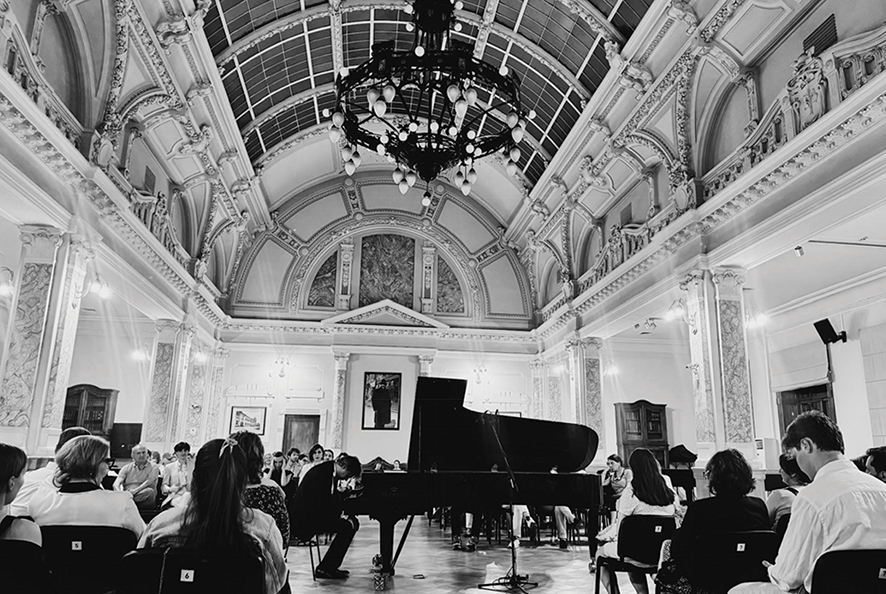
Yet perhaps the evening that clearly revealed the spirit of the festival was the recital by the Lithuanian-American pianist Andrius Žlabys at the National Library. Žlabys belongs to a rare category of musicians whose virtuosity never announces itself as virtuosity. There is no theatrical struggle with the instrument, no attempt to dominate the piano. Instead, one has the impression of listening to someone exploring the interior architecture of a score.
The program itself was a journey through three centuries of musical thought. Bach’s ‘French Overture in B minor’ opened the evening with a fascinating paradox: a German composer imagining the elegance of a French court through a highly personal musical language. The work requires not only technical precision but a sense of rhetorical gesture: the ability to make every dance movement speak with a distinct character.
This sense of structure became even more striking in Beethoven’s Sonata No. 30 in E major, Op. 109: a work standing at the threshold of Beethoven’s late style, where classical architecture begins to dissolve into something almost metaphysical. The sudden violence of the Prestissimo movement did not appear as a display of energy but as an interruption, a fracture inside a deeply intimate musical universe.
After Beethoven’s philosophical landscapes came Debussy’s Suite bergamasque, a work often reduced in public imagination to the famous Clair de lune. Yet Žlabys approached the suite as a complete ecosystem of colors and gestures. The transparency of texture, the flexibility of rhythm, and the subtle transitions between light and shadow revealed Debussy not as a composer of beautiful impressions but as an architect of sound.
The evening culminated in Prokofiev’s Seventh Sonata and its final movement, Precipitato: one of the twentieth century’s most relentless musical machines. In many performances, this piece becomes a demonstration of physical endurance. Žlabys found something more unsettling: beneath the mechanical rhythm, one could hear the anxiety of a century marked by war, industrial force, and the transformation of human beings into parts of a larger mechanism.
This is precisely why the Tbilisi Piano Fest has become indispensable for the city. It does not simply import famous names. The world has many festivals capable of doing that. Its achievement lies in creating encounters with artists who bring not only their fingers to the stage but an entire way of thinking about music.
In an era when cultural events increasingly compete for attention through spectacle and speed, the piano recital remains one of the last radical forms of concentration. A single person sits in front of a black instrument. Nothing moves. Nothing flashes. There are no screens, no visual effects, no distractions. And yet an entire universe can appear. For two weeks every summer, Tbilisi has the privilege of entering that universe.
Review by Ivan Nechaev