Russia and Ukraine stepped up military operations over the past week, with intense fighting across the eastern and southern front lines and a sharp increase in long-range strikes deep inside each other’s territory. Russia kept up pressure in its summer offensive, concentrating on the Donetsk region and trying to expand its foothold around Pokrovsk, Kostiantynivka, and Kupiansk. Ukraine answered with a steady wave of drone attacks targeting Russian military sites and energy infrastructure, adding to the strain on Russia’s fuel sector. The week brought more civilian casualties, widespread damage to infrastructure, renewed Western support for Ukraine, and another reminder that the war is increasingly being fought both at the front and far behind it.
Russian forces made slow but steady gains in eastern Ukraine, relying on heavy artillery, glide bombs, and repeated infantry assaults to inch forward. The fiercest fighting remained in the Donetsk region, where Russian troops continued pushing toward Pokrovsk and Kostiantynivka, two of Ukraine’s key defensive strongholds. Moscow also kept up offensive operations near Kupiansk in the Kharkiv region and along parts of the Zaporizhzhia front. While advances were measured in miles rather than sweeping breakthroughs, military analysts said the constant pressure forced Ukraine to commit more reserves to hold vulnerable sections of the front.
Ukraine acknowledged that fighting remained difficult along several sectors but said its defenses had prevented any major Russian breakthrough. Commanders reported carrying out localized counterattacks to slow Russian advances and retake tactical positions where possible. As has been the case for much of the past year, both armies continued paying a high price for relatively small changes on the battlefield.
Long-range strikes remained one of the defining features of the war. Russia launched another wave of missile and drone attacks against Ukrainian cities, energy facilities, and civilian infrastructure. Kyiv came under repeated attack, with missiles and Shahed drones hitting residential neighborhoods as well as infrastructure. Kharkiv, Zaporizhzhia, Odesa, and several central regions were also targeted. Ukrainian air defenses intercepted many incoming drones, but others, along with several missiles, got through, causing deaths and widespread destruction. On Tuesday alone, Russian attacks killed at least four people across Ukraine, including civilians in Kyiv, Kharkiv, and Zaporizhzhia, while dozens more were injured. Ukrainian officials reported additional casualties throughout the week as apartment buildings, industrial sites, and public infrastructure continued to come under attack.
At the same time, Ukraine expanded its long-range drone campaign inside Russia. Ukrainian drones struck oil refineries, fuel depots, and military-linked industrial facilities in regions including Saratov, Tatarstan, Bashkortostan, and Voronezh. The strikes are part of Kyiv’s broader effort to weaken Russia’s logistics by disrupting its refining industry and fuel distribution network. Over recent months, repeated attacks have forced temporary shutdowns at major refineries, reducing fuel production and putting added pressure on the Russian economy.
The impact of those attacks became more visible this week. Faced with shortages of diesel and gasoline, long lines at gas stations, and rising fuel prices, Russia introduced a temporary ban on diesel exports through the end of July. Deputy Prime Minister Alexander Novak acknowledged that the situation remained difficult and said Russia would begin importing fuel to stabilize domestic supplies. The export ban followed months of Ukrainian drone strikes that have significantly reduced Russia’s refining capacity, forcing the Kremlin to prioritize domestic demand over exports. It is one of the clearest signs yet that Ukraine’s campaign against Russia’s energy infrastructure is having broader economic consequences beyond the battlefield.
Fuel shortages continued spreading across parts of Russia. Drivers in several regions reportedly waited hours to refuel as diesel and gasoline became harder to find. Local authorities introduced temporary restrictions on fuel sales, while officials sought to reassure the public that supplies would recover.
Although President Vladimir Putin played down the seriousness of the situation, Russian officials increasingly acknowledged that repeated Ukrainian attacks on refineries had created significant logistical problems.
Both sides also continued targeting each other’s supply lines. Russia stepped up strikes on railway infrastructure, warehouses, and military facilities supporting Ukrainian operations. Ukraine focused on ammunition depots, command centers, air bases, and other military targets in occupied territory and inside Russia. Drone warfare remained central to both sides’ strategies, with relatively inexpensive unmanned aircraft increasingly shaping the battlefield and allowing precision strikes far behind the front lines.
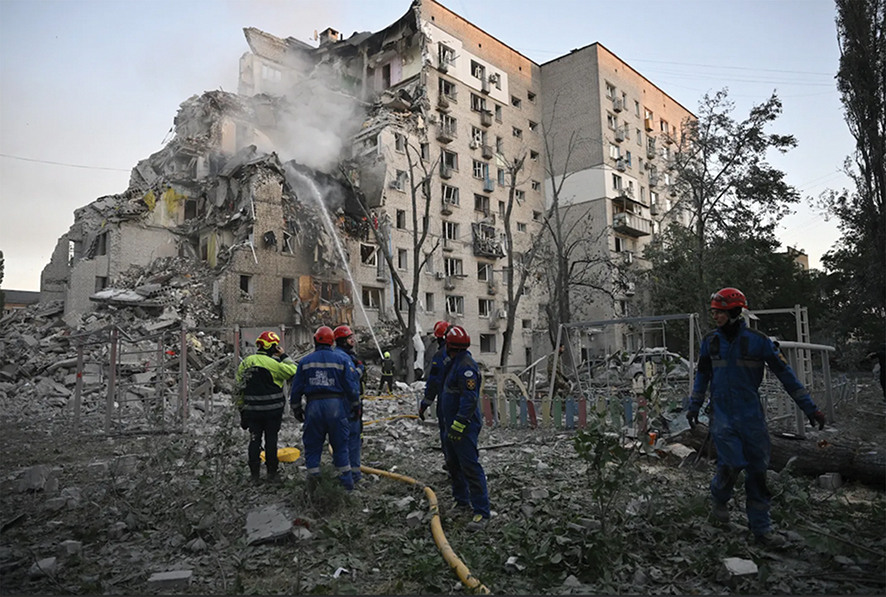
The humanitarian toll continued to grow. Russian missile and drone attacks damaged homes, schools, hospitals, and essential utilities across several Ukrainian regions. Emergency crews spent much of the week searching collapsed buildings for survivors after repeated strikes. Ukrainian officials again urged Western partners to speed up deliveries of additional air defense systems, arguing that stronger protection from aerial attacks remains the country’s most urgent military need.
Diplomatic activity also picked up alongside the fighting. At the NATO summit in Ankara, Ukrainian President Volodymyr Zelensky met with US President Donald Trump, with air defense dominating their discussions. Trump announced that the United States would license Ukraine to manufacture Patriot interceptor missiles domestically, saying Kyiv could begin producing them quickly once US experts provided the necessary technical guidance. The move could strengthen Ukraine’s long-term ability to defend itself against Russian ballistic missile attacks while reducing its reliance on imported interceptors.
Trump also revealed that the United States plans to purchase Ukrainian-made drones, praising Ukraine’s ability to rapidly produce large numbers of unmanned aircraft despite the war. “We would buy their drones,” Trump said, adding that Ukrainian manufacturers had demonstrated an “amazing” capacity to build them, even in underground workshops. The two leaders also discussed broader military cooperation and continued support for Ukraine’s defense industry.
NATO allies used the summit to reaffirm their long-term support for Ukraine despite continued uncertainty on the battlefield. Member states pledged additional resources for defense production and emphasized continued assistance aimed at strengthening Ukraine’s military resilience. Several European governments also announced new military aid packages focused on air defense ammunition, artillery shells, armored vehicles, and drones, while maintaining sanctions and diplomatic pressure on Russia.
Western military assistance remained focused on helping Ukraine withstand Russia’s grinding offensive rather than supporting an immediate large-scale counteroffensive. Western officials said that maintaining a steady flow of ammunition, interceptor missiles, and replacement equipment will be essential as the conflict continues to evolve into a prolonged war of attrition.
Russia, meanwhile, continued portraying Western military aid as proof of NATO’s direct involvement in the conflict. Kremlin officials criticized the alliance’s latest commitments and warned that expanding military cooperation with Kyiv would only prolong the war. At the same time, Moscow pressed ahead with mobilizing additional personnel and expanding domestic weapons production, despite growing economic pressure from sanctions and Ukraine’s increasingly effective long-range strike campaign.
Compiled by Ana Dumbadze