Russia’s war against Ukraine entered another week marked by intense long-range strikes, grinding frontline battles, and renewed diplomatic efforts to increase pressure on Moscow. The heaviest fighting remained concentrated in eastern Ukraine, where Russian forces continued offensive operations around Kupiansk, Toretsk, Pokrovsk and in the wider Donetsk direction, while Ukraine sought to slow the advance through defensive operations and increasingly effective mid-range drone strikes against Russian military logistics, air defenses and energy infrastructure. Institute for the Study of War reported that Russia’s strategic objective remains the capture of the entirety of Donetsk Oblast and further advances toward Dnipropetrovsk Oblast.
Over the past week, the battlefield picture remained largely one of pressure rather than decisive territorial breakthrough. Russian forces continued probing and assault operations along multiple sectors, including near Kupiansk, Toretsk and Pokrovsk, while Ukrainian forces worked to contain Russian advances and disrupt supply routes behind the front. ISW reported that Russian forces had recently advanced near Kupiansk, Toretsk and Pokrovsk, but Moscow’s broader campaign continued to face heavy costs and difficulties in converting local gains into operational success.
The most intense combat continued in the Donetsk region, where Russia has concentrated significant manpower and firepower in an effort to push deeper westward. Pokrovsk and nearby areas remained central to the fighting, as did the broader line toward Kostiantynivka and other Ukrainian-held positions. At the same time, Ukraine’s ability to strike Russian assets behind the front has become an increasingly important factor. Reuters reported that Ukrainian mid-range drone strikes, reaching roughly 30 to 180 kilometers behind Russian lines, have targeted air defenses, logistics, communications and major military vehicles, complicating Russia’s operations and forcing it to disperse assets.
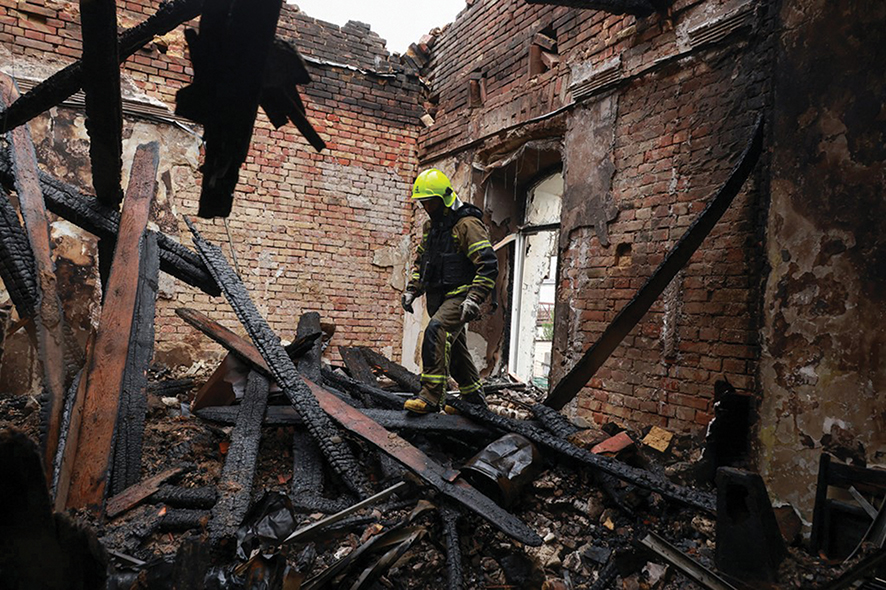
The air war also escalated sharply. On May 18, Russia launched one of the week’s largest attacks, striking Odesa and Dnipro with missiles and drones. Ukrainian officials reported that residential buildings, a university and infrastructure were damaged, while at least 22 people were injured in Dnipro, including children. Odesa also came under attack, with damage reported to residential buildings, a school, a kindergarten and historic architecture. Ukraine’s Air Force said Russia launched more than 500 drones and 22 missiles in the broader wave of attacks.
Russia also continued targeting Ukraine’s energy and port infrastructure. On May 19, a Russian air attack damaged port facilities in Izmail, Ukraine’s largest Danube port and a key logistics hub in the Odesa region. Local authorities said there were no casualties or major destruction in that strike, but the attack underscored Moscow’s continued focus on Ukraine’s export routes and economic infrastructure. Russian drones also struck Naftogaz infrastructure in the Dnipropetrovsk region, destroying a filling station and injuring two employees.
The Black Sea also saw renewed danger for civilian shipping. Ukrainian authorities said Russian drones hit several foreign-flagged civilian vessels approaching Ukrainian ports, including a Chinese-owned cargo ship sailing under the Marshall Islands flag. Other vessels sailing under the flags of Guinea-Bissau and Panama were also reportedly hit, though no casualties were reported. The attacks again highlighted the vulnerability of Ukraine’s maritime trade routes and the wider risks Russia’s strike campaign poses beyond Ukrainian territory.
Ukraine, meanwhile, continued its own long-range and mid-range drone campaign against targets inside Russia. Russian authorities reported Ukrainian drone attacks aimed at Moscow, Kursk, Rostov, Belgorod and Yaroslavl regions. In Kursk, Russian officials said one woman was killed and two people were injured, while in Belgorod, two civilians were reported killed in Ukrainian drone strikes. In Yaroslavl, an “industrial object” was damaged; the region contains oil-refining infrastructure. Ukrainian President Volodymyr Zelensky said Russia’s refining capacity had dropped by 10% over recent months and that oil wells had been shut down, presenting Ukraine’s energy strikes as part of a broader effort to weaken Russia’s ability to finance and sustain the war.
The situation around the Russian-occupied Zaporizhzhia nuclear power plant remained a serious concern. The head of Russia’s state nuclear corporation Rosatom warned that the situation at the plant was approaching a “point of no return,” alleging intensified Ukrainian attacks. The plant is not generating electricity, but its reactors and nuclear fuel still require maintenance and cooling. Both Russia and Ukraine have repeatedly accused each other of endangering nuclear safety at the facility, which has been under Russian control since the early stages of the full-scale invasion.
Diplomatically, the most significant development of the week came from the Council of Europe. At a meeting of foreign ministers in Chis inau, 36 countries and the European Union expressed their intention to join a new Enlarged Partial Agreement establishing the management structure for a Special Tribunal for the Crime of Aggression against Ukraine. The tribunal is intended to prosecute those primarily responsible for launching Russia’s full-scale invasion, filling a legal gap left by the International Criminal Court’s limited jurisdiction over the crime of aggression.
The Netherlands has already undertaken preparatory work to host the initial phase of the tribunal in The Hague, a city closely associated with international justice. Ukrainian Foreign Minister Andrii Sybiha welcomed the move as a historic step toward accountability, saying the moral foundation of Europe and the world would only be restored when the crime of aggression against Ukraine is punished. The initiative has drawn comparisons with the Nuremberg trials, though legal experts note that prosecuting Russia’s sitting leadership would face practical and jurisdictional limits while senior officials remain in office.
Military aid and international support remained central to Ukraine’s ability to hold the line. In Washington, however, debate continued over the future of US assistance. Republican Representative Brian Mast said he did not expect another large US supplemental package for Ukraine, while indicating that Washington would continue intelligence support and allow weapons sales and transfers. The comments reflected a broader shift toward expecting Europe to carry a greater share of the burden, even as Ukraine continues to depend on Western air defense, ammunition, drones and long-range capabilities.
European support continued both politically and militarily. France invited European countries involved in the “coalition of the willing” for Ukraine to take part in Bastille Day events, presenting the move as part of a broader “European strategic awakening.” The coalition, led by France and the United Kingdom, is focused on security guarantees for Ukraine and possible post-ceasefire arrangements. Around 25 countries have reportedly pledged contributions to a potential multinational force, although such plans remain dependent on a ceasefire and face strong opposition from Moscow.
Compiled by Ana Dumbadze