Russia’s war against Ukraine entered another volatile week marked by intense fighting along the eastern and southern fronts, renewed mass aerial attacks on Ukrainian cities and infrastructure, and expanding Ukrainian drone strikes against Russian energy facilities deep inside Russian territory. Although both Moscow and Kyiv continued to speak of ceasefires and possible negotiations, developments on the ground offered little indication of de-escalation.
The heaviest fighting remained concentrated in eastern Ukraine, particularly around Pokrovsk, Kostiantynivka and nearby settlements in the Donetsk region. Ukrainian military reports said Russian forces continued repeated assault attempts in the Pokrovsk sector, trying to advance near Rodynske, Novooleksandrivka, Hryshyne, Bilytske, Udachne and other villages. On May 13 alone, Ukraine’s General Staff reported 187 combat clashes across the front, with Pokrovsk and Huliaipole among the most active directions. A day earlier, Ukrainian sources reported more than 200 engagements, underscoring the scale and persistence of Russia’s offensive pressure.
Despite the intensity of Russian operations, Moscow’s territorial progress appeared limited. The Institute for the Study of War assessed that Russia’s spring offensive had lost momentum, while Ukrainian counterattacks and long-range strikes were increasingly complicating Russian military operations. Russian forces continued attempting to improve tactical positions in Donetsk, Zaporizhzhia and Sumy regions, but there was no confirmed major territorial breakthrough during the reporting period. At the same time, Moscow maintained maximalist diplomatic demands, including Ukraine’s withdrawal from occupied areas of Donbas as a condition for negotiations.
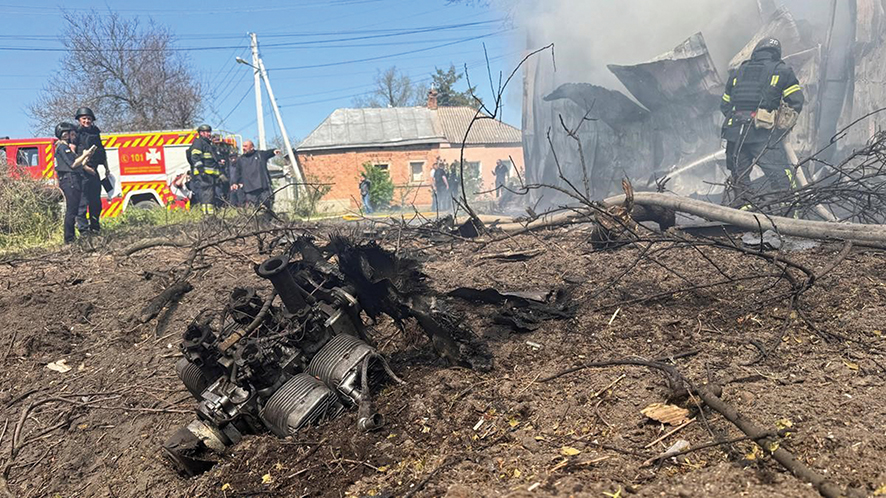
The week’s most dramatic escalation unfolded in the air. Following the collapse of a brief US-brokered ceasefire effort, Russia launched one of its largest recent drone and missile barrages against Ukraine. On May 13, Russian forces reportedly launched more than 800 drones across nearly 20 Ukrainian regions, targeting residential areas, railway infrastructure, ports and energy facilities. At least six people were killed and dozens injured. The scale of the assault affected areas close to NATO borders, prompting Poland to scramble military aircraft, Hungary to summon the Russian ambassador and Slovakia to temporarily close several border crossings with Ukraine.
The following night, Russia again struck Kyiv and other cities with drones, ballistic missiles and cruise missiles. Ukrainian officials said air defenses intercepted or electronically jammed hundreds of incoming targets, though several strikes still reached civilian areas and infrastructure. In Kyiv, at least one person was killed and 33 injured, while residential buildings sustained damage. Ukrainian President Volodymyr Zelensky said the renewed attacks demonstrated that Russia had no genuine intention of ending the war.
Civilian casualties remained heavy throughout the week. Earlier in the reporting period, Russian attacks across eastern Ukraine killed at least 27 people, including 12 in one of the deadliest strikes reported this year. The attacks came shortly before Ukraine’s proposed ceasefire was due to begin, while Russia had separately announced a temporary Victory Day ceasefire for May 8-9. Both sides later accused one another of violations, and fighting quickly resumed along much of the front line.
Ukraine, meanwhile, intensified its campaign against Russian military and energy infrastructure, increasingly targeting facilities located far from the battlefield. Zelensky said Ukrainian drones had struck a Russian gas facility located more than 1,500 kilometers from the Ukrainian border, marking one of Kyiv’s longest-range attacks since the beginning of the war. The Ukrainian president claimed that the strike targeted infrastructure linked to Russia’s energy sector as part of a broader strategy aimed at weakening Moscow’s military and economic capabilities. Zelensky said the operation showed Kyiv’s growing ability to strike strategic targets deep inside Russian territory, highlighting an increasingly sophisticated long-range drone campaign. The Russian authorities did not immediately provide detailed information regarding the reported attack, and the extent of the damage could not be independently verified.
Ukraine’s strikes on Russian energy infrastructure continued elsewhere. Ukrainian drones reportedly targeted oil and gas facilities deep inside Russia, including the Perm oil refinery, which Reuters reported had completely halted processing following a May 7 attack, and a gas processing facility in Astrakhan region, where falling drone debris reportedly sparked a fire. Other Russian refineries and energy sites, including facilities in Tuapse, Syzran, Novokuibyshevsk, NORSI and Ust-Luga, as well as port infrastructure, have been affected in recent months. Kyiv argues that such strikes are aimed at degrading Russia’s logistical capabilities, reducing fuel supplies and limiting revenues that support Moscow’s war effort. Russia, meanwhile, accuses Ukraine of targeting civilian and critical infrastructure.
Diplomatic efforts this week once again exposed the gap between rhetoric and battlefield realities. Zelensky accused Moscow of rejecting serious ceasefire initiatives, while Russian officials continued framing negotiations around conditions widely viewed in Kyiv and among Western allies as unacceptable. At the European level, defense ministers meeting in Brussels on May 12 discussed Ukraine’s urgent battlefield requirements, defense-industrial cooperation and long-term security guarantees. The European Union announced that Ukraine is expected to receive the first disbursement from a €90 billion support loan in June, while additional European Peace Facility funding was also discussed.
NATO support remained equally central to Ukraine’s military outlook. Secretary General Mark Rutte reportedly urged allies to dedicate 0.25% of GDP to supporting Ukraine, amid concerns that Kyiv’s military requirements remain substantial as Russia continues expanding missile and drone production. NATO has repeatedly emphasized that allied support since 2022 has included unprecedented levels of military equipment, training and logistical assistance.
Western pressure on Moscow also intensified this week, as the EU and UK imposed new sanctions targeting Russian institutions and officials accused of overseeing the deportation and ideological indoctrination of Ukrainian children. The EU announced sanctions against 23 institutions and individuals, while Britain introduced a broader package targeting 85 people and entities, roughly one-third of whom were linked to what London described as Russia’s campaign to forcibly deport and militarize Ukrainian children.
Based on EU estimates, nearly 20,500 Ukrainian children have been deported or forcibly transferred to Russia since the beginning of Moscow’s full-scale invasion in February 2022. Brussels described the practice as a grave violation of international law. The sanctions package targets individuals and institutions allegedly involved in subjecting Ukrainian children to pro-Russian ideological education, military-oriented activities and patriotic indoctrination programs. The measures, coordinated with Canada and approved by all 27 EU member states, include asset freezes and travel bans.
Among those sanctioned by the UK is the Warrior Center, formally known as the Center for Military and Patriotic Training and Education of Youth, where Ukrainian children are reportedly exposed to military training and pro-Kremlin ideology. Britain also sanctioned Yulia Sergeevna Velichko, the Moscow-installed minister for youth policy in the self-proclaimed Luhansk People’s Republic, over her alleged role in implementing youth initiatives in occupied territories. Responding to the measures, Zelensky accused those targeted of helping erase Ukrainian national identity. Russia has denied wrongdoing, maintaining that children were relocated for protection from frontline fighting and may be returned when relatives are identified.
The UK’s wider sanctions package also targeted Russia’s alleged information warfare operations, including individuals linked to the Social Design Agency, a Russian state-funded organization accused of running disinformation campaigns abroad and attempting political interference in foreign countries, including Armenia. The move comes during increasingly strained relations between Moscow and Yerevan, traditionally one of Russia’s closest regional partners.
Compiled by Ana Dumbadze