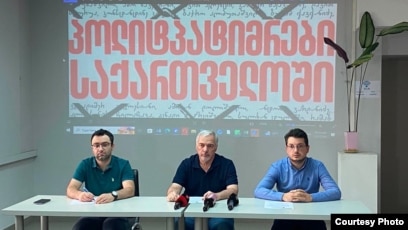
Transparency International Georgia (TI Georgia) says 91 people in Georgia currently meet the criteria established by the Parliamentary Assembly of the Council of Europe (PACE) for recognition as political prisoners. The organization presented its updated assessment at a briefing on July 21.
TI Georgia says the list was compiled using the criteria set out in PACE Resolution 1900 (2012). Each case was assessed individually, taking into account the circumstances of the case, court rulings and international human rights standards.
TI Georgia’s Human Rights and Justice Program Manager, Sandro Baramidze, said the overwhelming majority of those included on the list meet more than one of the five criteria. Organization says Mzia Amaglobeli, founder and editor of Batumelebi and Netgazeti, and Elene Khoshtaria, leader of the opposition party Droa, meet all five criteria.
Under the Council of Europe test, a person may be considered a political prisoner if their detention is linked to one or more of the following: a violation of fundamental rights; detention for political reasons where the alleged conduct is unrelated to any criminal offence; a clearly disproportionate sentence; discriminatory treatment; or legal proceedings incompatible with the requirements of a fair trial. TI Georgia said its document identifies which criterion or criteria it considers applicable in each individual case.
“Such a high number of political prisoners once again points to the existence of politically motivated justice in Georgia and the deterioration of the human rights situation,” the organization said in its statement. Speaking at the briefing, Baramidze described the situation as “a major black stain in Georgia’s history.”
Attorney Lasha Tkesheladze, who also took part in the briefing, argued that state institutions are undermining the right to a fair trial and prosecuting individuals for political reasons. He pointed to alleged use of false witnesses, restrictions on media access to court hearings and other violations of fundamental rights.
The ruling Georgian Dream party rejects the characterization of political prisoners, maintaining that individuals are imprisoned solely for specific criminal offences and not because of their political views or activities. Party representatives have described the term “political prisoner” as political speculation and an attempt to exert pressure on the judiciary.