Many a genius of the world has tried his brush to reflect in color and spirit the dramatic tension of the Last Supper of the Lord and His Apostles, among them Leonardo da Vinci, Tintoretto, Salvador Dalí and Andy Warhol, but nobody knows yet that, at this very moment, another masterpiece of the same genre, format and content is being created in Sakartvelo by the famous Georgian portraitist Giorgi Gegechkori.
The other day, I happened to drop by his tiny studio in the building of the Georgian Theatrical Society, officially headed by the artist, to have a look at a huge painting he is creating, using a white textural substance in a clearly Renaissance technique. I was so overwhelmed at the first glance that I could hardly believe this stunning piece of art was sitting right there near my own home, and I’d had no idea of its existence. The work speaks in an enigmatic religious, historical and artistic language, which reminds the viewer that Georgia is not idle: it is truly at work in an elevated humanistic tone and measure.
Giorgi Gegechkori, graduate of Tbilisi State Academy of Arts, grew up in a traditional thespian family. The prolific portrait painter dedicated a considerable part of his professional efforts to one of the most complicated and labor-intensive artistic directions, called scenography. His stage works always attracted public attention in this country and beyond, having produced the set design for more than twenty plays in the last 35 years of his creative life.
A dedicated follower of the realist school of painting, Gegechkori has on numerous occasions exhibited his celebrated portraits of Georgian monarchs, outstanding public figures and prominent actors, many of which are currently on display in the interiors of the Georgian Parliament, Ministry of Justice, the Zugdidi Dadiani Palace, the Georgian National Bank and many other state premises.
What deserves the most attention among his exhibitions is the one which took place in the renowned Palace of Santa Barbara in Madrid, where he made the so-called Duo-Exposition of two Iberias, Georgian and Spanish, in company with Augusto Ferrer-Dalmau Nieto, the Spanish hyperrealist painter specializing in historical military paintings.
The full professor of his cherished alma mater, and the winner of the Kote Marjanishvili Award, Giorgi Gegechkori teaches the younger generation of his beloved Sakartvelo with wisdom, patience, knowledge, experience and talent that he is so profusely endowed with.
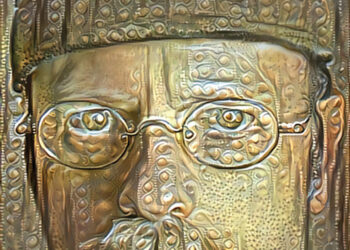
But of all this, the most thought-provoking creation seems to be the work which is probably going to win the appellation of a masterpiece, the greatest and most important of all his works ever, ‘The Keepers of the Holy Grail,’ this is the way this 68-year-old distinguished Georgian artist called his opus, and is working on it right now. It is almost finished, though the giant canvas waiting for some final touches of the master’s brush.
The mystical, symbolic and historical subject matter occupies a significant part of the productive aspect of the artist’s life, within which ‘The Keepers of the Holy Grail’ is one of the most outstanding plot-driven narratives. Thematically speaking, the Keepers are represented as images of warriors or nuns who are guarding the Holy Grail: the sacred chalice, marked with purity, knowledge, spiritual inheritance and momentousness of the story.
In terms of style, the artist is using dark, mystified colors, sharp contrasts and a mystery-stricken medieval atmosphere, instigating a sense of decorum, courtesy, veneration and enigma in the onlooker. At least, this was the sensation I felt overwhelmed with, peering into the canvas with utmost curiosity and uncontrolled emotion.
Conceptually, the figures and images of the Keepers of the Grail represent firmness of character, faith and readiness to serve the lofty cause. As a matter of fact, the entire work is based on Georgian traditional motives, connecting this ancient culture with European knightly legends.
Spontaneously sharing with me his nonstop train of thoughts about his monumental (206 by 145 centimeters) oeuvre, the internally tense and anxious Giorgi Gegechkori says he has been working on this most special to him canvas for the last three years.
The commonly familiar biblical characters, the apostles, together with them, Mary Magdalene, gingerly eyeing the Supper, as historic as all of them happen to be, are acquiring in his painting totally different images from various epochs, confessions, lineage and walks of life, embracing the cherished idea of noble internationalism: no matter what faith and cultures they represent, God is one for all of them. Isn’t this the loftiest ideal that humankind should eternally serve in good faith? Yes, and this amazing artistic project by Giorgi Gegechkori is dedicated to that particular ideal.
Blog by Nugzar B. Ruhadze