
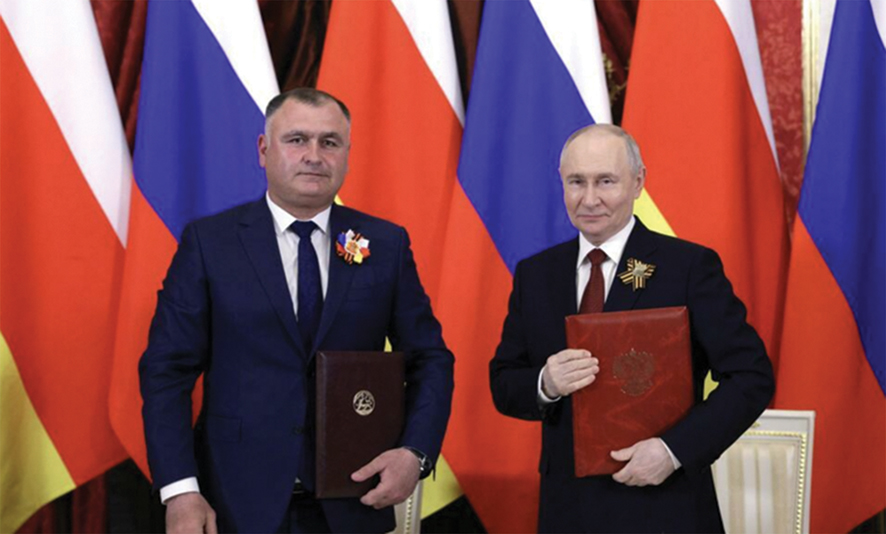
The signatures dried quickly on the document signed in Moscow on May 9, 2026, but the geopolitical shockwaves are still reverberating across the Caucasus. When Russian President Vladimir Putin and de facto leader from Tskhinvali Alan Gagloev put pen to paper for the “Treaty on Deepening Allied Cooperation,” it was framed as a bureaucratic upgrade. In reality, it represents a ruthless acceleration of Moscow’s favorite gray-zone strategy: creeping annexation. By swallowing the economic frameworks, energy networks, and civil service structures of the breakaway Tskhinvali region, Russia did not just absorb an enclave; it effectively erased the final, fragile illusions of South Ossetian so called “independence.”
For international jurists, the document is a legal fiction, a nullity under global statutes. It flouts the bedrock principle of international law prohibiting the acquisition of a territory through the threat or use of force. Because the global community recognizes South Ossetia not as a sovereign state but as an occupied territory under effective Russian control, the region lacks the international legal personality required to sign a binding treaty. This is de facto absorption dressed up in legal jargon. By harmonizing customs, merging energy grids, and allowing dual citizens to hold state office, Moscow is executing a quiet takeover that avoids the global outcry of formal annexation while securing the exact same structural outcome. For Georgia, the sovereign stakes could not be higher. Tskhinvali’s leadership openly boasted that the pact is a legal stepping stone toward formal integration into the Russian Federation. By cementing coordinated defense policies, Moscow has permanently anchored its military footprint deep within Georgia’s internationally recognized borders.
Yet, Tbilisi is not entirely powerless. It holds a sophisticated legal arsenal of diplomatic sanctions, economic embargoes, and airspace restrictions capable of converting Moscow’s anti-Georgian moves into painful experience. If the government expects general public, local elites and international observers to believe in its sovereign survival, it must weaponize these tools immediately.
On one end of the spectrum, long-term legal warfare carries the lowest immediate political risk for Tbilisi but inflicts pain on a Kremlin that routinely flouts international norms. Filing state-responsibility cases at the International Court of Justice or the European Court of Human Rights serves to deepen Moscow’s diplomatic isolation and solidify its status as a lawless actor. Even if Russia ignores the verdicts, political implications on international arena are significant.
To inflict more immediate discomfort, Tbilisi could escalate to measures by revisiting its controversial immigration policies. Introducing step-by-step stricter visa regime for Russian citizens, who have flooded into Georgia since the invasion of Ukraine, would disrupt the Kremlin’s domestic stability by squeezing its migrating population and signaling a hard break from the economic status quo.
The most severe, high-impact measures lie in leveraging Georgia’s geographic and aviation sovereignty. Georgia could target the skies by banning flights by Russian airlines and completely sealing Georgian airspace to Russian carriers, effectively severing lucrative transit corridors. Taking this to the absolute diplomatic nuclear option, Tbilisi could shut its airspace to Russia-bound air traffic originating from third countries. This move would instantly turn the South Caucasus into a logistical bottleneck for Moscow, forcing foreign airlines to reroute flights at immense fuel and time cost, thereby multiplying the economic pressure on Russia’s international connectivity.
Simultaneously, Georgia can weaponize its territory on the ground by tightening customs oversight and slowing down compliance checks at the critical Lars checkpoint, the lone functioning land border crossing between the two nations. This would choke off the parallel import pipelines that Russia relies on to bypass Western sanctions, introducing costly delays into Russian logistics.
For naive observers who still believe a pragmatic, non-confrontational approach can placate Moscow, this treaty offers a cold dose of reality. For years, the Kremlin has demanded that Tbilisi sign a binding “non-use of force” agreement, a diplomatic trap designed to force Georgia into recognizing its breakaway regions as equal neighbors. While demanding peace on paper, Russia has systematically dismantled Georgia’s sovereignty on the ground. The illusion that Moscow will ever peacefully return South Ossetia or Abkhazia in exchange for Georgian neutrality or anti-Western concessions is officially dead. Moscow views these enclaves as a permanent geographic veto over Georgia’s Euro-Atlantic aspirations. As the dust settles on this latest pact, relations between Tbilisi and Moscow have entered a deep freeze, proving that Georgia’s only real shield lies in relentless international visibility, legal defiance, and a resolute alignment with Western security networks.
OP-ED by George Katcharava
Author’s bio: George Katcharava is the founder of eurasiaanalyst.com, a geopolitical risk and advisory firm.









