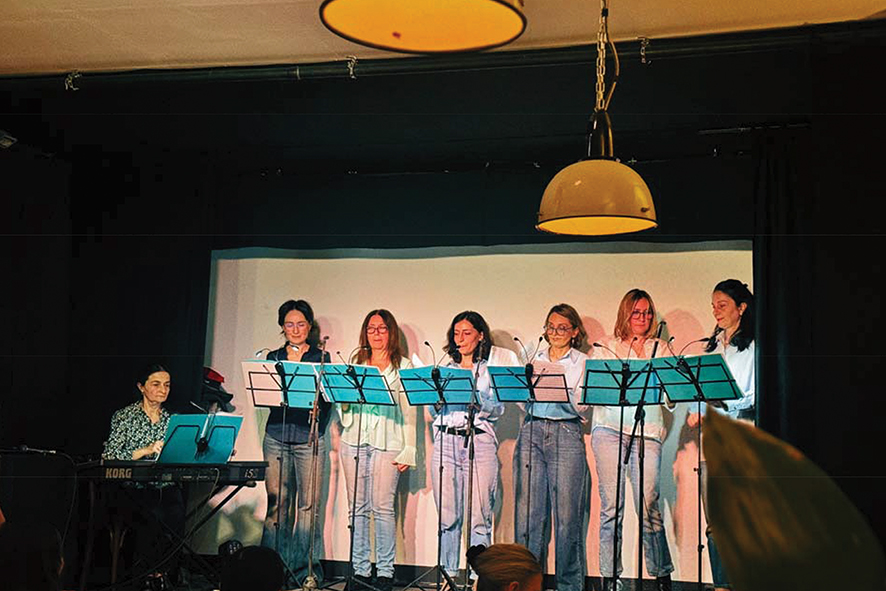
In a cultural landscape often dominated by virtuosity, competition, and institutional prestige, the concert of the community choir Opus 117 offered something increasingly rare: music as a civic practice.
Held at the warmly intimate Bistrot76, the evening gathered a group of amateur singers whose professions range from accountant and programmer to lawyer, doctor, and artist. The ensemble, Tamar Akhvlediani, Ketevan Kharatishvili, Nana Gvazava, Marina Ortolashvili, Mano Japaridze, and Nino Turabelidze, appeared before the audience first as musicians and only later as citizens. At the end of the concert, listeners learned exactly who had been performing: “an economist,” “an accountant,” “a programmer.” The announcement landed almost like the final scene of a contemporary theater piece. The revelation shifted attention away from the stage and back toward the city itself.
Each participant briefly spoke about a composer who held personal significance for them, turning Beethoven, Schubert, Chopin, and Bach into figures of lived experience rather than distant monuments of classical culture. The repertoire felt thoughtfully curated and pedagogical in the best sense of the word: ambitious enough to challenge, modest enough to remain honest.
The musical results were naturally uneven. This was not professional choral singing, and technical imperfections were never hidden. Yet the performance possessed qualities often absent from more polished productions: genuine attentiveness, careful listening, respect for the score, and a visible willingness to learn. Even the dynamic shaping of phrases revealed patient work and musical curiosity.
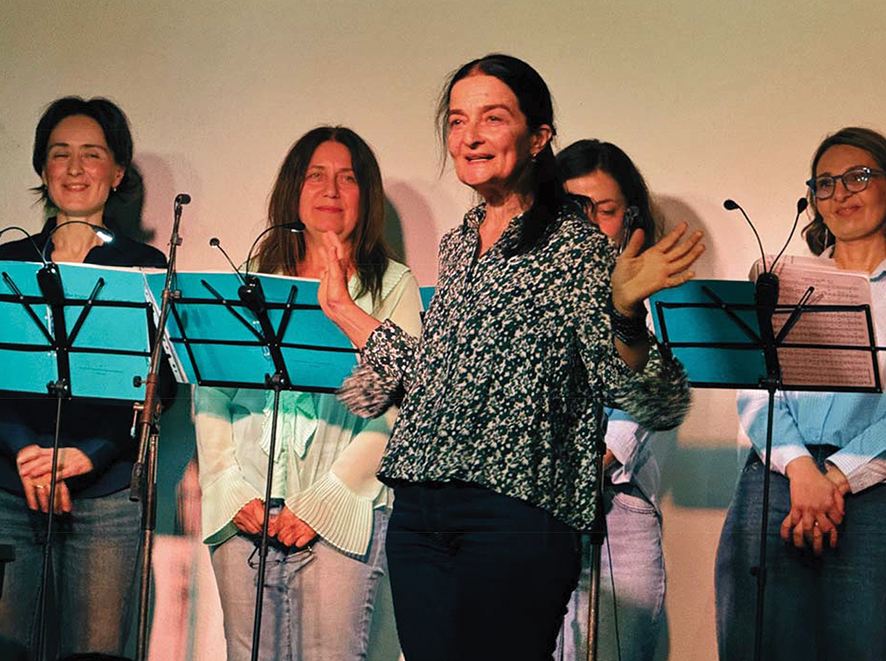
This is where Nino Janjgava’s work as artistic director became particularly evident. Conducting an amateur ensemble requires a skill set distinct from directing professionals. Technical instruction is only one component. Equally important is the ability to create an environment where participants feel empowered to engage seriously with difficult material without becoming paralyzed by comparison. Throughout the concert, Janjgava’s influence could be heard in the choir’s attention to phrasing and dynamic contrast. The singers demonstrated a collective awareness of musical shape that exceeded their technical limitations.
Crescendos arrived with purpose. Textures expanded and contracted. Musical lines possessed direction.
These are signs of listening: perhaps the most important skill any ensemble can develop.
The event ultimately resembled a contemporary citizens’ theatre: residents looking at residents, discovering one another through art. In an era obsessed with excellence, Opus 117 quietly reminded its audience that participation remains one of culture’s most valuable forms.
By Ivan Nechaev