The United States carried out a third consecutive night of military strikes against Iran, while Tehran claimed responsibility for attacks on two United Arab Emirates-flagged tankers in the Strait of Hormuz, further escalating tensions across the region.
The Islamic Revolutionary Guard Corps (IRGC) said it targeted the vessels after they allegedly ignored warnings and attempted to pass through what it described as a “mined route.” UAE says one crew member was killed and several others were injured in the strikes.
The latest escalation comes as Washington says its overnight attacks focused on Iranian coastal defense systems and missile sites.
Iran responded by launching missiles at a US military base in Bahrain, where air raid sirens reportedly sounded twice, and firing missiles toward Jordan, which also hosts American forces.
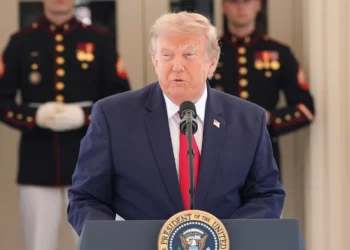
The current round of hostilities followed US President Donald Trump’s warning that Iran would face “heavy” strikes on Monday and Tuesday, signaling that additional military action could follow.
Trump also announced that the United States would restore its naval blockade of Iranian ports beginning Tuesday, saying Washington would effectively assume responsibility for securing shipping through the Strait of Hormuz.
US Central Command says the renewed blockade is scheduled to begin at 4:00 p.m. Eastern Time on Tuesday. A previous blockade had remained in place from April 13 until June 18, when Washington and Tehran signed a memorandum of understanding aimed at opening negotiations to end the conflict.
Trump further suggested that the United States could charge commercial vessels a 20% “protection fee” for safe passage through the Strait of Hormuz. He did not explain how such a system would operate, who would be required to pay, or how it would be enforced.
Iranian Foreign Minister Abbas Araghchi dismissed the proposal, saying that if any fees were to be collected, Iran—not the United States—should receive them.
“Twenty percent is certainly too much. We will be fair,” Araghchi wrote on X.
The International Maritime Organization (IMO) said international law requires that navigation through the Strait of Hormuz remain free of tolls and other charges.
The renewed confrontation has also rattled global energy markets. Following Trump’s announcement, Brent crude rose 7.1% to $81.40 per barrel, while US benchmark West Texas Intermediate (WTI) climbed 7.2% to $76.50 per barrel—the highest levels for both benchmarks since June 15.