
There was something almost perfectly symbolic about Ye’s performance in Tbilisi: a concert where the music itself became the least important element. This is not merely a complaint about poor acoustics, although the technical failure was impossible to ignore. The sound system appeared to be designed almost exclusively for certain sections of the stadium, leaving large areas of the audience trapped inside acoustic dead zones where songs could not be heard but only guessed. Even in places where the speakers were directed, the sound was muddy, distorted, and strangely two-dimensional: a collapse of exactly the sonic precision upon which Ye built his reputation as one of the most influential producers of the last three decades.
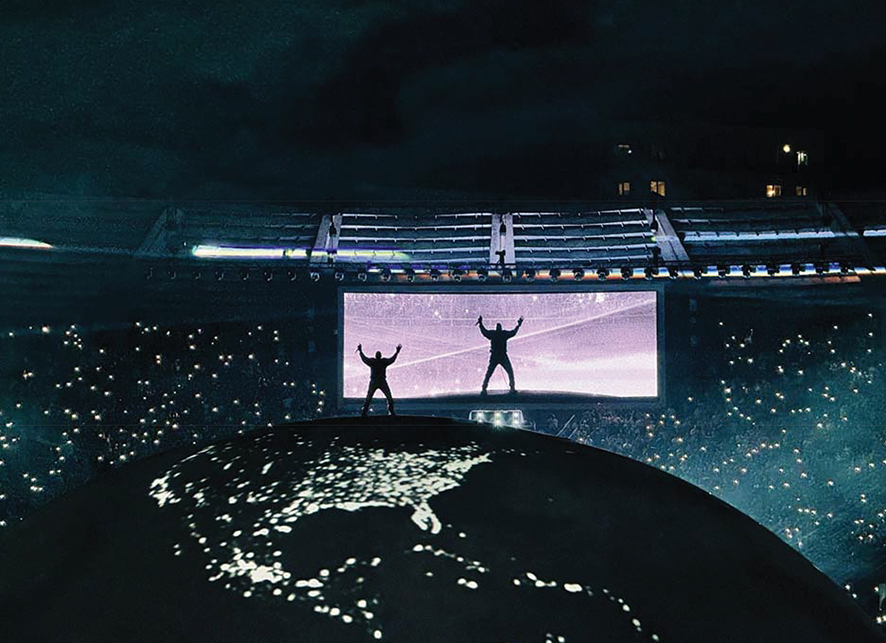
The paradox was painful. Here was an artist who transformed the possibilities of hip-hop production, who taught a generation of musicians to think about texture, silence, distortion, sampling, and the architecture of sound. Yet the audience was placed in a situation where they were asked not to listen but to remember.

The concert worked only for those who already carried the songs inside their heads. A change in rhythm, a familiar bass line, a fragment of a vocal phrase: these became enough for thousands of fans to mentally reconstruct tracks that the venue itself failed to deliver. It was less a concert than a collective act of musical memory.

In this sense, the evening became an unexpected portrait of contemporary fandom. Many people did not come to hear music; they came to document proximity to an event. The glowing screens of smartphones often became more visible than the performer himself. The value of the evening was increasingly located not in the experience of sound, but in the evidence of attendance: the selfie with the stage in the background, the Instagram story proving that one had been there.
The stage design reinforced this contradiction. A giant spherical structure, with Ye moving on top of it for nearly two hours, was clearly intended to create an image of cosmic loneliness or monumental distance. In practice, however, the metaphor quickly exhausted itself. Watching a solitary figure slowly walking around a sphere for such an extended period produced a less philosophical impression, almost as if someone had tied the artist to a planet and he was spending the entire evening looking for a way down.
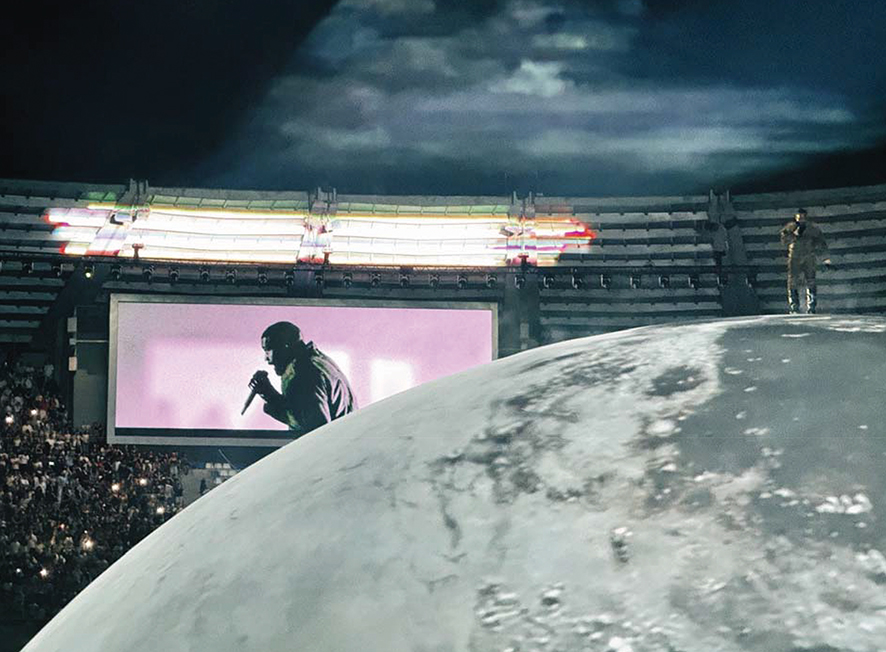
It was an unintentionally comic image: a prisoner of his own mythology. This perhaps captures a broader problem of the contemporary mega-concert. Spectacle has become increasingly detached from performance. The visual icon must be recognizable from a hundred meters away and fit into a fifteen-second video clip. It no longer needs to reveal itself gradually, to reward close attention, or to sustain two hours of live presence.
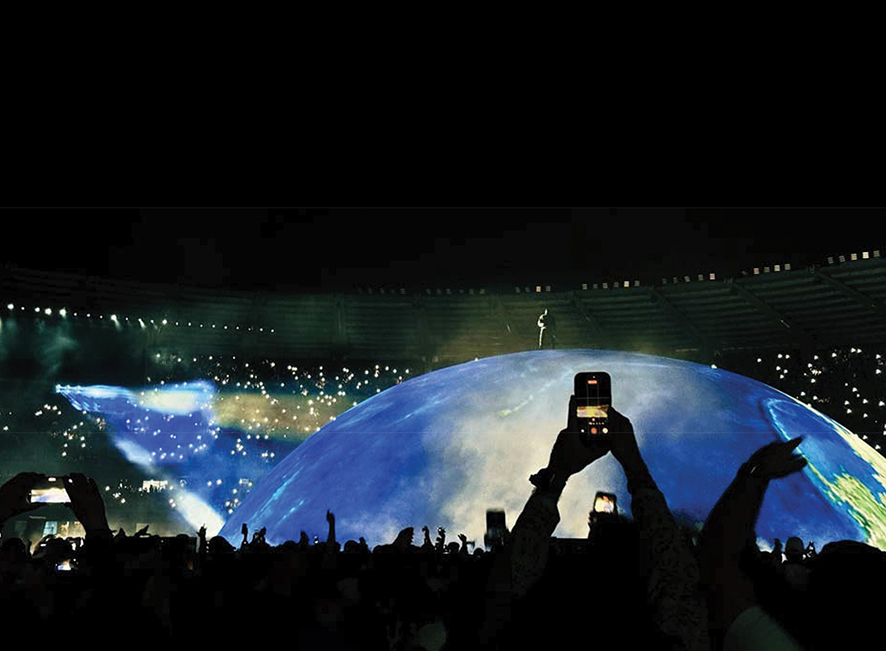
A great concert is built around a fragile exchange between performer and audience: a breath, an unexpected phrase, a change of tempo, a moment when thousands of people suddenly become aware of the same sound. In Tbilisi, that exchange was largely absent. The crowd did not react to what they heard, but to what they knew was supposed to be happening.
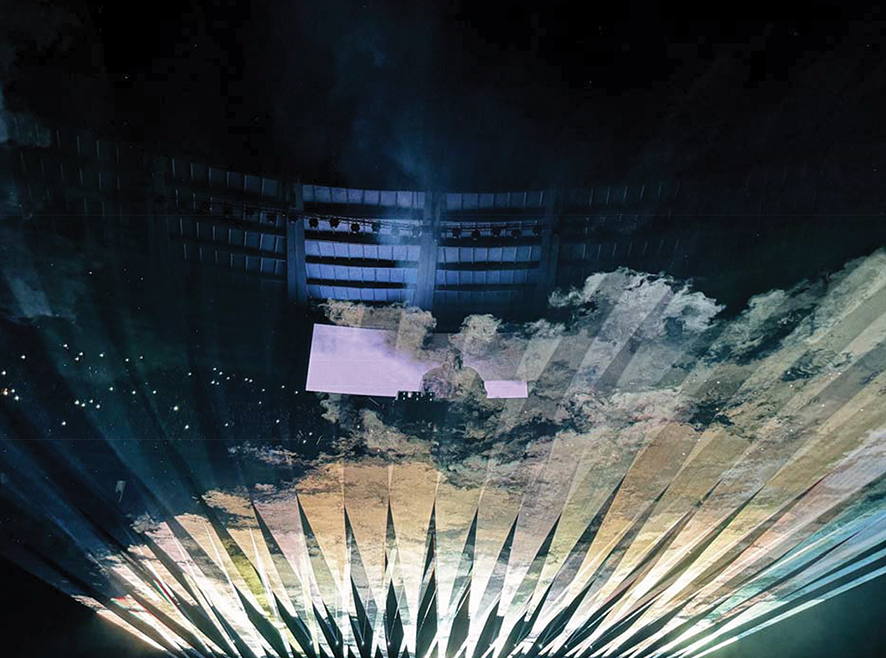
And yet, the evening cannot be dismissed entirely. Its strange power came precisely from this contradiction. It was a failure as a live musical event and a success as a cultural ritual. People gathered not because the performance offered something unique in that moment, but because Ye has already become a historical figure: an artist whose catalogue has entered the collective imagination of the 21st century.
The tragedy of the evening was that one of the most innovative ears in contemporary music was represented by a concert where listening became almost impossible. Perhaps that is the ultimate irony of Ye in Tbilisi: thousands of people came to hear a musician who changed the way the world listens, and spent two hours proving that they no longer needed to hear him at all.
Op-Ed by Ivan Nechaev