In October 2025, the Government of Georgia unveiled its “National Concept for Reforming the Higher Education System,” outlining seven steps to restructure the country’s public university sector. The document portrays Georgian higher education as misaligned with labor‑market needs, weak in international competitiveness, and burdened by duplicated programs across public institutions. On this basis, the reform introduces stronger state steering: redistributing funded places, financing only public universities, narrowing disciplinary offerings in selected institutions, and consolidating institutional profiles by city.
Academic Freedom and Autonomy: International Norms vs. Georgia’s Reform Instruments
In higher education, autonomy is not treated as an ideological luxury; it is an operational condition for quality teaching, credible research, and innovation. The 1997 UNESCO Recommendation defines academic freedom as the freedom to teach, research, publish, and participate in academic bodies without constraint by prescribed doctrine or institutional censorship. The Bologna Process anchors the European Higher Education Area in institutional autonomy and academic freedom. The European University Association (EUA) measures autonomy across four dimensions: academic, organizational, financial, and staffing.
To understand how these international standards compare with the current reform package, the table below summarizes each EUA dimension alongside the corresponding state steering instruments introduced in Georgia. Taken together, the comparison shows a shift from autonomy‑preserving governance toward direct structural intervention.
| Dimension | International standard (EUA) | Observed reform approach (state steering instruments) |
| Academic autonomy | Academic autonomy refers to a university’s power to set student numbers, define admission criteria, introduce and terminate study programs, choose the language of instruction, and determine program content and quality mechanisms.
|
Program closures and quota-setting by field; ‘one city–one faculty/department’ logic reduces institutional choice and differentiation. |
| Organizational autonomy | Organizational autonomy covers the institution’s ability to decide on internal governance structures, select executive heads, determine the role and selection of external members in governing bodies, and create legal entities, enabling universities to pursue their missions under an enabling regulatory framework.
|
Consolidation logic and externally imposed profiling reshape institutional structures and missions by administrative decision. |
| Staffing autonomy | Staffing autonomy concerns a university’s capacity to recruit, promote, and dismiss staff; define salaries and employment conditions; and design internal human‑resources policies free from direct political control.
|
Central steering increases vulnerability to political priorities via funding/quotas; structural uncertainty can trigger staff exits and self-censorship effects. The government has unlimited power in the reorganization process; The new position of leading professor is introduced without the justification of need or proving efficiency of such position internationally or locally. |
| Financial autonomy | Financial autonomy refers to an institution’s authority to allocate internal budgets, set tuition fees, own and manage buildings and assets, borrow funds, and retain financial surpluses, without disproportionate restrictions or earmarking.. | Targeted funding and quotas channel resources to selected institutions/fields, increasing dependency and reducing internal strategic freedom. Restriction to attract international students; Restriction getting funding from families via tuition fee |
Analytically, the key issue is not whether the state may set priorities. It clearly may. The issue is proportionality and mechanisms. In European systems, governments typically pursue objectives through competitive funding, quality assurance, and performance agreements, while preserving universities’ capacity to maintain plural missions, compete, and self‑differentiate. The Georgian reform instruments shown in the table rely more on structural restriction than on quality‑building incentives. By affecting all four autonomy dimensions simultaneously, mechanisms such as quota allocation and program consolidation weaken the balance between state oversight and institutional independence, creating a clear tension between European governance norms and domestic implementation practices.
Quality and Educational Pathways: Compressed Pathways, Reduced Choice: How Reform Reshapes Quality
One of the most far‑reaching ideas linked to the reform is compressing the entire education pathway, fewer years of general schooling and shorter bachelor’s and master’s degrees. Even without debating the exact model, the direction matters. International evidence consistently shows that more years of education correlate with better employment outcomes and major non‑economic benefits, including improved health, stronger civic participation, and lower antisocial behavior. Research exploiting compulsory schooling reforms finds that additional education reduces criminal involvement, while broader OECD reviews link higher educational attainment with social outcomes that support democratic resilience.
From a quality standpoint, compression also moves against the dominant European model, where bachelor’s programs last three years and master’s programs mostly two. Shortening the pipeline forces earlier career and discipline choices, often before students have enough exposure to different fields. Research on early tracking and premature specialization shows that accelerating decisions in this way can widen inequality and lock in disadvantages, contradicting the reform’s stated aim of improving quality and opportunity.
Program Reductions & Access: Fewer Options, Narrower Futures
Program-level changes across high-demand disciplines raise a deeper set of concerns that go beyond quality rhetoric. The current reductions do not simply narrow program portfolios, but they narrow access itself. By concentrating entire disciplines in a single city, the reform effectively limits who can study these fields based on geography, making access contingent on the ability to relocate rather than on academic interest or merit. For students in regional areas, subjects such as political science, business administration, sociology, journalism, computer science, law or international relations may become practically unreachable, even if formally “available” somewhere in the system.
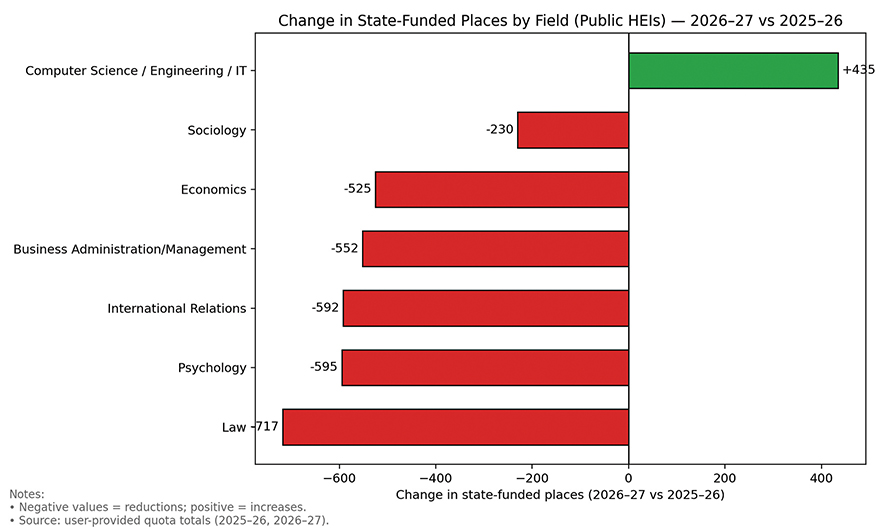
Program‑level changes in high‑demand fields add a structural dimension to the quality debate. The reform does not just shorten the pathway: it narrows it. As the chart shows, state‑funded places fall sharply in Law, Business Administration, Psychology, International Relations, Sociology, and Economics, while only Computer Science/IT expands.
This consolidation also restricts choice across public higher education institutions. Previously, students could select programs based on curriculum focus, institutional culture, research strengths, or pedagogical approaches. Under the ‘one city–one department/faculty’ design, this diversity disappears. Students are left with a single provider per discipline, eliminating the ability to choose between multiple public universities offering distinct profiles within the same field.
The reform additionally abolishes competition among institutions, a key driver of program quality. Strong evidence shows that innovation flourishes in environments where multiple actors operate under quality‑assured competition: too little competition lowers performance, while moderate competition incentivizes improvement. When only one institution is allowed to offer a discipline, benchmarking, academic mobility, and cross‑institutional learning collapse, weakening incentives to innovate or invest in program development.
Concentrating on a field in one institution does not guarantee its sustainability. In fact, it may produce the opposite effect. Disciplines with small cohorts or uneven labor‑market trajectories, such as sociology, become highly vulnerable when only one university is allowed to run them. Without the balancing effect of multiple providers, a single downturn in enrollment, staff departures, or even administrative shifts can render the field academically fragile or non‑viable, putting entire knowledge domains at risk of erosion.
Taken together, these measures reshape disciplinary ecosystems in ways that limit access, restrict choice, eliminate competitive quality pressures, and endanger long‑term sustainability- consequences that contradict both the stated reform goals and international evidence on how robust academic fields are maintained.
Institutional Profiles & Capacity: Reshaping Universities: Expansion, Contraction, and Strategic Loss
The reform aims to redistribute institutional capacity across the public university system. If the reform intends to improve quality, redistribution patterns should reinforce research strength rather than weaken high-performing institutions. Quota data for HEI programs show that the reform is not only about disciplines; it is a redesign of the public university landscape. Some institutions grow, while others face drastic contraction. The scale matters, because it determines whether a university remains multi-profile, research-capable, and regionally relevant.

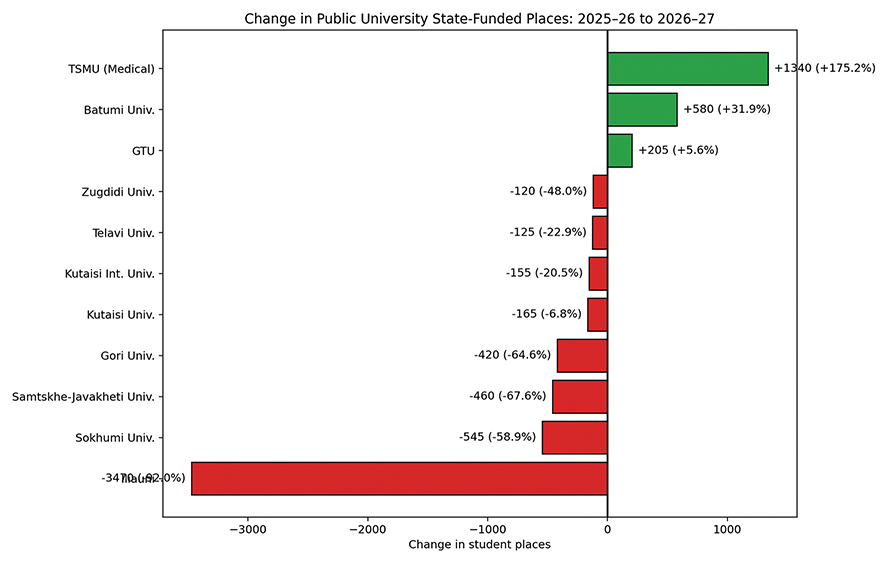
The reform restructures hierarchy within the public system. The chart illustrates the change in student quotas by university between 2025–2026 and 2026–2027. It visually demonstrates which institutions expand and which contract. The magnitude of reductions at Iliauni, Sokhumi State University and several regional universities indicates systemic restructuring rather than incremental adjustment. Ilia State University is the best research university in Georgia; Sokhumi State University holds a specific symbolic and political meaning in Georgia’s higher education landscape as a displaced institution associated with Abkhazia. Treating it as a generic regional institution through major reductions and a narrowed program mission risks eroding this institutional identity and the social function it plays beyond labor-market preparation.
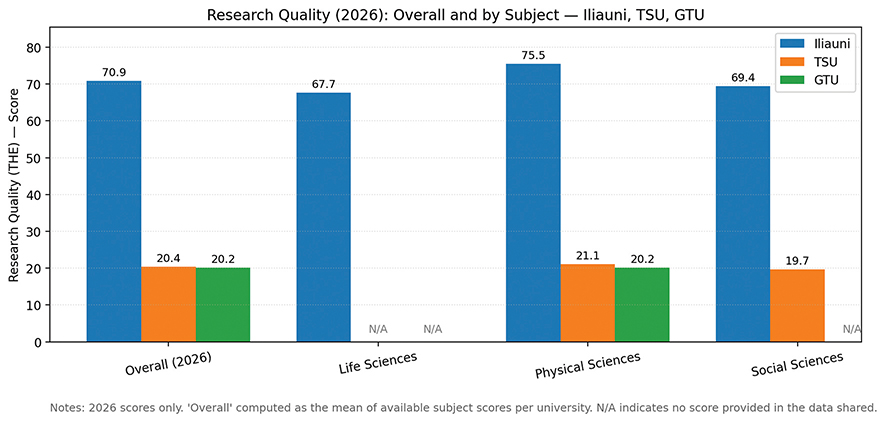
The government frequently invokes low international rankings to justify sweeping restructuring, presenting upward movement in global league tables as a central policy objective. If this is the standard, then Ilia State University (Iliauni) becomes the clearest test of reform credibility. By every internationally recognized indicator, Iliauni is the most influential and best‑performing public institution in Georgia. Times Higher Education (THE) assigns Iliauni its highest weight, 30%, to Research Quality, measured through citation impact. In this metric, Iliauni significantly outperforms all other Georgian universities across overall scores and the subject fields in which it appears, including Physical Sciences, Life Sciences, and Social Sciences. Yet, paradoxically, Iliauni is the institution most negatively affected by the reform: its student intake is reduced by 92% through quota allocation. A reform justified by rankings begins by weakening the only institution that already meets the criteria those rankings reward.
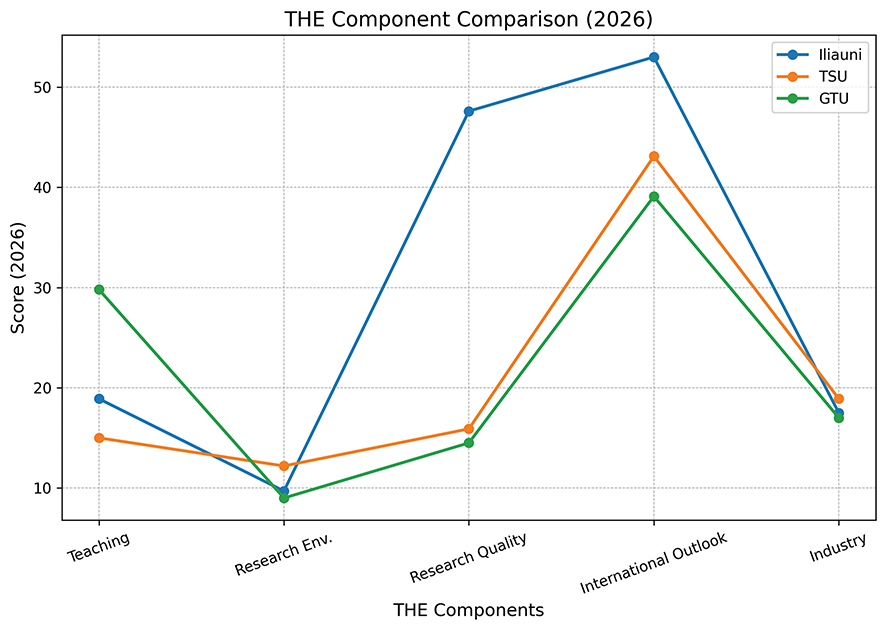
The contradiction extends to International Outlook, another major THE component. Internationalization—incoming foreign students, cross‑border partnerships, and global academic presence—is indispensable for competitiveness. Iliauni scores highest in this dimension as well, consistently outperforming TSU and GTU. However, reform proposals simultaneously introduce a restriction that prohibits public universities from admitting international students, directly undermining the very indicator the government claims to prioritize. Once again, the strongest performer in the field most relevant to rankings becomes the center of policy pressure rather than policy support.
The Times Higher Education component comparison underscores the strategic differentiation among Georgia’s universities: Iliauni leads in Research Quality and International Outlook; TSU shows moderate balance; GTU demonstrates strength in Teaching. Effective policy would recognize and cultivate these complementary profiles. Instead, the reform’s consolidation logic—merging programs and concentrating fields within single public institutions—rests on an assumption that ranking performance is additive. It is not. Citations, the backbone of the Research Quality metric, are average‑impact indicators: merging high‑impact clusters with lower‑impact ones does not raise the average; it risks diluting it. Iliauni’s citation strength cannot be transferred to TSU by administrative decision, nor can GTU’s strong teaching indicators survive being blended into a combined institutional score.
Against this backdrop, cutting Iliauni’s scope and intake while claiming to build global competitiveness becomes the reform’s most visible contradiction. Weakening the only Georgian university positioned to climb global rankings, and restricting the international pathways that underpin those rankings, creates the appearance of a quality reform without substance. The instruments undermine the very goals they are meant to achieve.
Reconcentration Instead of Renewal: The Regional Impact
The objective to achieve regional deconcentration was presented as an important driver for this higher education reform. The proposed regional enrollment redistribution gives the possibility to evaluate whether reform supports balanced territorial development. The chart demonstrates significant reductions in enrollment quotas across regional institutions. The magnitude of reduction supports the analytical claim that reconcentration, rather than regional strengthening, is occurring. Regional universities (Zugdidi, Telavi, Akhaltsikhe, Gori) are not only teaching sites: they are anchors for local human capital, public-sector staffing pipelines, and regional innovation ecosystems. OECD work on higher education and regional development highlights that universities can have disproportionate positive effects in less-favored regions, especially where the private sector is weak and R&D capacity is limited.
Restricting regional program portfolios into a small set of fields creates two predictable consequences. First, it reduces geographic access to popular fields that students choose, shifting opportunity to large cities. Evidence shows that distance and ‘education deserts’ affect enrolment choices and amplify socio-economic gaps. Second, it accelerates demographic brain drain: young people leave and do not return, weakening local labor markets and civic life. The policy narrative often uses ‘regional development’ language while implementing deconcentration. These are opposing logics. Deconcentration requires strengthening regional institutions through quality assurance, partnerships, staff development, and research niches, not stripping them to minimum profiles.
Labor-Market Justification and the Public–Private Asymmetry
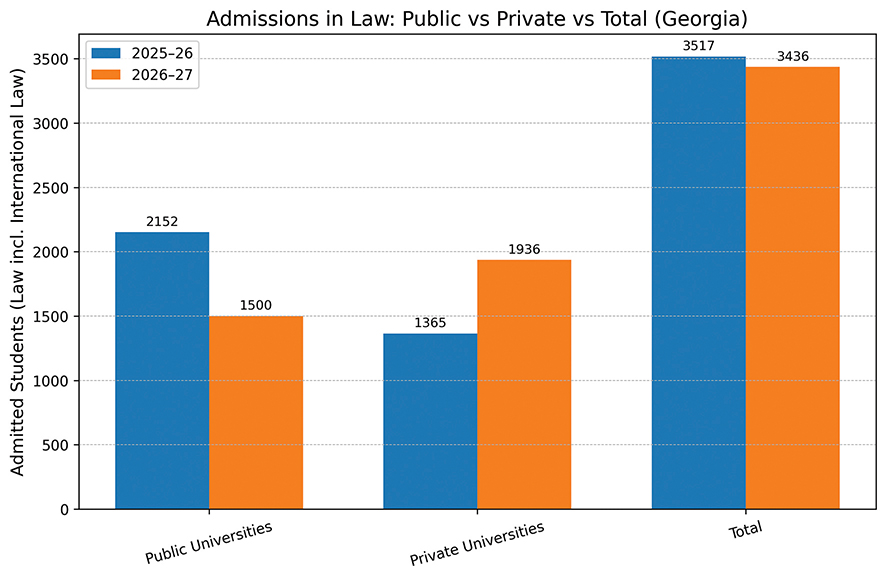
The labor-market justification is structurally coherent across the whole higher education system. If oversupply is the concern, policy must address total graduate output rather than only public universities. The reform appeals to labor-market research but primarily constrains public universities, while private universities are not structurally integrated into the quota logic. This creates a basic policy problem: graduates from public and private universities enter the same labor market. If the goal is to reduce oversupply, policy must address total system output.
In law (including international law), intake data show public-sector admissions reduce sharply based on new higher education reform initiatives, but private institutions retain capacity, including previously unused places. The likely result is overall admission remains close to the previous year, while the public share shrinks. This is a redistribution of who delivers degrees and who pays for them, not system-level labor-market alignment.
Conclusion
When the reform is read as system design, it prioritizes centralized steering, reconcentration, and institutional hierarchy. Yet the empirical patterns (regional stripping, public–private asymmetry, and the targeting of the strongest research performer) create a strong analytical contradiction: the instruments do not align with the declared goals of quality, competitiveness, deconcentration, matching labor market and optimization of scarce resources. A credible quality reform would look different: strengthen quality assurance, fund research clusters competitively, support regional universities’ capacity and differentiation, align labor-market logic across both public and private sectors, and protect academic freedom as a democratic core value. The contradiction between the declared goals and the instruments presented to achieve these goals clearly indicates the hidden political agenda of the higher education reform.
Analysis by Shalva Tabatadze