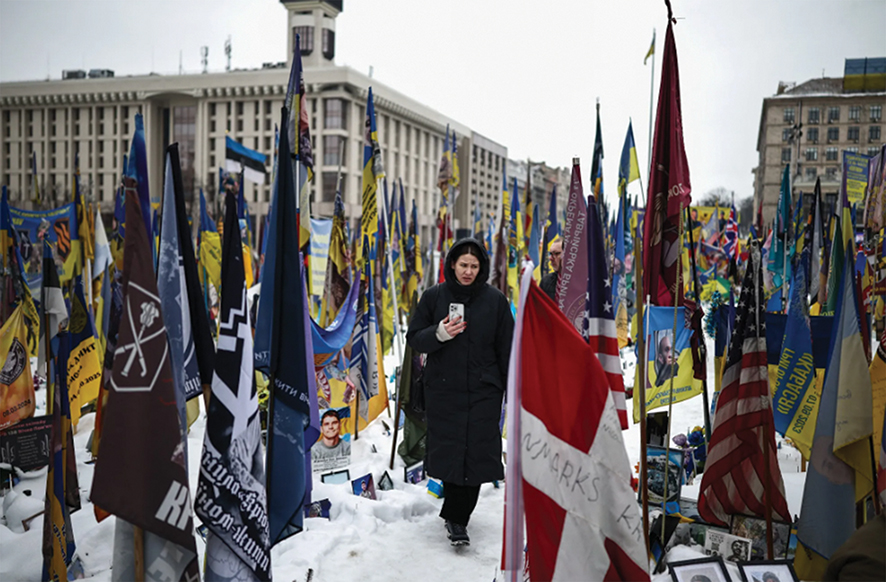
Ukraine entered the fifth year of Russia’s full-scale invasion this week the way it has lived through much of the war: honoring loss, keeping the state functioning, and repairing shattered infrastructure while missiles and drones continued to arrive. The fourth anniversary on February 24 became both a memorial and a diplomatic deadline: an attempt by Kyiv and its partners to show that Ukraine’s struggle is not only about lines on a map, but about a democratic society’s right to exist without being broken by terror strikes and coercion.
That message has been increasingly tied to the human cost of Russia’s air campaign, which has again concentrated on energy: turning winter into a weapon. In the most significant barrage reported this week, Russia launched a large combined attack of drones plus cruise and ballistic missiles aimed primarily at Ukraine’s power system, with damage reported across multiple regions, including Kyiv and Odesa.
Ukrainian officials said at least one person was killed and five injured, alongside damage to residential buildings and rail infrastructure. President Volodymyr Zelensky framed the pressure in stark civic terms, saying Russia’s week of attacks included more than 1,300 drones, 1,400 guided bombs, and nearly 100 missiles: numbers he used to argue that “normal life” is being deliberately targeted through blackouts and fear.
Kyiv has responded with a mix of air defense, long-range strikes, and an intensified push to keep its institutions and international alliances steady. Ukraine’s air defenses said they intercepted a large share of incoming weapons during the energy-focused onslaught, but the broader pattern remains: even when many threats are shot down, the strikes that get through keep forcing emergency shutdowns, repairs, and rolling disruptions. The point, Ukrainian officials argue, is not just physical damage: it is psychological exhaustion, the slow grind of making everyday life harder and making the state look incapable.
Ukraine’s own strikes into Russia also carried a “systems” logic this week, aimed less at symbolism and more at degrading the machinery of war. A notable example was an attack deep inside Russia on the Votkinsk Machine Building Plant, an important defense-industrial facility associated with missile production, where Russian officials reported injuries and damage after explosions. Ukraine also reported strikes on energy and industrial sites elsewhere in Russia, part of a campaign intended to complicate Moscow’s logistics and pressure the economy supporting the war.
Diplomatically, the anniversary week produced declarations of solidarity, but not a breakthrough. On the eve of the war’s fourth anniversary, the European Union failed to agree on its 20th package of sanctions against Russia because Hungary and Slovakia vetoed the measure, blocking the new sanctions and a €90 billion EU aid package for Kyiv. The dispute centers on energy transit: both countries have tied their approval to the resumption of Russian oil deliveries through the Druzhba pipeline, which has been halted following damage in January. EU Foreign Policy Chief Kaja Kallas described the impasse as a setback for unity on Ukraine support, while Kyiv condemned the move as political blackmail.
At the United Nations, the anniversary sharpened the argument that any peace formula cannot be built on partition by force. Reuters reported a UN General Assembly move, calling for a truce and peace, alongside visible diplomatic protests during Russian remarks: signaling how central the “rules-based order” frame remains for many states backing Ukraine. EU leaders also issued an anniversary statement paying tribute to Ukraine’s resistance and reiterating support.
Concrete support packages landed alongside the symbolism. The UK announced a new mix of emergency energy funding, humanitarian aid for frontline communities, training support, and money aimed at justice and accountability for alleged war crimes; an emphasis that mirrors Kyiv’s insistence that a ceasefire cannot mean amnesia. Separately, the UK government said it was rolling out its largest sanctions package in this context and highlighted over £30 million to bolster Ukrainian resilience after winter strikes.
Still, the political realities around Ukraine’s support remain contested. European debates over sanctions and financing, amid concerns about unity, continued to flare, underscoring Kyiv’s worry that battlefield fatigue could eventually become diplomatic fatigue.
For Ukrainians, though, the anniversary week was less about speeches than about staying warm, keeping transport moving, and getting through another night of sirens. The ceasefire conversation is alive, but as long as energy stations, homes, and cities remain targets, Kyiv’s core claim stands: the war’s central front is not only the trenches, but the survival of a democratic society under sustained attack.
Compiled by Ana Dumbadze