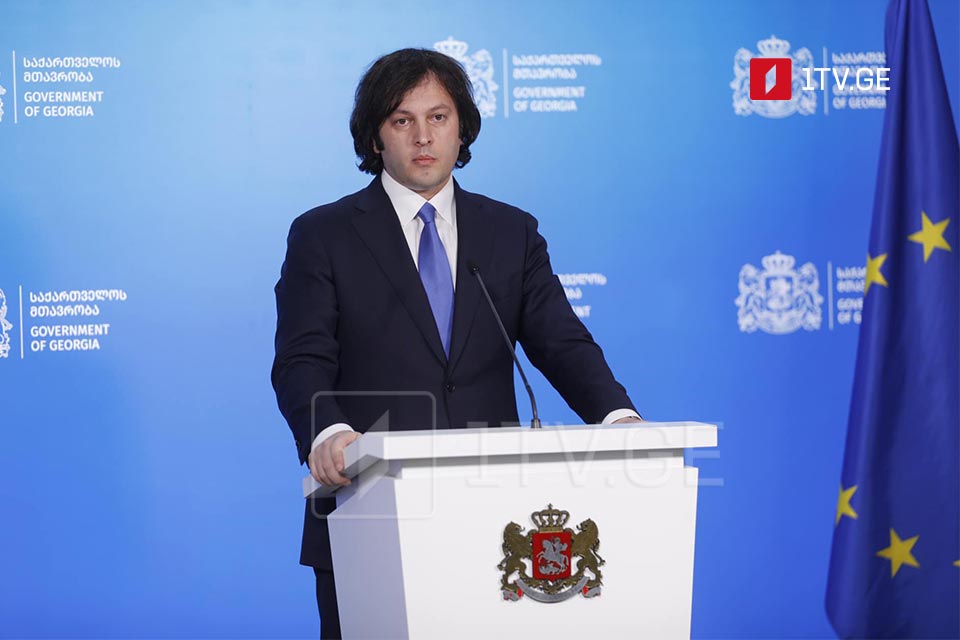
Georgian Prime Minister Irakli Kobakhidze this week said that the government does not plan to revise the laws on “transparency” and “family values”, despite criticism presented in a report prepared within the framework of the OSCE Moscow Mechanism.
Speaking at a briefing at the Government Administration, Kobakhidze said the criticism outlined in the report is not supported by evidence, and therefore does not justify revising the legislation.
“We will not review the laws on transparency and family values, as the criticism in the report is unsubstantiated,” the Prime Minister stated.
Kobakhidze acknowledged that certain practical shortcomings identified in the elections should be addressed, noting that preventing misconduct remains an ongoing responsibility.
However, he rejected a number of other claims included in the report as false.
“For example, the report mentions ‘torture,’ even though the author herself acknowledges that no torture was established,” he said.
The Prime Minister also dismissed criticism of the transparency legislation, arguing that it lacks factual basis and ignores broader political realities.
Kobakhidze claimed that the report fails to consider what he described as five attempted coups in Georgia over the past four years, allegedly involving foreign-funded non-governmental organizations.
He stressed that, under universal legal principles, external interference in the internal political affairs of a sovereign state constitutes a serious violation of sovereignty.
“The purpose of the transparency legislation adopted by the Georgian Parliament is to protect Georgia’s sovereignty and democratic system from such interference,” he said.
Kobakhidze further criticized the report as politically motivated and lacking objectivity, claiming it was prepared to serve “narrow political interests.”
He also alleged that the Polish author of the report failed to disclose a potential conflict of interest related to ties with the Polish government.
Prime Minister claimed that the report does not meet “even minimal standards of objectivity” and lacks depth — a point he noted the author herself acknowledged due to time constraints.
The Organization for Security and Co-operation in Europe Moscow Mechanism is a tool that allows participating states to initiate independent fact-finding missions on issues related to human rights and democratic governance.
While such reports are not legally binding, they often carry significant political weight in assessing a country’s democratic environment.
Georgia’s transparency and foreign influence-related legislation has been the subject of ongoing domestic and international debate, with the government arguing it is necessary to safeguard sovereignty, while critics warn it may restrict civil society and democratic freedoms.
Further developments are expected as discussions continue both within Georgia and among international partners.
Related story: 24 OSCE states urge Georgian government to implement Moscow Mechanism recommendations