
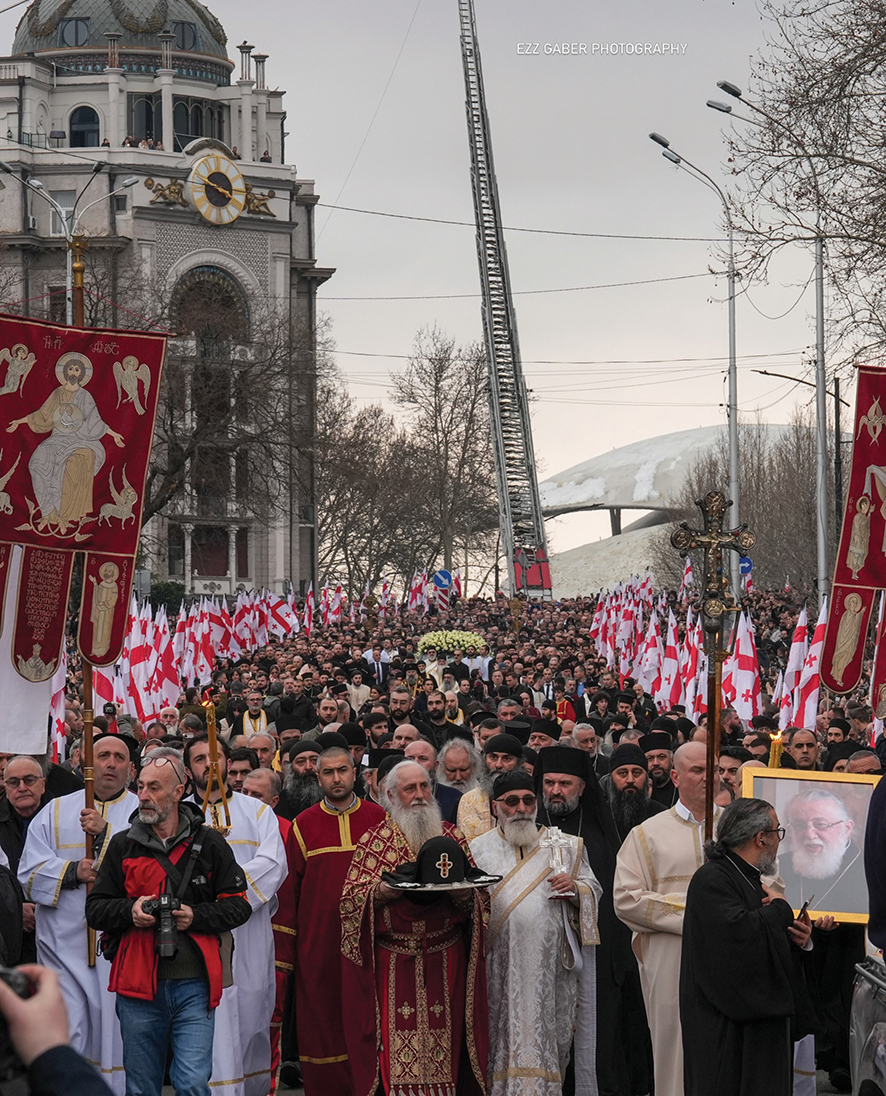
Could the divine transfiguration of the Patriarch serve as a happy harbinger of national unity in Sakartvelo? The heartbreaking demise, populous memorial services, and mournful committal of our beloved nonagenarian spiritual father call for earnest and heartfelt reflection. His Holiness and Beatitude, the 141st Catholicos-Patriarch of All Georgia Ilia II, was the longest-serving patriarch in the history of the Georgian Orthodox Church, whose passing is not regarded, both nationally and internationally, as a routine religious event. His death is not merely the expiry of another person, but the closing of an entire historical chapter, the end of a father-figure era. Even more, it is rather seen as a unique confluence of faith, national identity, and historical consciousness.
The all-out homage to his memory should probably be understood as an unquestionable sign of eternally cherished national unity, an unbelievably widespread expression of what we believe ourselves to be. Not many religious leaders are favored enough by fortune to command such universal reverence among believers and respect across social and political lines, which is an irrefutable symbol of the Patriarch’s extraordinary moral authority. If the entire nation mourns so naturally and discernibly, then the great man will not be considered merely a church leader, but a moral pillar of the state. Comparably, the funeral of Pope John Paul II attracted global attention as a token of a loud civilizational echo.
For an outsider watching the process, the whole event might seem striking because this sorrowful affair serves as undefeatable evidence of the centrality of faith in Georgia, which is perhaps not just a religious institution but a core mast of our society. There is also a layer of historical interpretation of the event, illuminated by the belief that the church has always been there when Georgia needed to survive empires, occupations, and ideological suppression, such as Soviet dogma. Thus, the Patriarch’s life and work serve as a bridge between past and present, tradition and modern statehood.
And if we truly unite after this, our national cohesion may surprise the entire world because it will be something very new for contemporary polarized societies. The world was watching us with bated breath, not very clearly understanding what was really going on. This is a fresh cultural image for external spectators: mass mourning, silent crowds, well-behaved children, ancient liturgy, millions of lit candles everywhere—not only in shrines, but also in private homes. The global eye was focused on a deeply spiritual, tradition-rooted nation, evoking dignity and continuity, but also raising questions about the balance between religion and modern governance in Georgia.
The Patriarch’s emotional legitimacy was so enormous that his passing will sooner create a psychological void throughout the nation than leave a simple, though lasting, memory of His Holiness. There is no doubt that Georgian Orthodoxy will remain powerful enough to have the same magnitude of influence over its now-orphaned parish, but my gut feeling is that, without the beloved Patriarch’s charisma, certain currently unknown larger or smaller chasms might emerge within the church itself. A nationwide question might arise: are we the same good people without him, or what will hold us together now—traditional deep faith, a strong state, or some divine power that is still on its way to arrive? Something stabilizing has left us, and the sense of bereavement might linger for a while, if not for good.
Concerning the external gaze, attitudes might differ greatly. Churches like the Russian Orthodox Church and the Ecumenical Patriarchate of Constantinople issued strong, respectful statements, emphasizing the Georgian Patriarch’s role as a bridge figure and moderating force in current Orthodoxy, although some uncertainty may ensue. Regional neighbors like Armenia and Azerbaijan responded with genuine respect. The Western world reacted diplomatically, highlighting his role in preserving national identity and his influence, but without deep emotional engagement.
Now the most crucial and very uncomfortable question is whether the grief we are experiencing truly harbors the potential to unite the nation, or whether it is only a fleeting illusion that will momentarily disappear after His Beatitude has been entombed. My brief and dry answer (and many might join me in this presumption) is that we might unite briefly, but not perpetually. It feels extremely good that our habitual political divisions are temporarily suspended, politicians and journalists being overly prim and reserved, dressed on air in their smart mourning weeds.
One thing is absolutely certain, though: a message has been sent to the entire world that some latent power is vibrant within the depths of this nation, which might reveal itself at the very moment when our identity is challenged for some reason, the godly words “I am who I am” being very true in our case.
Finally, to put it mildly, I don’t really know if Ilia II united this nation. He more often smoothed and delayed its internal iniquities and contradictions, coping with which seems impossible for anyone with any possible moral, intellectual, or political strength. As it now seems, this nation is verily a hard nut to crack.
My modest presumption is that the Patriarch’s death will neither unite nor divide the Georgian people. It could reveal some chasms and gaps that had existed before, but were dormant until now. I cannot be sure whether these holes could easily and immediately be patched up or not.
Right now, in line for the sacred memorial service, and in the immediate aftermath of our present life, when we are mourning and breathing together in one tormented soul and one saddened voice, when pain is pain and tears are tears, we truly feel like one body. And this is a real test of our endurance and chance to survive. The grateful believers in God and Him walked the holy man’s precious, blessed body all the way from Sameba to Sioni, both sacred and both elevated as never before.
As the unusual moment dictates, let the weeping nation incant together once again—Our Father who art in heaven.
Op-Ed by Nugzar B. Ruhadze









