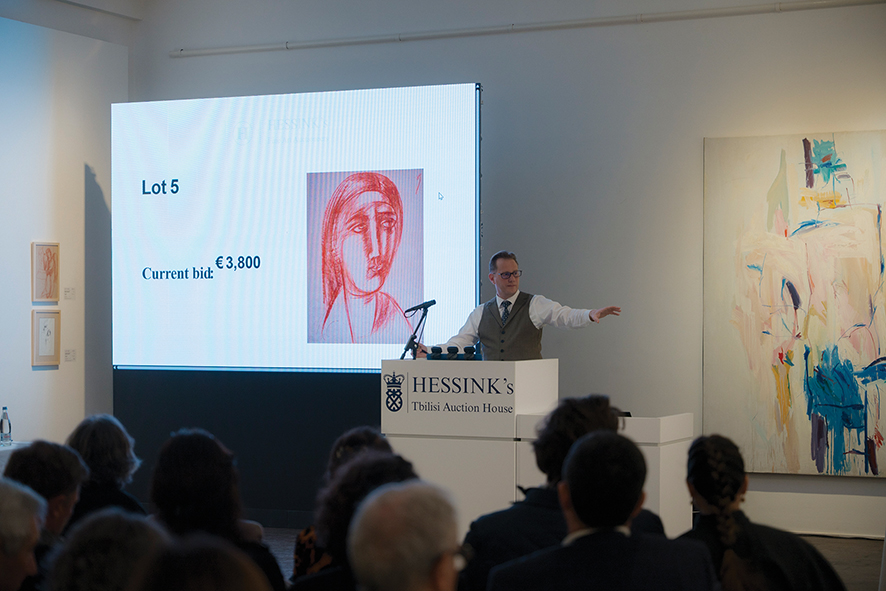
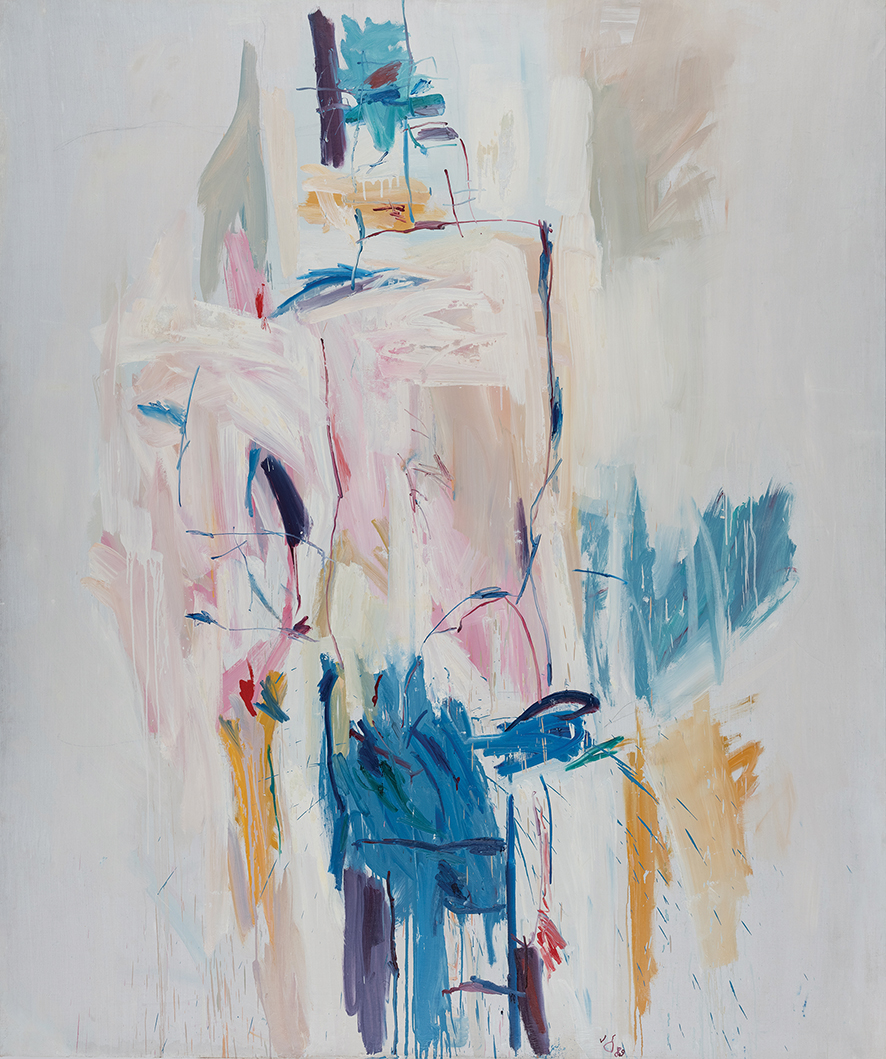
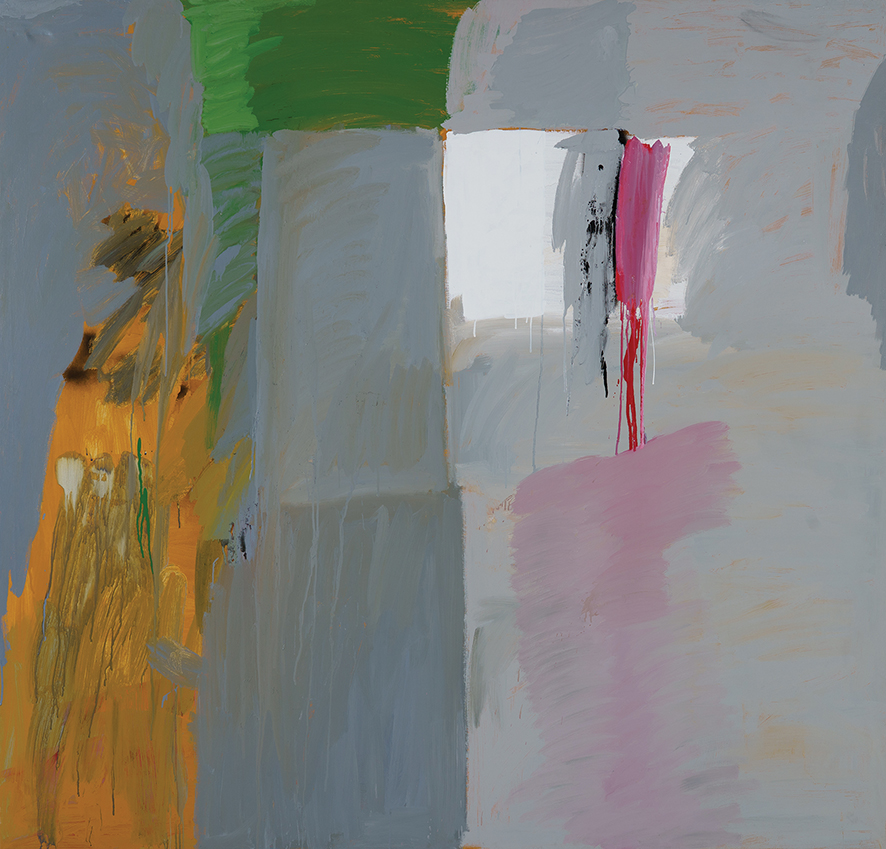
In a packed hall, emotional tension reaches its peak. The low hum of phones, restless movement and tightly held expressions fill the room. “One, two, three, sold!” announces Bradley Hessink, sharply bringing the gavel down on the table. Alexander (Shura) Bandzeladze’s monumental abstract canvas Dream of Noah (1989) is acquired by an anonymous buyer for €250,000, a price 25 per cent above estimate and unprecedented for Georgian contemporary art.
A record has been set. Never before has such a sum been paid for a work by a modern Georgian artist. Until now, the highest price achieved for a Georgian artist at auction, peaking at around €2.5 million at Sotheby’s, has been associated with Niko Pirosmani, one of the country’s most internationally recognised artists.
A 100% Sale in an Unfamiliar Market
The result was not only a record but a clean sweep: all 90 lots sold. In auction terminology, this is known as a “white glove” sale, a rare outcome in which every work finds a buyer. The term is more often associated with leading houses such as Sotheby’s or Christie’s and signals both accurate pricing and depth of demand.
For Tbilisi, however, such an outcome is almost without precedent. International auctions remain a relatively recent phenomenon in the city, and this was the first fully realised global sale dedicated exclusively to Georgian modern and contemporary art held on Georgian soil. Even so, market participants describe it as a turning point in the country’s cultural and financial positioning.
The auction was organized by the Dutch house Hessink’s Fine Art Auctioneers, known for early sales of works by Banksy and for its expanding presence in emerging art regions. Founded in Maastricht in 1997, the company has operated in Tbilisi since 2007 and has built a reputation as one of Europe’s fast-growing specialist auction houses. Last year, it also sold a rare Gibeon meteorite for €2 million.
A Catalogue Across a Century
The sale, titled Georgian Modern and Contemporary Art, brought together around 90 works spanning nearly a century of artistic production, from early modernist experiments to contemporary practices shaped by post Soviet transformation.
Among the historical anchors was Vera Pagava, whose Paris based modernism was shaped by the European avant garde. Alongside her stood Alexander Bandzeladze and Avto Mosiashvili, pioneers of Georgian abstraction who developed a unique visual language under the constraints of Soviet ideological pressure.
Contemporary positions included Iliko Zautashvili, Lia Bagrationi and Mamuka Tsetskhladze, alongside younger emerging artists. Rather than presenting a linear narrative, the catalogue created a compressed field in which different generations and political realities were placed in direct proximity.
Record Prices Across Generations
The strongest result of the evening came from Bandzeladze’s Dream of Noah. A second work by the artist sold for €150,000, confirming sustained demand for his large scale abstractions. Often described as a foundational figure in Georgian abstract expressionism, Bandzeladze is also credited with mentoring an entire generation of abstract artists during the Soviet period.
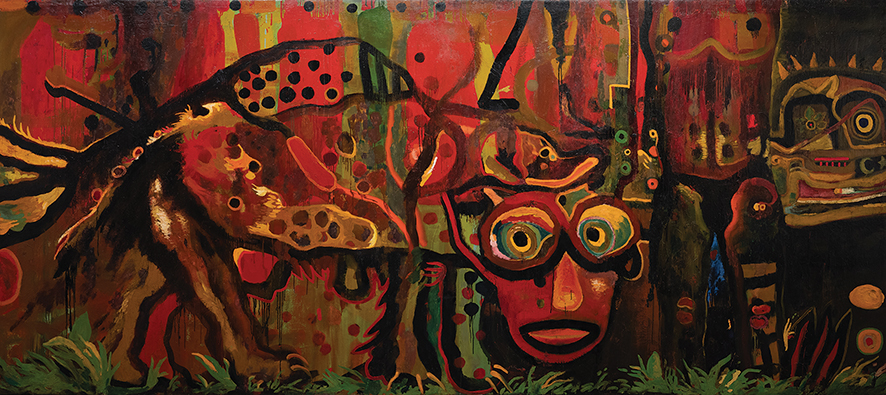
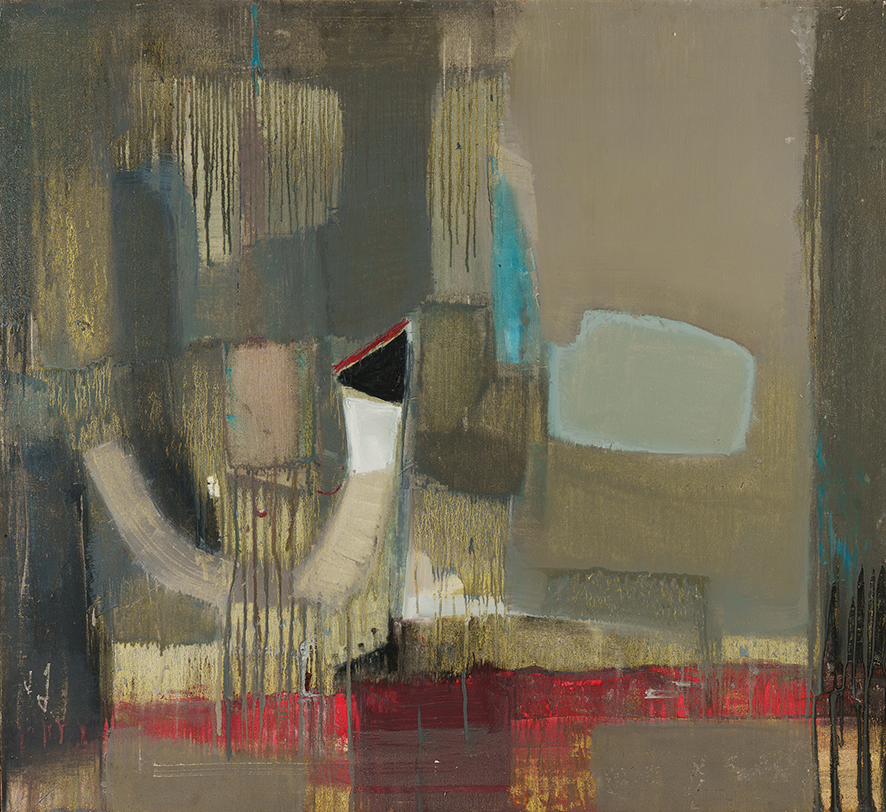
Another major result came from The Tiger by Mamuka Tsetskhladze, which achieved €120,000. The painting had recently been returned to Georgia from France, where it had remained in a private collection for nearly three decades.
Among mid tier highlights, Iliko Zautashvili’s untitled abstraction sold for €65,000, within its estimate range, while Vera Pagava’s Woman reached €35,000.
Non painting works also performed strongly. Lia Bagrationi’s installation 13 Aquarium and a Fish achieved €30,000. One of the most competitive moments of the evening came with Guela Tsuladze’s Armchair, estimated at €3,000 to €5,000. A bidding duel between a Swiss collector and a Georgian buyer pushed the final price to €13,000.
A Global Room in Tbilisi
The sale took place at the Museum of Modern Art Tbilisi, where more than 300 guests filled the room. Behind the scenes, the atmosphere was equally intense: Hessink’s team worked continuously on phones as bidding unfolded simultaneously across platforms.
The auction was streamed globally via Hessink’s own platform, as well as through Drouot and Invaluable, with several thousand viewers following online. Bidders were predominantly from the United States, the Netherlands, Belgium, Australia, Spain and Switzerland.
Despite the international reach, the highest in room result remained relatively modest compared with telephone and online bidding, underlining the globalization of demand even for locally staged sales. The top in room price was achieved by Merab Kopaleishvili’s Deer, which sold for €10,000.
“The Market Is Always Searching for Something New”
For Bradley Hessink, the Georgian auction is both strategic and personal. “How do you fall in love with something?” he says. “All of a sudden it strikes you, you are blown away.”
He describes a gradual attachment to Georgia built over years of engagement, strengthened through local partnerships and a shared commitment to Georgian culture. “The market is constantly searching for something new,” he adds. “There is an abundance of artworks, but collectors have seen everything. They are experienced and always looking for something fresh.”
He argues that auctions, unlike galleries with fixed prices, introduce a mechanism of competition. “When several people want the same work, they have to fight for it. That drives prices.” In his view, global promotion across Europe, the United States, Asia and beyond does not merely reflect demand but actively generates it, establishing price benchmarks that feed back into the broader market ecosystem.
Reclaiming Georgian Art History
The auction functioned as a condensed survey of Georgian art history. Works drawn from private collections, galleries and foundations including the Art Foundation Anagi collection, Vere Gallery, Gallery 4710, Chardin Gallery, Photoatelier, Dédicace Gallery and The Why Not Gallery were brought together in a single curated environment.
Rather than separating periods, the sale collapsed them. Modernism, Soviet era abstraction and contemporary practice appeared side by side, creating what might be described less as chronology than simultaneity. As Thea Goguadze-Apfel, who curated and selected all 90 lots, notes: “This is not about rewriting history, but about allowing fragmented visibility to enter a shared field.”
For her, the project addresses a long standing structural absence. “For decades, Georgian art was grouped under ‘Russian’ or ‘Eastern European’ categories,” she says. “Only recently has it begun to be seen as a category in its own right.” She adds that geopolitical rupture has paradoxically accelerated recognition. In 2025, Bonhams presented Georgian Art Now in London, achieving around €240,000 in sales with 64 per cent sold, an early signal of category formation. She was also among the key figures behind Bonhams’ first dedicated Georgian auction following an earlier Georgian-Armenian sale in 2023 initiated with Baia Gallery.
“Georgian artists were invisible for too long,” she adds. “Now Tbilisi is becoming an important centre in its own right. We are asserting a degree of cultural sovereignty and placing Georgian art more firmly on the international map. This is only the beginning.”
Finance, Culture and the Making of a New Art Market in Tbilisi
The auction also reflected growing institutional alignment between the art market and the financial sector in Georgia. It was supported by leading local financial institutions, including wealth management services and insurance providers, signaling increased confidence in art as an asset class. Such partnerships are increasingly significant in emerging markets, where cultural infrastructure and financial systems often evolve in parallel rather than sequentially. In this context, visibility is not only cultural but economic.
The Tbilisi auction signals a broader reconfiguration. For decades, Georgian art circulated internationally in fragments through exhibitions, private collections or secondary markets abroad. By staging a full scale international auction within the city itself, that structure was partially inverted. The mechanisms of valuation and comparison were temporarily relocated to Georgia rather than imposed externally. What emerges is not simply a national milestone, but a regional repositioning.
Hessink’s Auction House’s calendar already includes a further sale scheduled for autumn. Whether this momentum can be sustained will depend on continued demand, repeat transactions and the stability of price levels established in this inaugural sale.
For now, the figures stand clearly: 90 lots, 100 per cent sold, a hammer total of €1,019,070, and aggregate sales exceeding €1.3 million.
In a city where international auctions were once absent, the hammer has fallen. For the first time, it does not simply conclude a sale.
It marks the beginning of a market trying to define its place on the global map.
By Team GT