17-year-old Georgian reaches the Latvian Open final after defeating four experienced European opponents
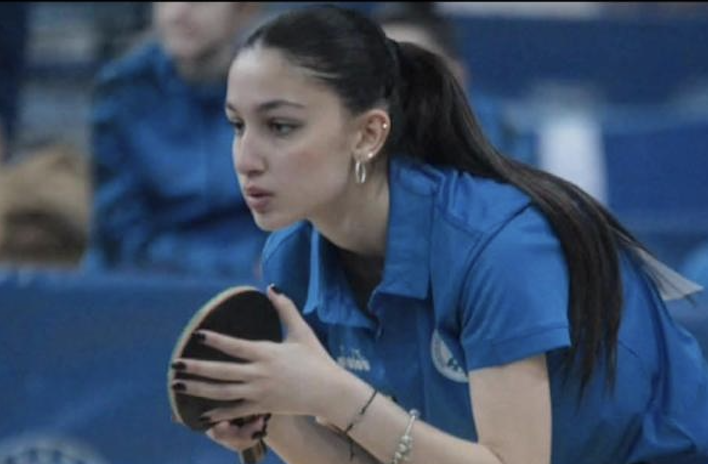
RIGA, LATVIA — Georgian table tennis teenager Anastasia Chkhartishvili made a major statement on the European stage at the Latvian Open, reaching the women’s singles final and claiming a remarkable silver medal at just 17 years of age.
Held in Riga from 6–9 August, the ranking event brought together strong players from 11 European countries, providing a high-level test for the young Georgian.
Seeded No. 14, Chkhartishvili produced a remarkable run through the draw, defeating four experienced European opponents on her way to the final.
And she did it in emphatic fashion.
Four opponents. Four victories. One historic run.
Chkhartishvili opened her campaign against Estonia’s Angela Laidinen, a multiple-time Estonian champion across different age categories and the winner of the 2026 Estonian Women’s Cup.
The Georgian teenager immediately set the tone, controlling the match from start to finish and securing a convincing 3–0 victory.
In the next round, another experienced opponent awaited her — Finland’s Maria Girlea, a bronze medallist at the Finnish Championships.
Once again, Chkhartishvili produced a composed and highly effective performance, recording another 3–0 victory.
Two matches. Two clean sheets.
But the biggest test was still to come.
The comeback that changed everything
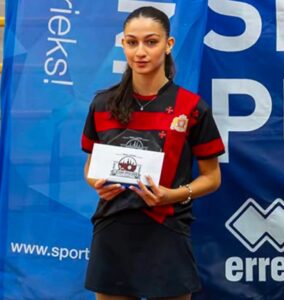
In the quarter-finals, Chkhartishvili faced experienced Dutch player Dobrila Jorguseska, a player with significant international experience and major results on her résumé, including a London Grand Prix women’s singles title and a Dutch national title in women’s doubles.
The match began badly for the Georgian.
She narrowly lost the opening game 10–12.
But rather than allowing the setback to affect her, Chkhartishvili responded with one of the defining performances of her tournament.
She adjusted her tactics, disrupted Jorguseska’s rhythm and began dictating the exchanges on her own terms.
The 17-year-old completely turned the match around.
Chkhartishvili defeated Jorguseska 3–1.
It was one of the tournament’s biggest upsets — and it sent the Georgian teenager into the semi-finals.
Another statement in the semi-final
Waiting in the last four was 20-year-old Lithuanian Maria Mikalauskytė, who had already won the U21 title at the same tournament.
But Chkhartishvili showed no signs of slowing down.
Playing with confidence, intensity and tactical discipline, she produced another outstanding performance to defeat Mikalauskytė 3–0.
Four rounds.
Four victories.
And a place in the Latvian Open women’s singles final.
A 17-year-old in a European final
Chkhartishvili’s final opponent was 28-year-old Estonian Airi Avameri, an eight-time Estonian women’s singles champion whose career-best world ranking reached No. 196.
Despite the significant difference in age and experience, Chkhartishvili showed from the opening point that she had no intention of simply making up the numbers.
She started the final aggressively, playing at a high tempo and taking the initiative early in the rallies.
The strategy worked.
Chkhartishvili took the opening game 11–7.
Avameri, however, used her experience to change the rhythm of the match. As the final progressed, the Estonian managed to put greater pressure on Chkhartishvili’s attacking game and gradually turned the momentum in her favor.
The third game proved particularly decisive.
With the score at 9–10, Chkhartishvili received an uncomfortable ball on her forehand and was unable to execute the shot cleanly, sending the ball beyond the table.
The score moved to 1–2.
Despite the setback, the Georgian continued to fight until the final point.
Avameri eventually secured a 3–1 victory and the Latvian Open title.
For Chkhartishvili, however, the result was still a major breakthrough.
At just 17, she was a European women’s singles finalist.
More than a silver medal
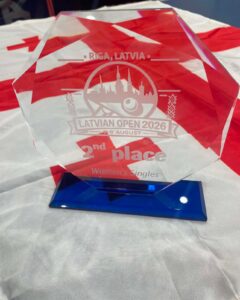
Chkhartishvili’s achievement in Riga goes far beyond the medal itself.
As the No. 14 seed, she defeated four players with greater age and international experience:
Angela Laidinen — 3–0
Maria Girlea — 3–0
Dobrila Jorguseska — 3–1
Maria Mikalauskytė — 3–0
The run demonstrated the qualities that are increasingly defining the young Georgian player: tactical maturity, discipline, confidence under pressure, mental resilience and an exceptional fighting spirit.
Most importantly, Chkhartishvili proved that she can compete not only within her own age group, but also against senior European players with considerably more international experience.
For Georgian table tennis, that is perhaps the most significant message to come out of Riga.
A strong result for Georgian table tennis
Two Georgian players competed at the Latvian Open with funding from the Georgian National Table Tennis Federation and the support of the Georgian Ministry of Sports.
Alongside Chkhartishvili, 20-year-old Nini Lipartia represented Georgia at the event.
The Georgian players finished 5th in the U21 competition.
In the women’s singles event, Lipartia was unable to show her full potential after suffering a minor injury and finished the tournament in 20th place.
The overall performance in Riga nevertheless represents another positive step for the development of Georgian women’s table tennis.
Next stop: WTT Youth Contender Tbilisi
The next major international challenge for Georgia’s young players is already on the horizon.
From 27–30 September, Tbilisi will host a WTT Youth Contender at the Tbilisi Olympic Palace, bringing together young players from around the world across the U11, U13, U15, U17 and U19 age categories.
For Georgian table tennis, the tournament will be another opportunity for the country’s rising generation to compete against some of the strongest young players internationally.
And after Anastasia Chkhartishvili’s breakthrough performance in Riga, expectations will be high.
The silver medal at the Latvian Open is more than an individual achievement. It is a powerful signal that a new generation of Georgian table tennis is ready to make its mark on the European stage.
Riga may have brought Anastasia Chkhartishvili a silver medal — but it may also have marked the beginning of something much bigger.