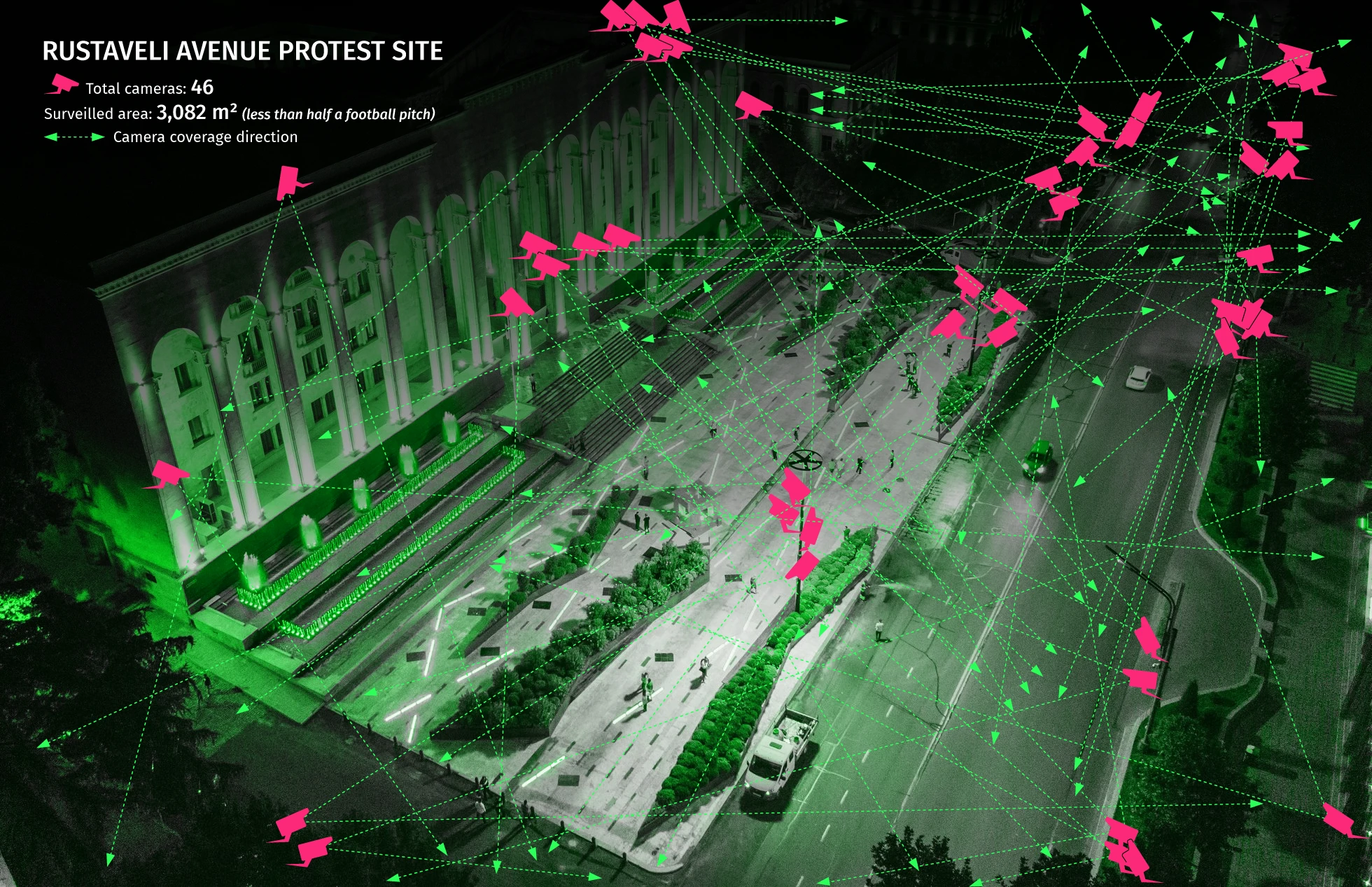
“How Russian Surveillance Software Suppresses Georgian Civilians Rights” is the title of an investigation by AlgorithmWatch, which examines how algorithms and AI systems affect human rights and democracy.
The report says that since 2013, Georgia’s Ministry of Internal Affairs has been purchasing the Polyface facial recognition system from Moscow-based Papillon AO, a company linked to Russia’s Federal Security Service (FSB). It adds that the firm is sanctioned by Switzerland, Ukraine, Japan and the United States.
AlgorithmWatch notes that the latest version, Polyface 3.7.0, was delivered to the ministry in early June 2025, by which time mass identification of protest participants and fines had already begun.
The investigation says the system, developed by Russian company 3DiVi, can capture high-resolution images in crowds, including in low light, and identify faces even when partially covered.
It also says the system can link faces to a “unified information bank” of civil registry photos and search images from social media and other databases, following a 2024 request from the ministry.
Based on tender documents and technical data, AlgorithmWatch outlines three possible uses: real-time automated scanning of crowds, manual operator-controlled identification, and targeted tracking of individuals flagged in pre-loaded watchlists.
The report concludes that while similar surveillance technologies exist globally, their use in Georgia raises human rights concerns, with the Georgian Young Lawyers’ Association also saying such tools have been increasingly used against protests since late 2024.