A joint Armenian-Italian archaeological expedition has concluded its 2026 excavation season at the Shamiram archaeological site in Armenia’s Aragatsotn Province, making discoveries that researchers say could reshape understanding of the region’s pre-Urartian history.
The excavation, carried out from late May through late June, focused on establishing the chronology of the fortified rocky plateau, which has been inhabited continuously from the Late Bronze Age through the medieval period.
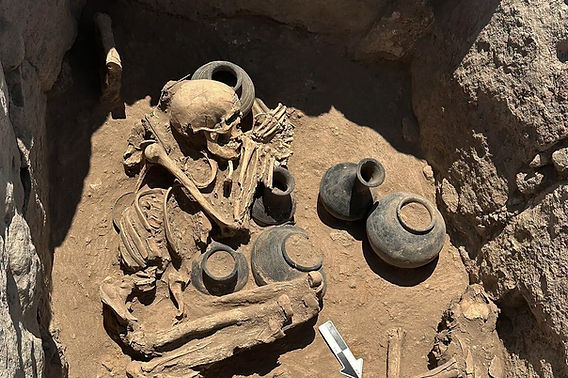
One of the season’s most significant discoveries was made in Tomb 3, a monumental Late Bronze Age burial complex. Archaeologists uncovered a central stone burial chamber surrounded by concentric stone rings.
The tomb contained numerous grave goods, including bronze weapons, metal and obsidian arrowheads, as well as the remains of a horse believed to have been ritually sacrificed. Researchers say the finds provide important evidence about the burial practices and social status of local elites during the Late Bronze Age.
Excavations also revealed previously unknown pre-Urartian occupation layers. Behind one of the fortress towers, archaeologists uncovered a Middle Iron Age room showing traces of fire, built above an even older burial that predates the construction of the fortress itself.
Research team says the sequence offers a rare and well-preserved insight into the development of local Iron Age communities immediately before the expansion of the Urartian Kingdom across the region.
The expedition also uncovered part of the site’s massive fortifications, including a well-preserved megalithic tower measuring approximately 8.5 by 8.5 meters. Archaeologists also found evidence indicating that the fortress gates were reconstructed during the Hellenistic period.
With fieldwork now complete, the recovered artifacts will undergo laboratory analysis as part of the next stage of the project, which is co-financed by Italy’s Ministry of Foreign Affairs.
Image source: The Armenian Report