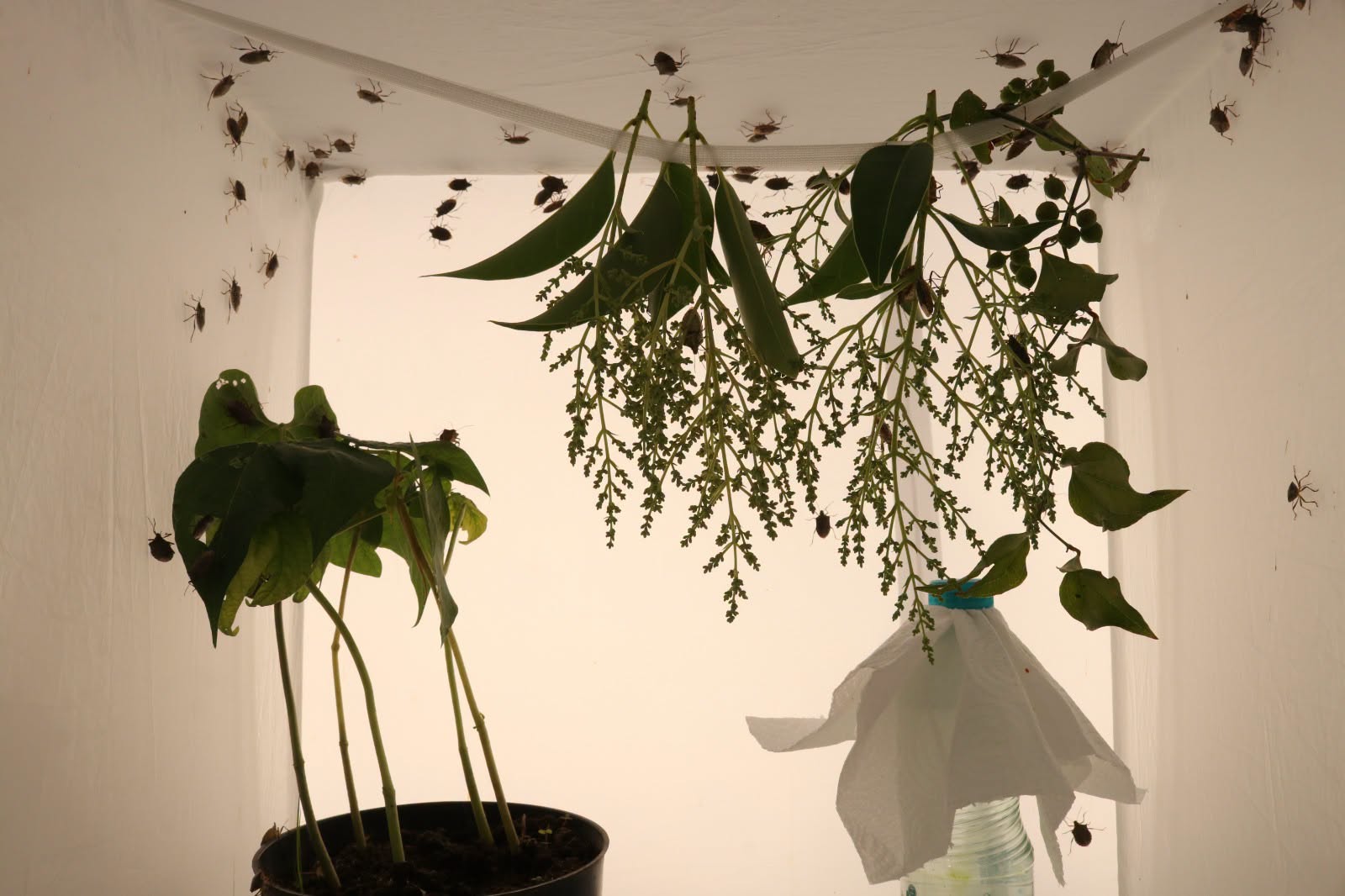
Specialists from the National Food Agency and the Scientific Research Center have begun testing a natural enemy of the Asian stink bug, the Japanese parasitic wasp (Trissolcus japonicus), in field conditions.
More than 30,000 Japanese parasitic wasps were released at 370 specially selected locations where chemical treatments against the Asian stink bug are not carried out. Specialists will monitor the spread of the insect and assess its impact on the pest population.
“Georgia is carrying out large-scale measures against the Asian stink bug. At the same time, like leading countries around the world, we are actively working on developing biological control methods. The Japanese parasitic wasp is one of the most promising biological agents in this field, but assessing its effectiveness and ability to control the pest population requires long-term observation,” Zurab Lipartia, Deputy Head of the National Food Agency, said.
The Japanese parasitic wasp was first identified in Georgia by specialists in 2023 in Zugdidi Municipality. Its presence was later confirmed by scientists from the University of Turin. With the support of the National Food Agency, relevant infrastructure was established at the Anaseuli Laboratory of the Scientific Research Center, while cooperation began with Swiss, Italian and Turkish scientists to study the insect’s reproduction and potential phytosanitary risks.
Research by Georgian scientists and international experience indicates that the Japanese parasitic wasp does not negatively affect beneficial insects. The insect, which is around one millimeter in size, lays its eggs inside the eggs of the Asian stink bug, preventing the development of a new generation of the pest.
The use of Trissolcus japonicus as a biological control method is currently being studied in several countries, including Switzerland, Italy, the United States and Turkey.