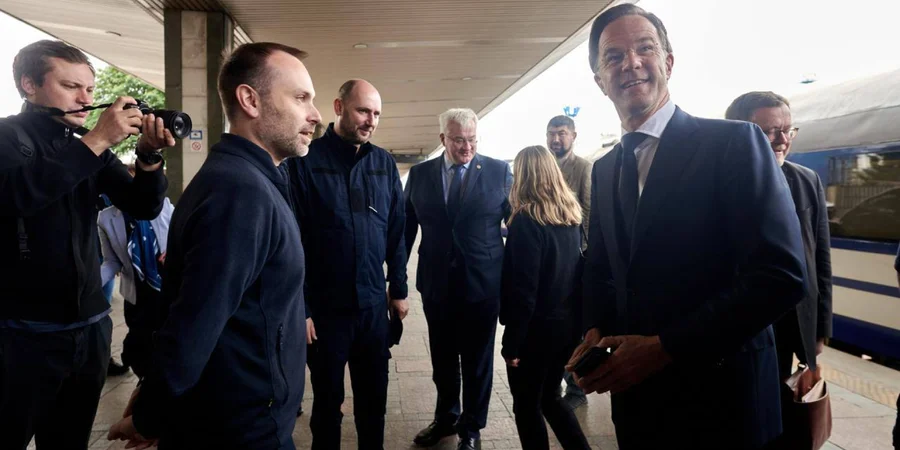
NATO Secretary General Mark Rutte arrived in Kyiv on June 3 alongside the entire North Atlantic Council, underscoring the Alliance’s continued commitment to Ukraine as Russia intensifies missile and drone attacks across the country.
The visit, announced by Ukrainian Foreign Minister Andrii Sybiha, included talks with President Volodymyr Zelensky and other senior Ukrainian officials. It marked the first NATO-Ukraine Council meeting held in Kyiv and comes as Ukraine continues to seek sustained military, financial and political support from its Western partners amid Russia’s ongoing full-scale invasion.
Speaking at a joint press conference with Zelensky, Rutte said the presence of all 32 NATO allies in Kyiv sent “a strong message of the enduring bond between NATO and Ukraine” and demonstrated the Alliance’s unwavering support for the country.
“Russia’s aggression continues unabated. They are bombarding civilians and civilian infrastructure. Russia is terrorizing the population,” Rutte said, referring to recent large-scale missile and drone attacks across Ukraine. He noted that Russian strikes continue to target cities, critical infrastructure and civilians, while also posing risks beyond Ukraine’s borders, citing a recent drone incident in Romania.
The NATO chief argued that Moscow’s continued attacks reflect growing desperation rather than strength, claiming that Russian forces are suffering significant losses on the battlefield. Rutte claimed that Russia is losing more than 30,000 troops per month, a figure he described as “absolutely staggering.”
Despite renewed Russian offensives and intensified aerial bombardments, Rutte praised Ukraine’s military performance and its ability to adapt on the battlefield. He said NATO allies had discussed Ukraine’s military needs as well as the country’s increasing role in shaping modern warfare through innovations in drone and counter-drone technology.
“Ukraine is successfully changing the dynamics on the battlefield,” Rutte stated, adding that cooperation between Ukrainian and allied defense industries continues to deepen.
A major focus of the discussions was air defense. Ukraine has repeatedly warned that Russia’s growing use of ballistic and hypersonic missiles is placing enormous pressure on its air-defense network and increasing the need for Patriot interceptor missiles.
Rutte said the supply of Patriot PAC-2 and PAC-3 interceptors from the United States continues despite concerns about global stockpiles and competing security demands elsewhere. He emphasized that NATO allies are continuing to finance deliveries through the Alliance’s PURL programme, which provides Ukraine with critical U.S.-made military equipment funded by partner countries.
Rutte claimed that allies and partners have now pledged nearly $6 billion through the programme, which has become one of several key channels for supporting Ukraine’s defense efforts. He acknowledged concerns over production capacity but said NATO governments and defense manufacturers are working to increase output and ensure Ukraine has the resources necessary to defend itself, particularly ahead of next winter.
The NATO chief also used the occasion to reaffirm the Alliance’s long-standing position on Ukraine’s future membership. While stressing that Ukraine remains on an “irreversible path” toward NATO integration, Rutte acknowledged that there is currently no consensus among allies regarding full membership.
“At the moment there is no unanimity on that,” he said, while highlighting Ukraine’s growing interoperability with NATO forces and increasing alignment with Alliance standards.
Addressing questions about Ukraine’s expanding long-range drone campaign against targets inside Russia, Rutte said Kyiv has demonstrated increasing effectiveness in striking military capabilities that support Moscow’s war effort. At the same time, he emphasized that responsibility for the conflict lies with Russia’s decision to launch and continue its war against Ukraine.
The visit comes at a critical moment in the conflict, as Russia escalates aerial attacks against Ukrainian cities and infrastructure while Ukraine seeks additional military assistance from Western partners. NATO allies continue to discuss long-term security support for Kyiv, with air defense, ammunition supplies and defense-industrial cooperation remaining among the Alliance’s top priorities.
“We strongly condemn Russia’s aggression and continue to call for a negotiated peace,” Rutte said. “At the same time, we are clear-eyed about the need to continue our support for Ukraine.”