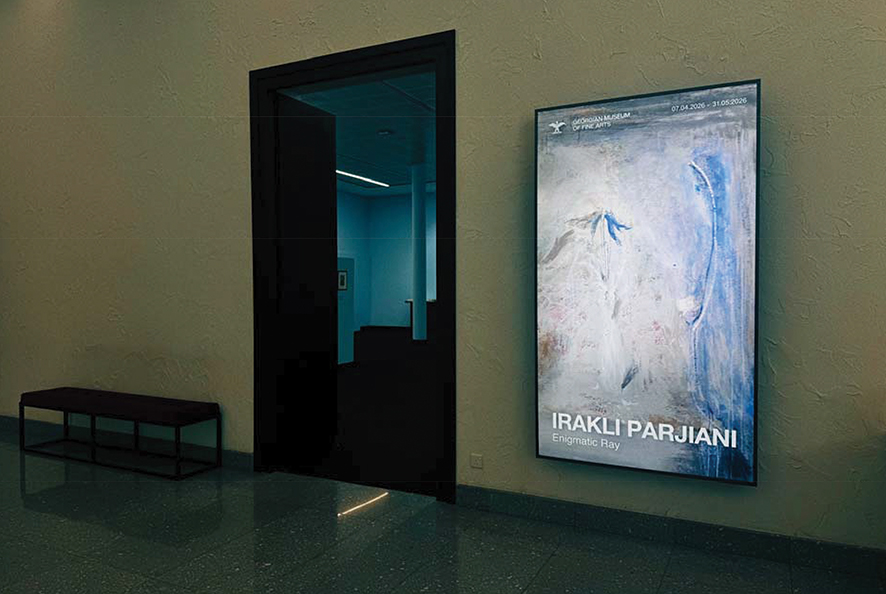
At the Georgian Museum of Fine Arts, the exhibition Enigmatic Ray arrives as the reopening of an unfinished spiritual archive. Dedicated to Irakli Parjiani, one of the most singular and metaphysically restless figures in late Soviet Georgian art, the exhibition unfolds like a transmission from a civilization perpetually suspended between revelation and collapse.
Parjiani has always occupied a peculiar place within Georgian cultural memory. Revered almost mythologically by artists, intellectuals, and collectors, he nevertheless remained strangely outside the stable institutional canon. Perhaps because his work resists canonization itself. His paintings do not behave like historical objects. They behave like visions.
To encounter Parjiani today, in 2026, feels uncannily contemporary. Not because his art anticipated political events directly, but because it anticipated a psychological condition now familiar across the modern world: spiritual exhaustion inside collapsing systems of meaning.
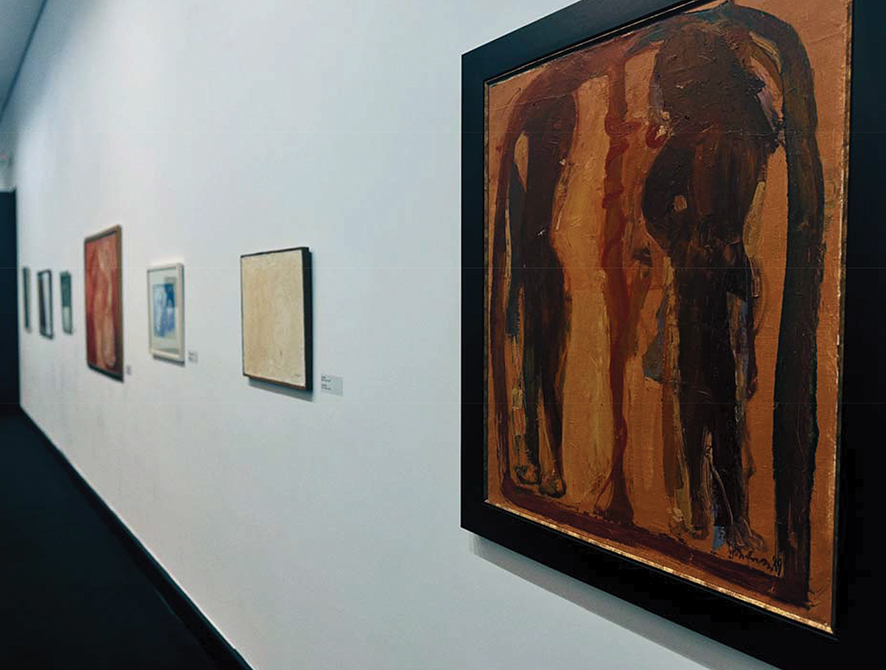
The exhibition’s curatorial structure, developed by Konstantine Bolkvadze, wisely avoids presenting Parjiani as merely another representative of the celebrated Georgian artistic generation of the 1980s. Chronology exists here, certainly, yet the deeper logic of the exhibition follows something more unstable: the evolution of consciousness itself.
Parjiani differed radically from many of his contemporaries because he liberated Georgian painting from collective emotional choreography. Soviet art, even in dissident or semi-independent forms, often remained socially legible. Parjiani instead turned inward with terrifying intensity.
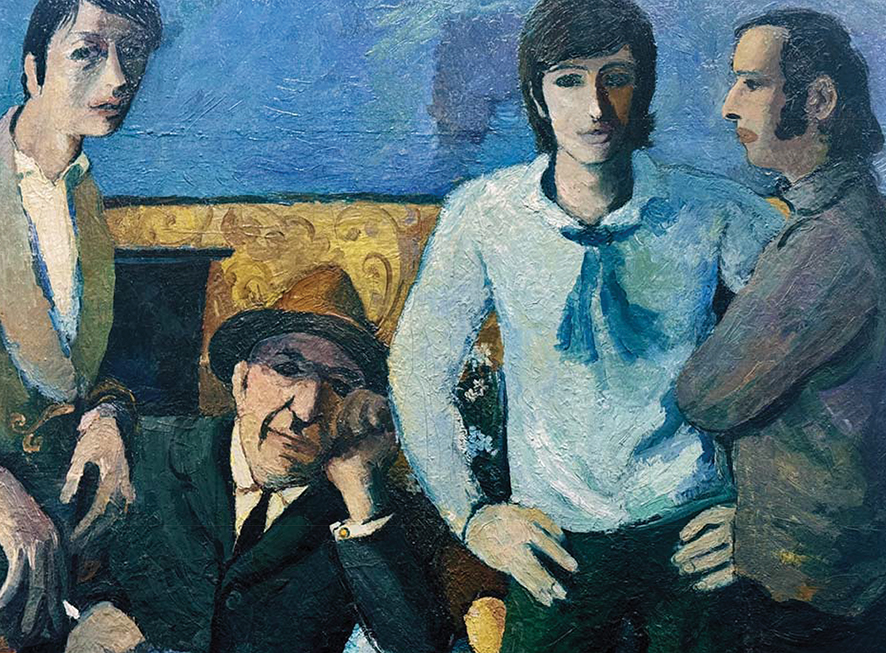
His work is almost violently subjective. Religious imagery, anthroposophy, abstraction, medieval iconography, German expressionism, Georgian calligraphy, oriental visual systems, mythological archetypes, and private hallucination all collide inside the same pictorial field. Yet the result never feels eclectic in the superficial postmodern sense. Everything in Parjiani’s world appears governed by a hidden metaphysical grammar.
The exhibition title could hardly be more accurate. Everything about Parjiani is enigmatic. His people appear illuminated from invisible sources. His plants possess psychological tension. Biblical scenes unfold like memories from forgotten dreams. Faces hover somewhere between saints, peasants, ghosts, and witnesses. Space itself dissolves into spiritual weather. Even stillness in Parjiani feels unstable.
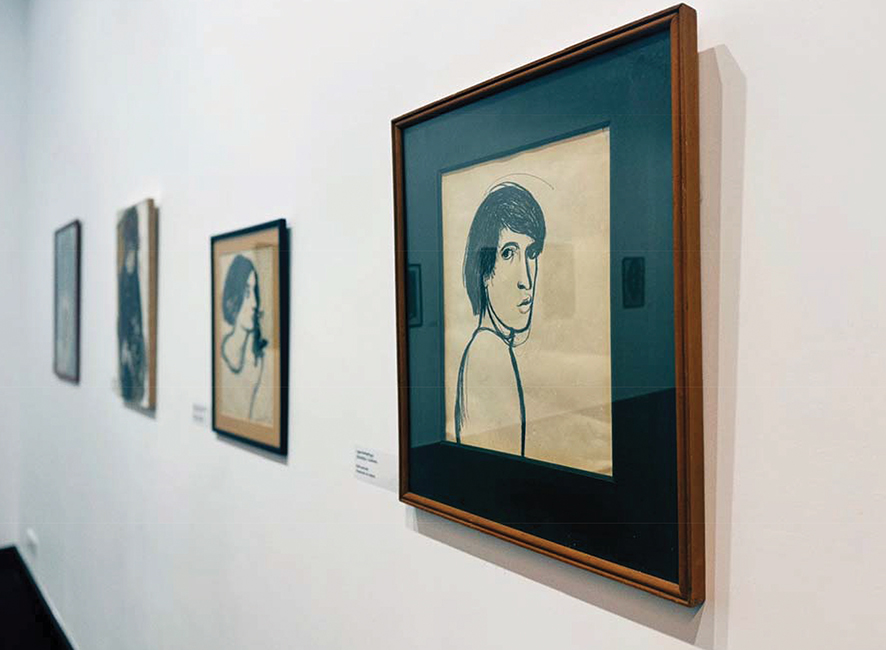
Born in Mestia in 1950, Parjiani belonged to a generation raised during the late Soviet period, yet his artistic universe seems fundamentally incompatible with Soviet materialism. This tension defines much of the exhibition’s emotional power.
His participation in Tbilisi’s anthroposophy circles during the 1970s becomes especially important in understanding the work. Anthroposophy, with its fusion of spirituality, cosmology, esotericism, and scientific mysticism, offered an alternative intellectual architecture inside a society officially organized around ideological rigidity and rationalist dogma.
Parjiani absorbed this worldview completely. His paintings do not depict reality. They attempt to penetrate its invisible structure. This explains why his works often feel suspended between icon and hallucination. He was never interested in realism as representation. He pursued painting as revelation.
The exhibition demonstrates this particularly powerfully through works connected to biblical cycles: The Gospel of Mark, The Gospel of John, The Gospel of Luke, The Annunciation, and The Crucifixion of Christ. These are not devotional works in any conventional religious sense. Nor are they ironic reinterpretations typical of much late twentieth-century contemporary art.
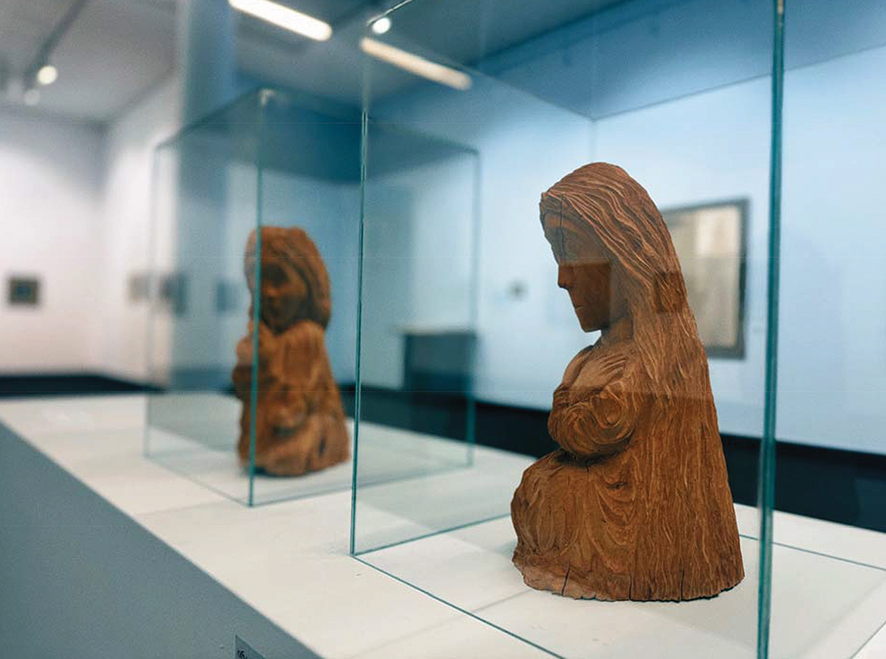
Parjiani approaches biblical narrative as metaphysical anthropology. The sacred becomes psychological terrain. And perhaps nowhere is this clearer than in the debut presentation of The Annunciation, one of the exhibition’s central revelations. The large-scale canvas radiates the strange internal luminosity characteristic of Parjiani’s late style. Figures emerge almost as if materializing from darkness rather than occupying physical space.
One begins to understand why Parjiani remains so emotionally overwhelming for Georgian audiences: his art transforms national trauma into spiritual atmosphere.
One of the exhibition’s most haunting dimensions emerges through the contextualization of Parjiani’s final years. He witnessed the collapse of the Soviet world directly. He stood in Berlin during the fall of the Wall. He participated in the April 9 protests in Tbilisi, where Soviet troops used toxic gas against demonstrators: an event that severely damaged his health and permanently scarred Georgian cultural consciousness.
The exhibition subtly suggests that Parjiani’s later paintings absorbed this atmosphere of civilizational disintegration. His Berlin Cycle carries particular emotional gravity because Berlin itself appears almost mythological in late Soviet imagination: a city where history physically cracked open. For many Eastern European and Soviet artists, the Wall’s collapse symbolized liberation. In Parjiani’s work, however, liberation always remains ambiguous.
Freedom arrives already haunted by catastrophe. This intuition proved devastatingly prophetic for Georgia. Parjiani died in 1991 at only forty-one years old, during the violent unraveling of the country into civil war. In one of the cruelest symbolic episodes imaginable, many of his works burned together with the Artists’ House in Tbilisi amid the chaos.
That biographical detail hangs over the exhibition like smoke. The destruction feels horrifyingly consistent with the logic of his art itself: beauty permanently threatened by historical combustion.
Perhaps the most extraordinary quality of Parjiani’s paintings is their treatment of motionlessness. His figures rarely act. They wait. Endure. Radiate. Listen. Witness. And yet the paintings vibrate internally with immense tension. This paradox gives Parjiani’s work its enduring contemporary relevance. In an age obsessed with speed, visibility, production, and constant digital motion, his paintings insist upon stillness as a form of metaphysical resistance.
The universe in Parjiani is alive, but not noisy. Anthroposophical ideas about cosmic interconnectedness become visual atmosphere rather than ideological statement. Objects, colors, textures, and bodies appear bound together through invisible spiritual energies. The world becomes personified without becoming sentimental.
His paintings ask viewers to slow down enough to perceive hidden frequencies. To modern spectators trained by algorithmic culture to consume images rapidly, this can feel almost physically disorienting. Parjiani’s art refuses acceleration.
What Enigmatic Ray ultimately reveals is how deeply Georgian modernism has always been tied to metaphysical hunger.
Western narratives about Soviet-era art often emphasize dissidence, conceptual resistance, underground networks, or political symbolism. All of that matters. Yet Parjiani represents another parallel tradition inside Georgian culture: the attempt to preserve spiritual complexity against the flattening pressures of ideology and modernity alike. His work feels connected less to institutional contemporary art than to ancient Georgian frescoes, mountain cosmologies, medieval manuscripts, liturgical chant, and apocalyptic folklore.
Even when using expressionist or abstract visual languages, Parjiani remains profoundly Georgian in emotional architecture. His art understands suffering as illumination.
And this may explain why the exhibition resonates so intensely now. Contemporary societies increasingly produce informational saturation alongside spiritual emptiness. Images circulate endlessly while meaning erodes. Against this background, Parjiani’s paintings appear almost shockingly sincere in their pursuit of transcendence.
By the end of the exhibition, one leaves with the unsettling sensation that Parjiani painted as though he already knew the twentieth century would end in flames. Yet Enigmatic Ray refuses tragedy as its final note. The exhibition instead proposes something more fragile and perhaps more important: that art can preserve forms of inner vision even after the systems surrounding it collapse.
Many of Parjiani’s works disappeared into fire. The Soviet world disappeared. Entire ideological universes disappeared. And still these paintings remain capable of transmitting light. A mysterious ray, indeed.
The exhibition runs until May 31 at the Georgian Museum of Fine Arts. Admission is free.
Review by Ivan Nechaev