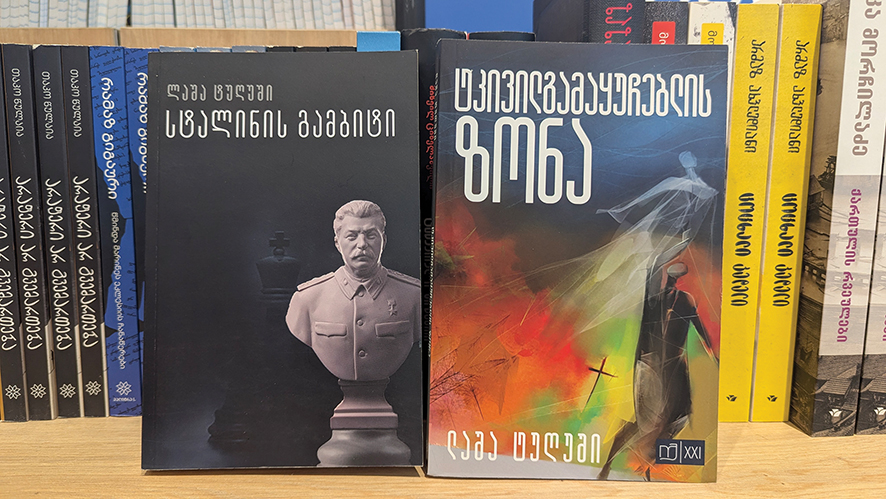
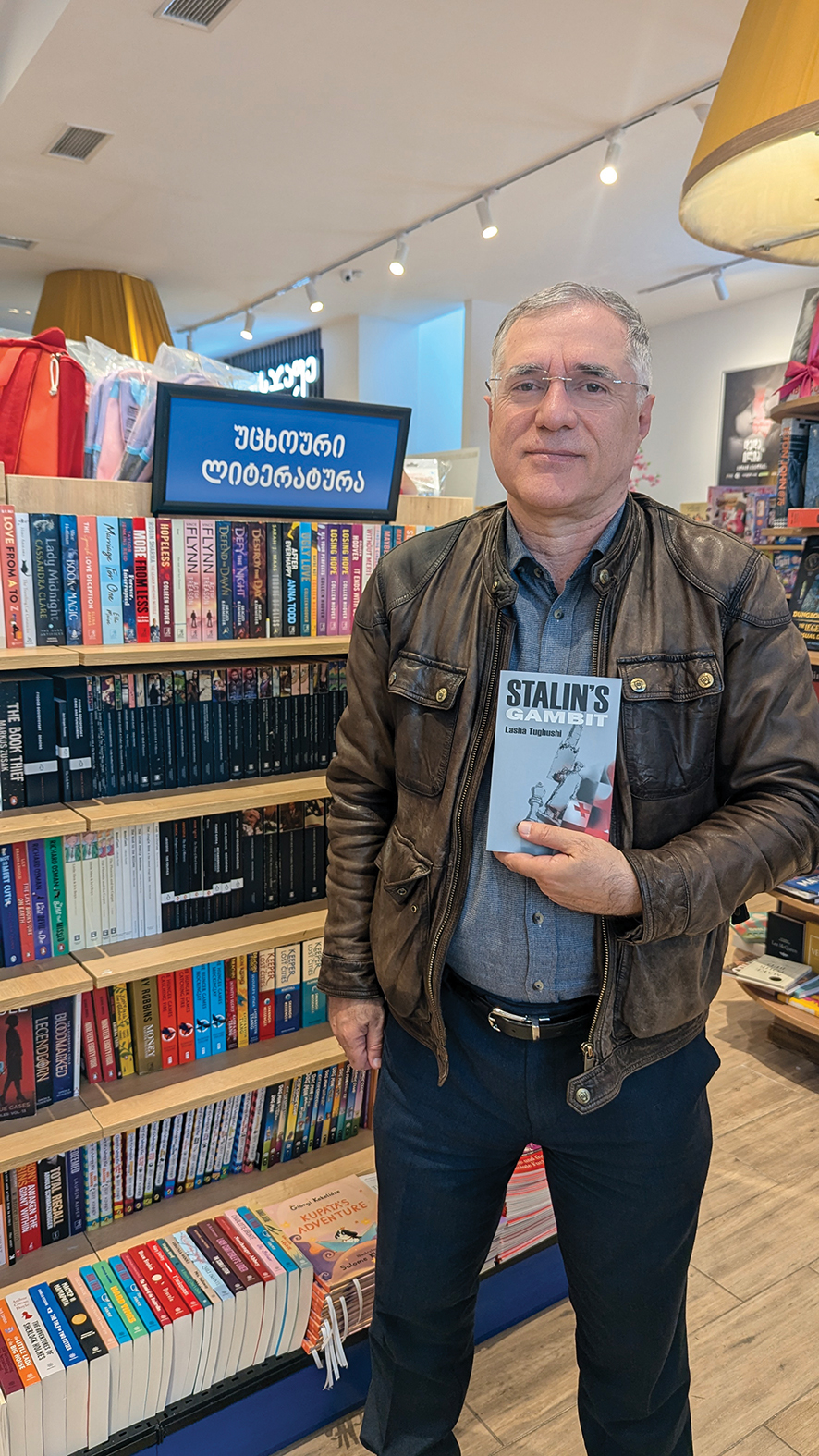
Lasha Tughushi’s novel Stalin’s Gambit was first published in Georgian in 2024 and has recently appeared in English. The book captures the quintessence of Georgian politics over the past thirty years.
The private lives of its characters serve as a pars pro toto for the country’s key social and political dynamics. On every page, the author demonstrates sharp insight and intellectual depth: it takes a master to weave personal stories so seamlessly into national upheavals.
In Stalin’s Gambit, Tughushi blurs the line between fiction and reality, constructing a scenario that, as he himself notes, “has either already happened or is on the verge of happening.”
At the center of the narrative is a sinister plan by the Kremlin: to destabilize Georgia and prevent its accession to the European Union, the reburial of Joseph Stalin’s remains in Georgia is set in motion. This highly symbolic act threatens to disrupt the country’s already fragile social balance and provoke internal conflict.
In this “anti-novel,” each character stands for something larger than themselves, reflecting both past and present political currents in Georgia. It is a story of a gambit: a risky sacrifice in a global power struggle that starkly highlights Georgia’s dependence on its powerful neighbor, Russia.
That Tughushi addresses themes of power and autocracy at this moment is widely seen in Georgia as an artistic response to current political tensions. His professional background lends particular weight to the work: as a Fulbright scholar, professor, and former editor-in-chief of prominent media outlets such as Rezonansi, he is regarded as one of the most experienced observers of Georgia’s media landscape and a strong advocate for press freedom.
The novel is available at bookstores such as Biblusi.
You are known as one of the leading advocates for freedom of speech. What pushed you to change your field and turn to writing literature?
At some point, I realized that, through storytelling, I had developed a desire to express myself differently, in another form, and in doing so to be in a process that allows me to be myself and to be free.
What was the starting point for writing Stalin’s Gambit? The novel is relatively short, yet it is extremely dense in information. How did you achieve such mastery?
The stories, images, and both internal and external conflicts that I describe in the book themselves pushed me toward this kind of dynamic and kaleidoscopic development that is visible in the novel. In other words, the content itself dictated the conditions. And when I was writing, the process stemmed from the meaning I wanted to express.
Your novel gives the impression of being based on deep knowledge of domestic and international political processes. How long did your “investigation” take, and how long did you spend developing the idea?
It is difficult to call this book documentary prose, even though it contains widely known facts. It also includes specific facts that perhaps fewer people are aware of. For a long time, I served as editor-in-chief of a weekly newspaper, and I had to learn about many things that, for various reasons, could not be published, usually because they could not be proven.
In addition, the book includes fictional stories, many allusions, and even futurological elements. So the entire process ultimately led to the creation of the book.
As for the idea and the stories themselves, they had been accumulating inside me for a long time. At some point, it simply became necessary to write them down. In terms of the actual writing process, the final stage, when I actively began working on the book, took about three to four months. That is how long it took to write it.
You are known to have first-hand knowledge of Russian influence in Georgia. Did your research on this topic inform the novel?
Russian influence in Georgia has different foundations, both material and symbolic. These include fear, religion, finance, and issues of power distribution. One could even say that at its core lies a basic instinct: the pursuit of power. Cultural factors and geopolitics also play a role.
As editor-in-chief, I constantly engaged with these issues, both in media practice and in an academic sense. This influence has always been a central focus of my research. As for whether I relied on research when writing the book, my answer is necessarily subjective, since it is a novel.
Of course, I included real facts and real stories. But alongside them are authorial interpretations and representations. It may sound unscientific, but I would say that the reality created in the book is sometimes more real for the author than the reality described in historical or academic works.
And I would add that the questions that arise while reading the book are, for me, as the author, sometimes even more significant than those that emerge within a strictly academic framework.
Do your characters have real prototypes, or are they composite figures?
The book presents different characters: some are based on real prototypes, others are collective images, and others are synthesized figures.
They exist in narratives that can be divided into reality and what could be called post-reality. And they act within these different layers of reality.
In the novel, part of the Georgian government enters into a deal with the Kremlin to reverse the country’s European path. How relevant is this for Georgia today? And when will it end?
This plot twist reflects real risks for modern Georgia. We see it not only in the book but also in real life.
As for when this confrontation might end, in my view, as long as the Russian Empire exists in its current form, this confrontation will continue. It is unlikely that we can speak of a clear endpoint.
The book shows that even a government that is not aggressive, not strongly pro-Western, but rather constructive, is still unacceptable to Russia. This is because, according to the logic of the book, it is an existential issue for them: that liberal democracies should not exist around Russia, on the territory of the former Soviet Union.
This is directly connected to the processes described in the book: conspiracies, infiltrations, operations, coups. All of this corresponds to imperial thinking and imperial policy. Naturally, the book is permeated by these dynamics. And, of course, the figure of Stalin, his ideas, also plays a role. These processes are interconnected. What is happening in Russia today is also, in a sense, linked to Stalin.
One character turns toward a pro-Russian orientation simply because they “do not understand the West.” Why do such forces still exist in Georgia after years of democratic development?
There are different dichotomies based on different systems of understanding. In a broader sense, they can be seen as cultural mismatches, not in a simplistic propagandistic sense.
In this context, we can speak of two Georgias: a Western and an anti-Western one. I emphasize: Western, not simply pro-Western. This distinction is important.
If a person is truly a bearer of European identity, they cannot be pro-Russian. In the book, there are characters who criticize both themselves and the West, but that does not make them anti-Western. Of course, not everyone in Georgia has a Western identity. Here, the idea of Stalinism plays an important role. It forms a basis where imperial Russian views and anti-Western sentiments intersect within Georgia itself. Sometimes, these views appear ultranationalist, appealing to the idea of a “special Georgia,” but in the end they converge into a single point.
The main divide between the Western and the anti-Western lies in the recognition of human rights and the freedom of choice. For the so-called anti-Western side, a lack of freedom, what could be described as the Russian model of governance, is closer to them.
The book features investigative journalists engaged in dangerous reporting. How relevant is investigative journalism in Georgia today?
In Georgia, there are still investigative journalists. They produce very serious and important work.
Of course, this is difficult work, but fortunately such journalists exist, and we regularly see their output on various media platforms.
Their work does influence decision-making processes in one way or another. Even if this influence is not always directly visible, the critical thinking they generate inevitably affects political and social processes.
I believe that much of the ongoing struggle in the country today relies on such people; on such journalists.
What does Stalin mean for Georgia today, and is his meaning different in Georgia and Russia?
This is a complex question, because Stalin is difficult to discuss. He has existed in Georgia in different forms; during the Soviet period and after its collapse.
He was not merely a museum figure. I remember Soviet times, especially in regions like Kartli, where he was born. His portraits were often placed in buses as an image of a leader or important figure. These were not isolated cases.
I also remember the events of 1956 in Tbilisi, when large demonstrations took place against Khrushchev’s de-Stalinization campaign, which many Georgians perceived as anti-Georgian. For some, Stalin symbolized the leader of a great state.
Of course, he also had opponents, especially among those repressed under his rule. But even some families of victims sometimes had a complex, ambivalent attitude toward him.
The image of Stalin persisted in culture as well, for example, in Soviet films where he was portrayed as Georgian, with a Georgian accent. People in some sense identified with him as part of their own historical identity.
Before the collapse of the Soviet Union, this perception had not fully disappeared, although it was changing. National movements strengthened, and a new Georgian patriotism emerged.
After independence, many turned away from the cult of Stalin, sometimes in a very sharp and even aggressive way. He was increasingly seen as a figure associated with imperial restoration under Soviet Russia.
However, political myths are always changing. Today, Stalin’s image is once again being transformed. Some portray him as a “demonic figure,” while others suggest he was a supporter of Christianity or even a “crypto-Christian,” and that, without him, the Church would have suffered.
There are also narratives portraying him as a protector of Georgian culture and literature, someone who supported poets and writers and helped integrate them into educational programs.
Such myths emerge particularly in times of social tension. In Georgia, this is not a dominant mainstream position, unlike in Russia, where Stalin is often associated with state power and strength.
Most of Georgian society is oriented toward European values. Nevertheless, Stalinism as an idea, as a symbol of a “strong leader,” still exists and can become a political trigger in the future.
The story of Medea and Gogita is tragic: their breakup occurs because of politics. Why does the figure of Stalin still possess such destructive power, capable of dividing people on a personal, intimate level?
The characters are different. Medea and Gogita are mutually attracted, as in ordinary relationships, but they are drawn into a vortex of ideas. Medea is an allusive character.
As you know, in Greek mythology, as well as in Georgian tradition, Medea is a mythological figure who sacrificed principles for love, abandoning her father, brother, and home.
In my novel, however, the modern Medea acts differently: she rejects love for the sake of principles. For her, principles are more important than love, unlike the mythological Medea.
You describe the terrifying influence of ultra-nationalist groups. In your view, how should civil society resist these forces in reality to ensure they do not become a defining factor in the country’s future?
Georgian ultra-nationalism intersects with Russian imperialism, and at certain points they converge. There are strong connecting impulses between them, and imperial Russia tends to view this process favorably and support it to some extent.
In Georgia today, mainstream political ideas are increasingly close to nationalist and populist rhetoric, which I believe poses serious risks to both political stability and democratic development.
Ultimately, this is a question of choice: what do the citizens of Georgia want, a democratic, European path, or ultra-nationalist models? The problem of ultra-nationalism is a problem of society as a whole. All social groups must be more united, and concrete steps must be taken.
The novel is very cinematic; events shift with breakneck speed. Is this your authorial technique, or a reflection of the pace at which the contemporary history of Georgia is being written today?
It is precisely in this rhythm that I saw the development of the story in the book. And it strongly resembles the development of modern Georgian history, which is extremely dynamic and rapidly changing.
This dynamism appears in both struggle and transformation: movement goes in different directions at different times.
Today, we can see serious deviations from democratic processes, which inevitably affect Georgia’s historical choices.
Two realities may indeed coincide here: one described in the book and the other taking place in real life.
The book’s ending is deeply symbolic. How realistic does the final end of the “cult of the leader” in Georgia seem to you? What must happen in the national consciousness for this figure to cease being an object of glorification?
If we talk about the real situation in Georgia and the issue of the mythologization of Stalin’s figure, I find it quite difficult to approach. It is hard to imagine such a radical and complete shift in attitudes toward him.
I believe that in the foreseeable future there will always be people in Georgia who see him as a great Georgian. But the key question is to what extent this myth, existing within a certain part of society, will remain relevant and influential. And this is where the main, and in my view very serious, problem lies.
To be honest, I do not have simple answers to this question. One can only say that the majority of Georgian citizens today do not view Stalin’s figure in a positive light.
However, political myths constantly change their form and content. As long as society remains divided into categories of “black and white,” “good and evil,” figures such as Stalin, these demonic figures, will inevitably continue to influence people’s thinking and behavior.
At least in the foreseeable future, this factor will remain present. It exists today. We can see that society remains divided in this regard: even those who criticize Stalin sometimes retain a certain reverence or elements of admiration for him.
Have you definitively decided to abandon your public activity and dedicate yourself to writing? Is this a new kind of struggle?
You know, I would not say that this is a particular kind of struggle. I simply wanted to write, and I wrote. And now I want to write, and I write. That’s all.
Interview by Tatjana Montik