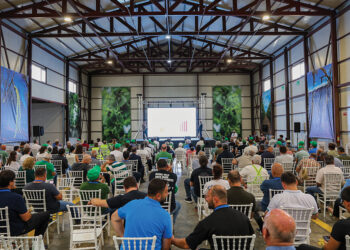
It was, in fact, a small-scale event under open skies, with about three hundred people gathered in one of the Tbilisi mini-gardens at the back of the Georgian Theatrical Society edifice in downtown Tbilisi. Yet nothing more important and meaningful could have taken place in this country on that warm Sunday of April 26.
The admirers of the Georgian (Kartuli) alphabet were celebrating 150 years of Deda Ena (verbatim, mother tongue) by Iakob Gogebashvili, a Georgian educator, children’s writer, and journalist, known as the founder of scientific pedagogy in Sakartvelo. Deda Ena is the first textbook of the Georgian language that we all grew up with. Not only did we grow up with it, but through it we learned how to love our motherland and how to use our native tongue correctly, singularly unique in its own special way.
The Georgian language happens to be one of the fourteen functioning alphabets in the world today, with its thirty-three curly, beautiful characters reflecting the existing thirty-three sounds with amazing phonetic precision and originality. One of the scientific presumptions suggests that Georgia’s linguistic story spans thousands of years, miraculously enduring the cruel vagaries of time and safely bringing our complex and absolutely independent linguistic essence into the mid-twenties of the 21st century. How divinely lucky we are!
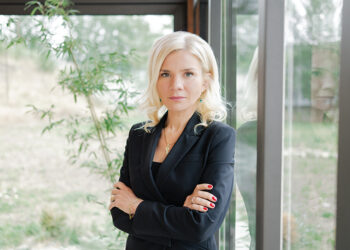
The event was organized and brought to fruition by Mariam Lomtatidze, the founder and director of a nongovernmental body called International Culture Space, operating as an active promoter of Georgia’s recognizability in the international arena, as well as fostering friendship and cooperation between Sakartvelo and the rest of the world. A truly elevated mission and an honorable endeavor.
Mariam is indeed a dedicated fighter for popularizing Georgian culture around the globe. Suffice it to say that it was her idea to create the electronic version of Gogebashvili’s Deda Ena, which is now being successfully used by Georgian children living abroad who wish to maintain their mother tongue, as well as by interested foreigners who regard knowledge of the Georgian language as a valuable intellectual asset.
As Marina Shengelia, Mariam’s associate and supporter, notes, “Yes, she is a genuinely energetic and astute workaholic, whose ways and means of realizing various projects in favor of our indigenous culture amaze all of us.” Notably, this highly appreciative evaluation comes from a high-class specialist in the field, a graduate of the famous Moscow Institute of Culture.
Indeed, most of the projects implemented by Mariam Lomtatidze deserve the attention of society. Among them are Kvevri Wine Symphony, Georgian Alphabet Anthem, Shota Rustaveli Museum, Wheat & Wine Museum, Georgian Silk, Bio Farmers and Products, Corner of Georgian Calligraphy, and last, but definitely not least, the idea and creation of her wonderful Georgian Alphabet Garden.
I have not, in a long time, seen a public event that has attracted this much enthusiasm and interest. That miniature garden, which will henceforth bear the name of the Georgian Alphabet, was filled with people of different generations, socializing with warmth and mutual consideration.
The event was initiated by Giorgi Gegechkori, the president of the Georgian Theatrical Society, a well-known Georgian artist himself and the progeny of Gogi Gegechkori, one of the most beloved actors of the Georgian people. Mariam led the show attentively and elegantly, as she always does.
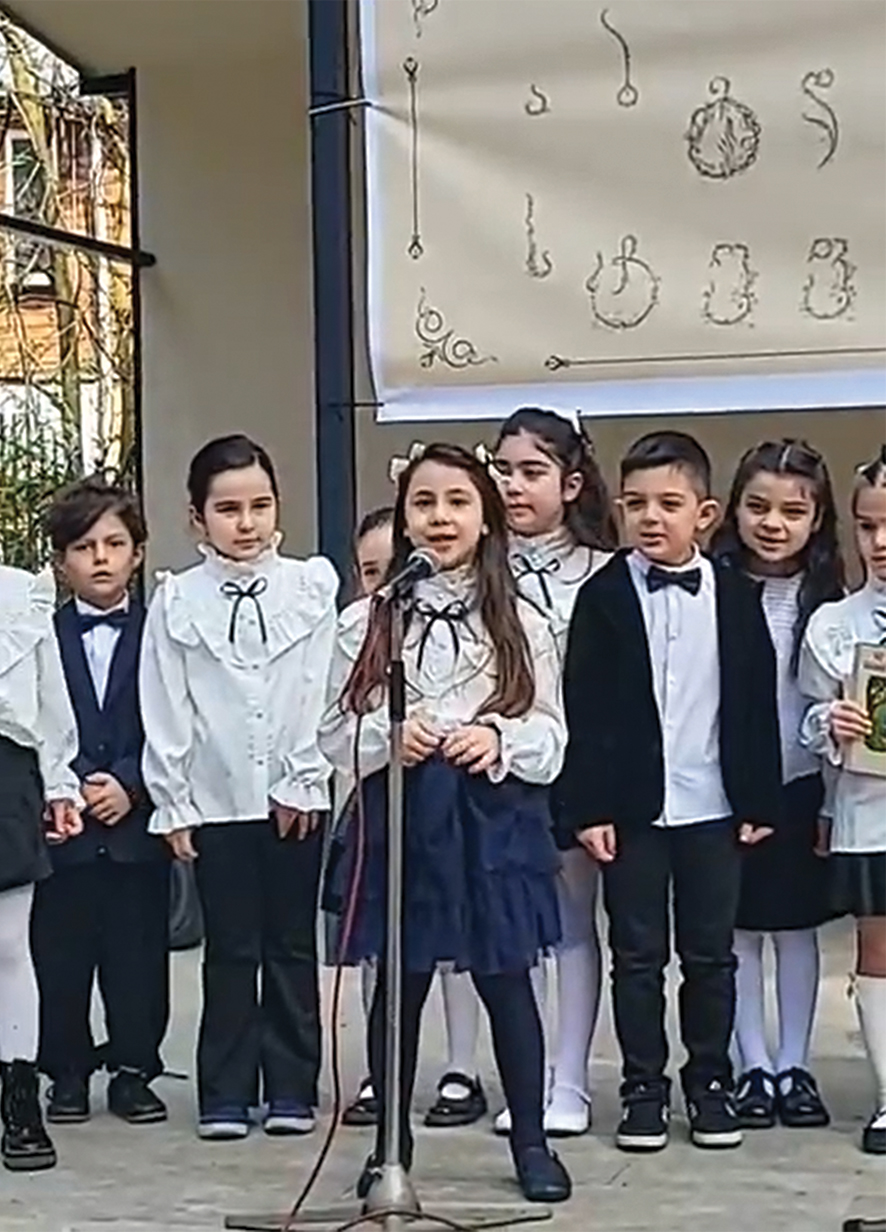
When the children of Tbilisi Kindergarten No. 150, led by their tutor and director Mzia Metreveli, appeared on the tiny makeshift stage of the garden, the excited spectators fell silent. They watched the little Georgian performers with emotion, realizing that the entire event was dedicated to nurturing a future generation capable of carrying the motherland forward with dignity in the very near future. That is exactly what Mariam Lomtatidze is doing for Georgia. She truly deserves our full-time kudos.
Delightedly, the grownups did not lag behind, presenting a charming humorous theatrical piece, directed and produced by Nino Lezhava, the widely known Georgian actress.
The event contained many other attractive elements worth mentioning, but alas, not all good things can be reflected in this brief report.
In conclusion, it must once again be emphasized that for Georgians, speaking Kartuli is profoundly important, not merely as a means of communication, but as a pillar of identity, continuity, and cultural survival. Our alphabet truly distinguishes us among the nations of the planet, representing a rare fusion of language, culture, spirituality, and historical resilience.
So let us not be overly surprised that our little Sakartvelo occupies a unique niche in world heritage. And if all this is true, then the new and lovely Georgian Alphabet Garden, created by Mariam Lomtatidze, will be nurtured and preserved by generations to come, ensuring that Georgia’s intellectual, cultural, and spiritual uniqueness and loftiness endure for as long as humankind exists.
Blog by Nugzar B. Ruhadze